Curve Commentary: April 27, 2026

Overview

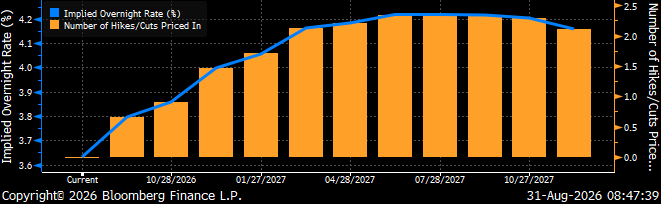
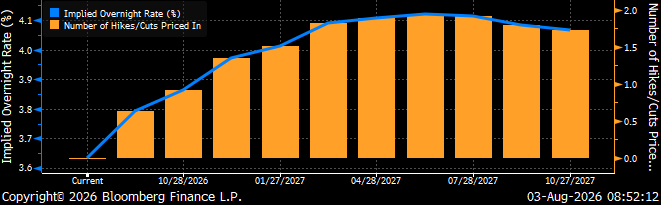
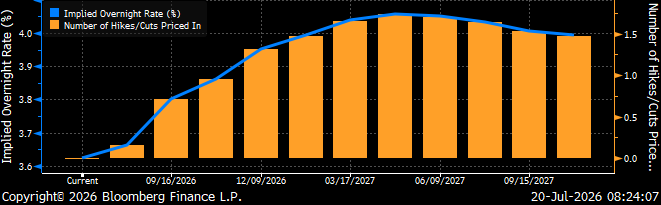
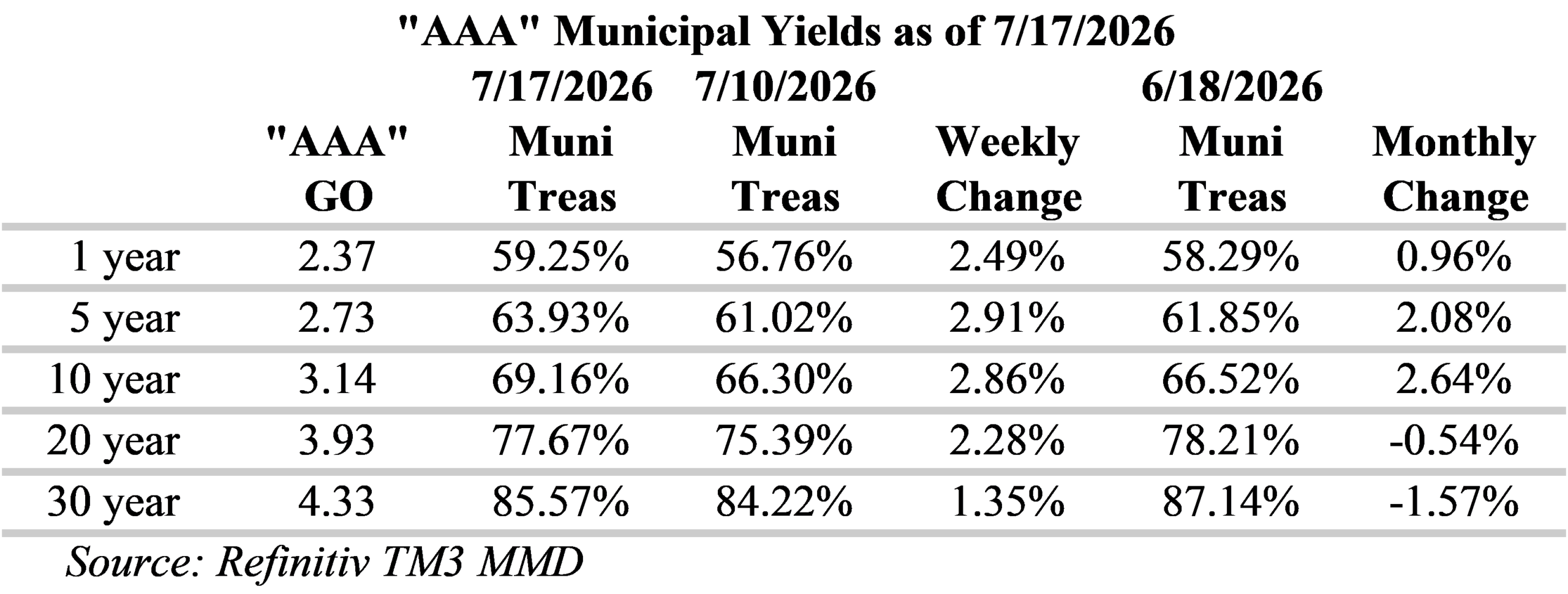
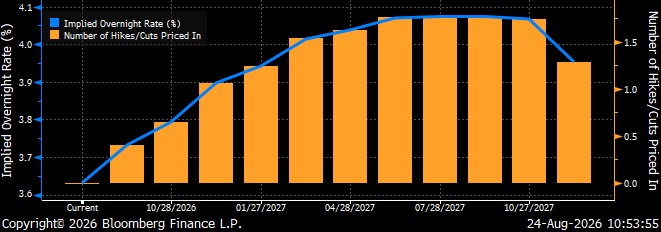
Last week, the markets shifted their focus from day-to-day geopolitical tensions to Kevin Warsh’s testimony to Congress.  The markets and Congress are both looking for indications of the independence of the Fed with Warsh acting as Chair.  However, after the Department of Justice dropped its criminal investigation into the current Chair Jerome Powell, Senator Thom Tillis announced his plans to support Warsh’s nomination.  It is notable that as the market transitions from Powell to Warsh, the rate-path has remained essentially unchanged.  Markets are currently anticipating Warsh will proceed as the next Federal Reserve chair with his first meeting acting as Chair on June 16-17.  The Fed funds futures market is currently anticipating that rates remain unchanged at this week’s meeting and for the overnight rate to remain essentially unchanged for the next 12-months.

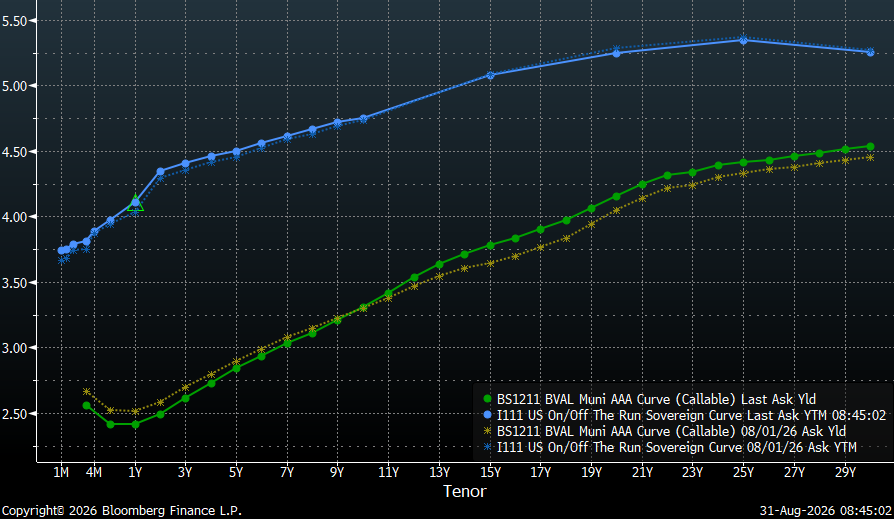
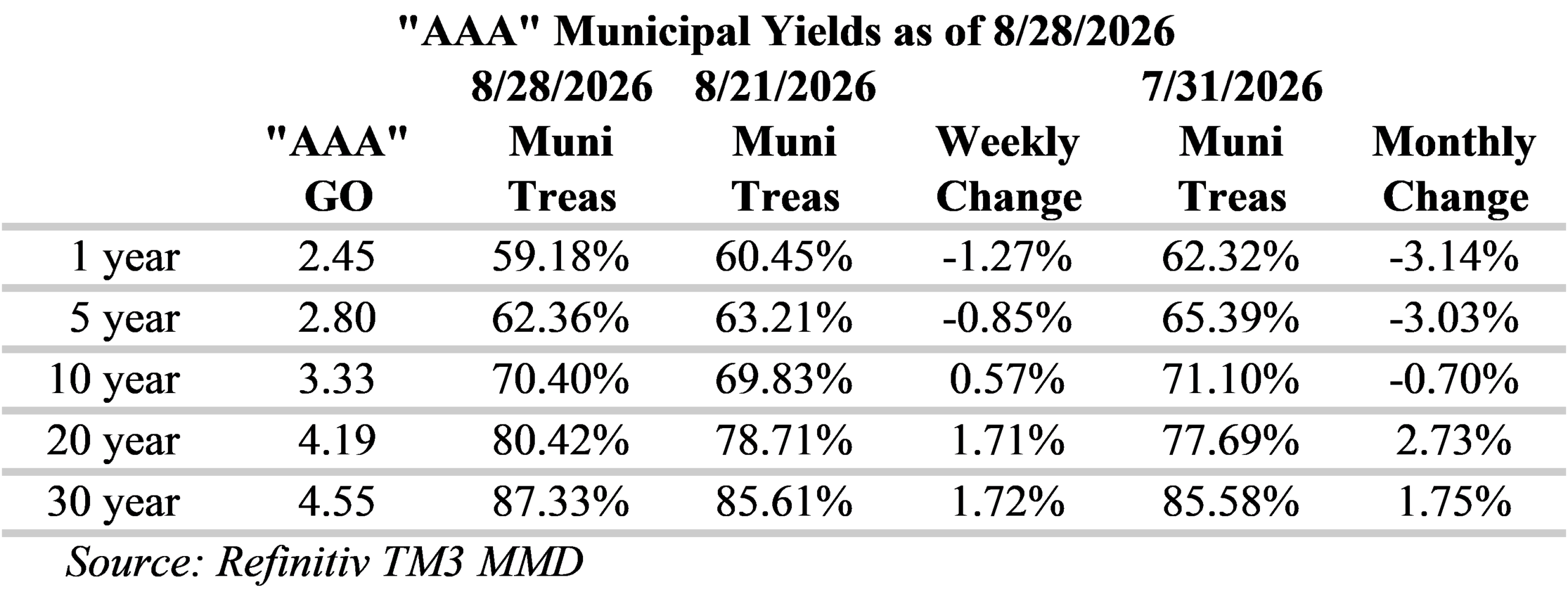
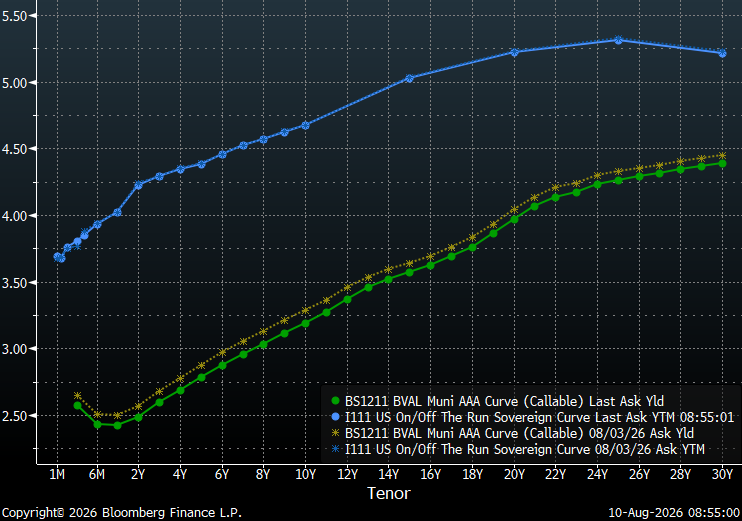
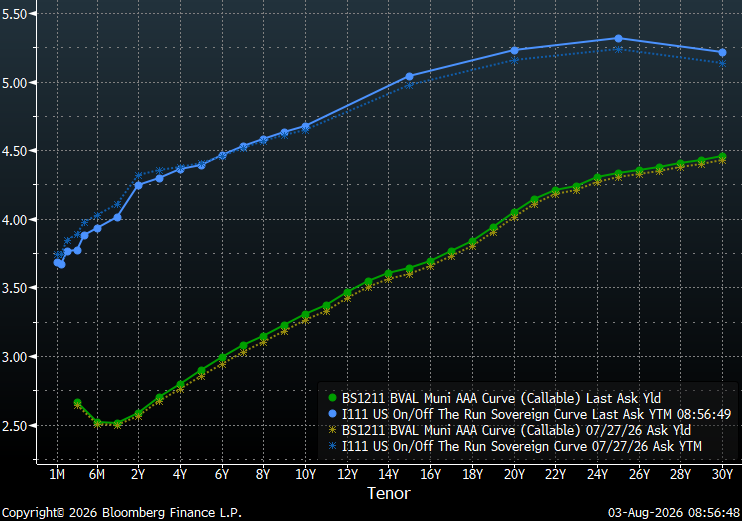
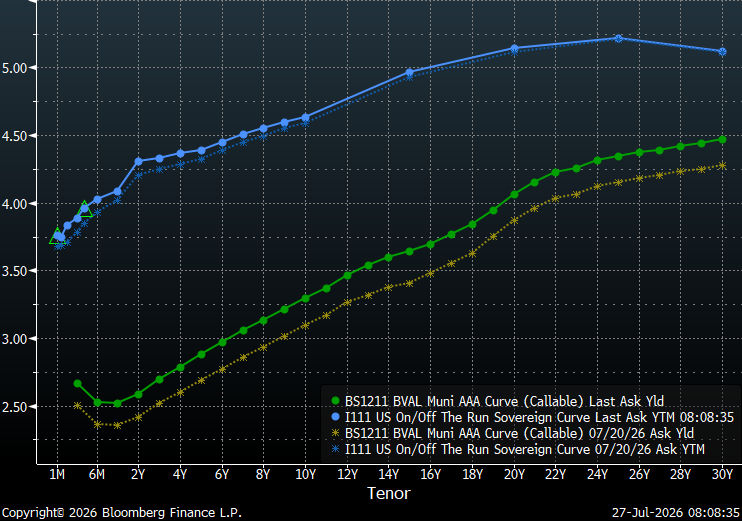
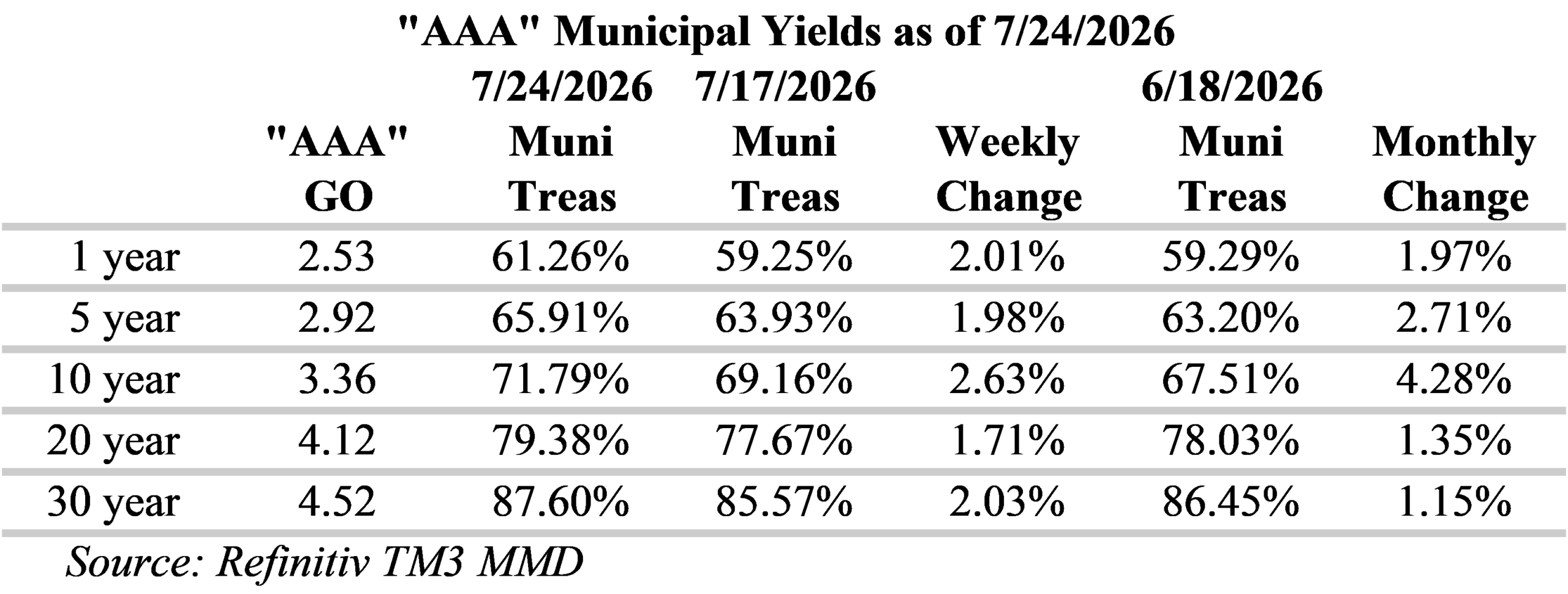
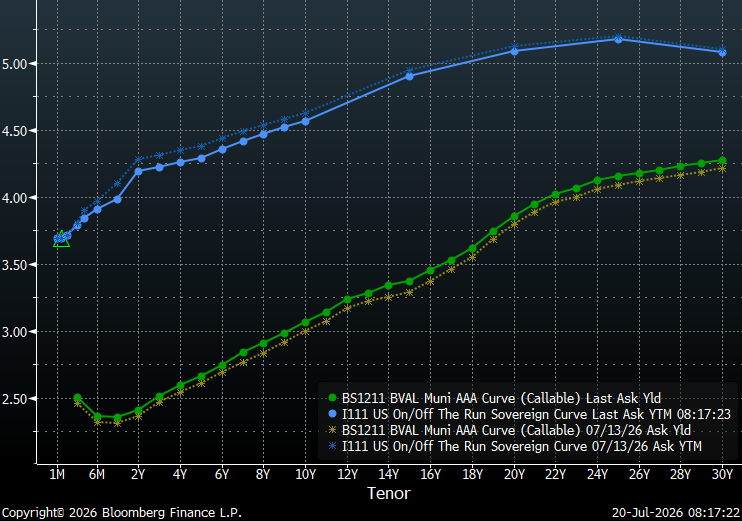
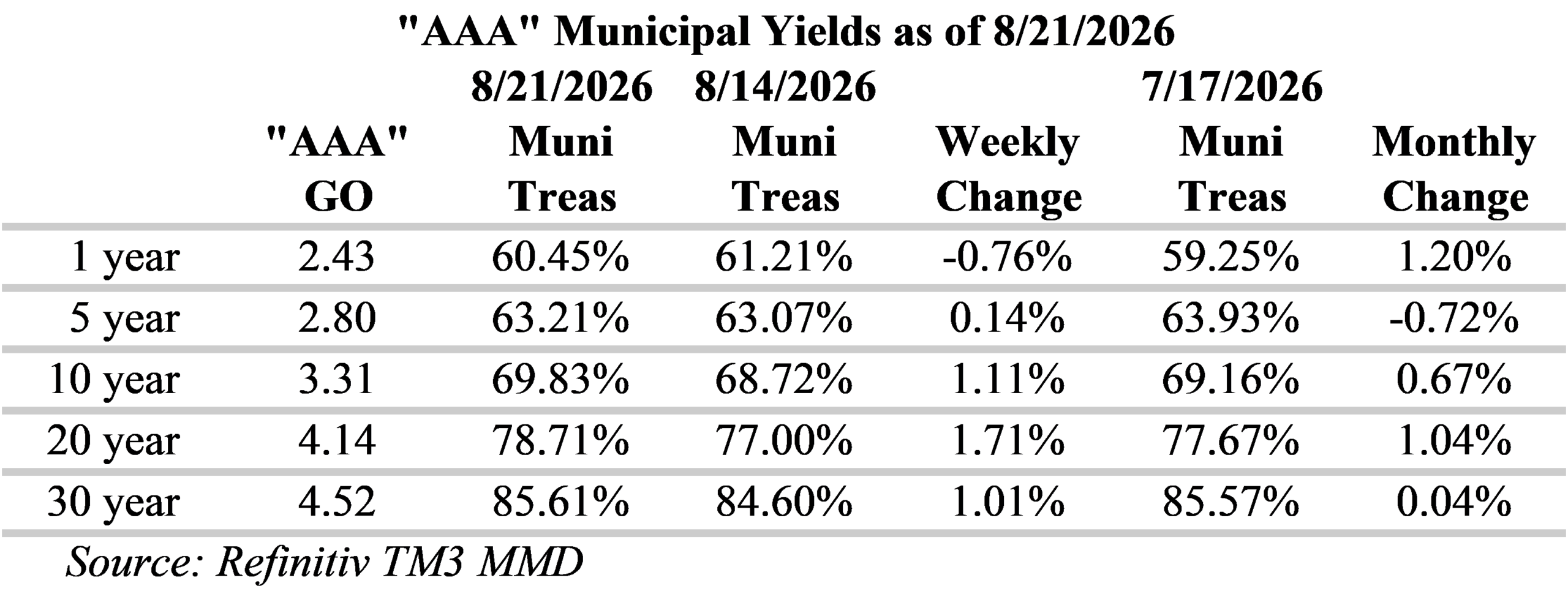
Over the last month, munis have generally outperformed Treasuries.  Year-to-date, the Bloomberg U.S. Municipal Index, which includes investment grade tax-exempt municipal bonds, has returned 1.32% which has outperformed the Bloomberg US Treasury Index by 97bps.  This outperformance is notable given the level of issuance, which is currently 10.5%, and relatively weak ratios in the intermediate portion of the municipal yield curve.  Over the past month, Treasury yields were essentially unchanged while municipal yields fell approximately 15 to 20 bps per year from five to 30-years.

Insights and Strategy

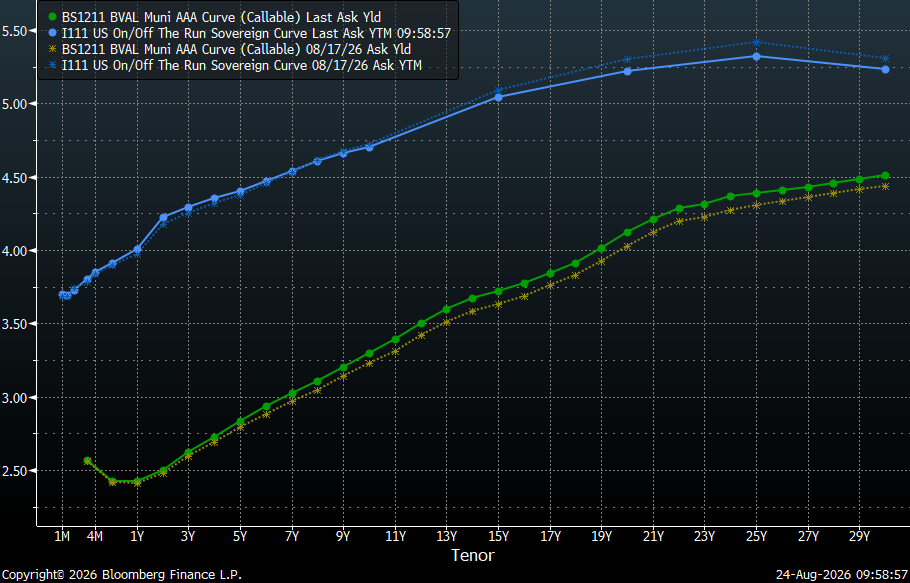
Despite recent developments, investors continue be rewarded for extending out the yield curve with the steepest yield slopes in the 18-21-year maturity range.  On the long-end, the yield curve becomes increasingly flat past 20-years, with a total slope of 26 bps from 21-30-years.  Due to the flat tail, municipal bond investors can currently buy maturities under 20-years that yield almost 90% of the 30-year curve.

Due largely to the prolific short bid-wanted activity, municipal/Treasury ratios for one-year maturities are meaningfully higher than they were last week with ratios over 2% cheaper for 1-year and shorter maturities.  Past five years, ratios are a bit lower with demand extending out the curve to the longer maturities where relative yields are more appealing.  However, municipal bonds have fallen just below several important reference points along the curve.  Ratios for 10-year municipal yields are under 70% of Treasuries, 20-year ratios are below 80% and 30-year ratios are below 90% of equivalent Treasuries.  For investors seeking to maximize curve positioning with relative value, the 18 to 21-year part of the municipal yield curve has become tempting with slopes of 12 to 13-bps per year.  Although ratios past 20-years remain attractively priced relative to Treasuries, the yield curve is very flat over these longer tenors. 

This week, US state and local governments are expected to sell almost $10 billion of bonds.  Notable deals include: Dana-Farber Cancer Institute Obligated Group, which plans to sell $1.4 billion of bonds; Texas State University System has scheduled $762.2 million; and the Los Angeles Unified School District plans to offer $650 million.

Herbert J. Sims & Co. Inc. is a SEC registered broker-dealer, a member of FINRA, SIPC. The information contained herein has been prepared based upon publicly available sources believed to be reliable; however, HJ Sims does not warrant its completeness or accuracy and no independent verification has been made as to its accuracy or completeness. The information contained has been prepared and is distributed solely for informational purposes and is not a solicitation or an offer to buy or sell any security or instrument or to participate in any trading or investment strategy, and is subject to change without notice. All investments include risks. Nothing in this message or report constitutes or should be construed to be accounting, tax, investment or legal advice.

Curve Commentary: April 20, 2026

Overview

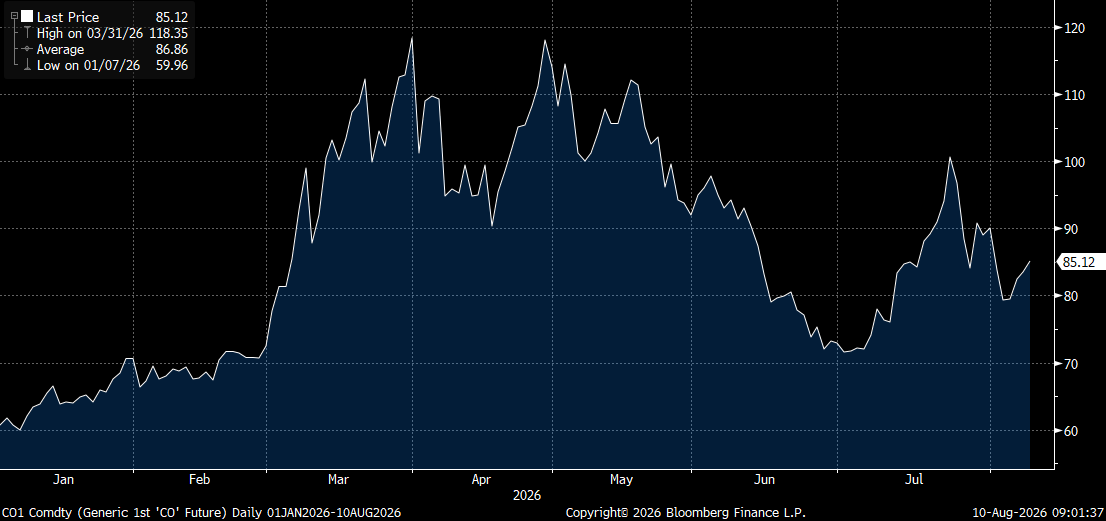
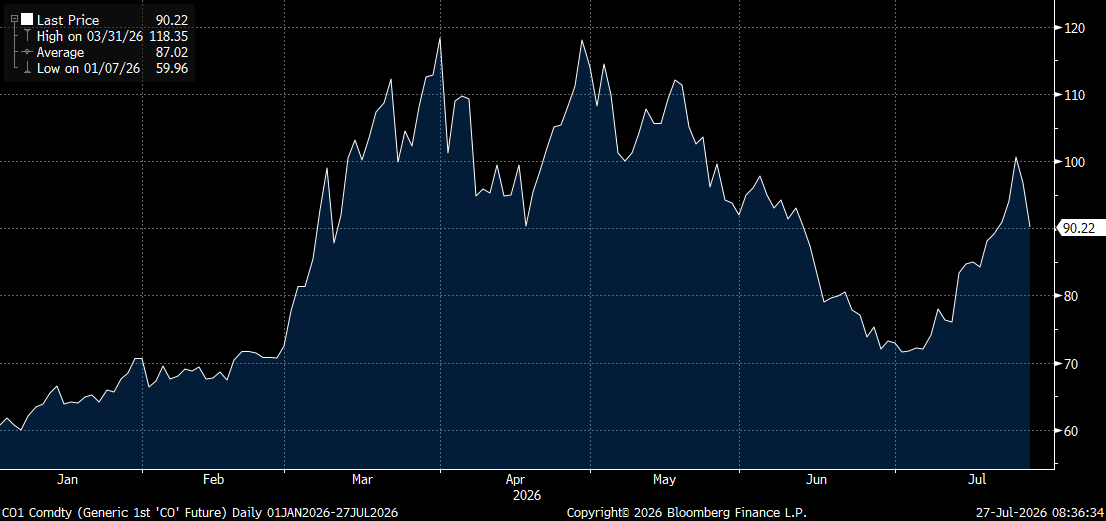
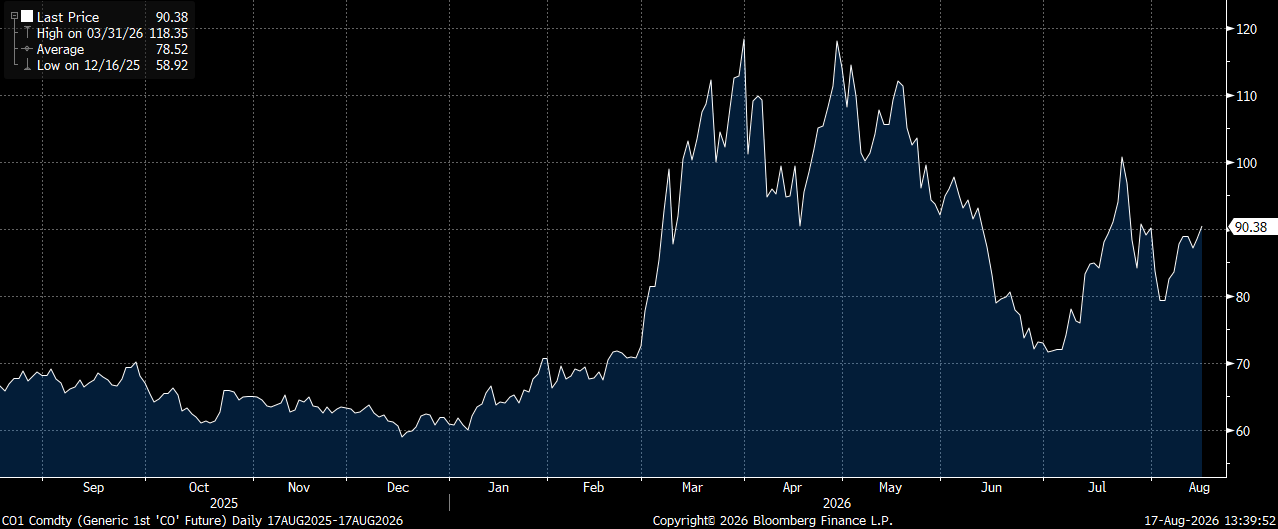
Day-to-day geopolitical tensions continue to weigh on the bond market, despite a ceasefire and the anticipated second round of peace talks.  Oil prices have been very dynamic with the Strait of Hormuz effectively closed, blocking oil shipments and pressuring global prices.  As a result, interest rate volatility in the bond market remains high with inflation continuing to drive rates.  Although last week’s economic calendar was relatively light, sentiment drifted throughout the week between the optimism of peace talks and continued growth concerns.  This week, the independence of the central bank may be tested as Kevin Warsh faces his confirmation hearing tomorrow.  The hearing is particularly important because it is taking place less than a month before the current Chair’s term expires, on May 15.  In addition, there is the potential for a stand-off with Republican Senator Thom Tillis vowing to block the confirmation until a Justice Department investigation is resolved.

Treasury yields were largely unchanged last week, with the biggest moves just past the policy sensitive two-year maturity as inflation, as the front end continues to be driven by inflation expectations.  Munis generally outperformed Treasuries despite outflows of $427 million, according to LSEG Lipper Global Fund Flows.  The biggest moves along the municipal yield curve occurred from 10 to 20-years, where the municipal curve is steepest, with yields falling roughly 5 bps in this range.  On the short-end of the municipal curve, there was little change with yields slightly higher due to elevated short maturity bid-wanted activity at the tail-end of tax season.  

Insights and Strategy

Despite last week’s moves, investors continue be rewarded for extending out the yield curve with the steepest yields in the 18-21-year maturity range.  On the long-end, the yield curve becomes increasingly flat past 20-years, with a total slope of 26 bps from 21-30-years.  Due to the flat tail, municipal bond investors can currently buy maturities under 20-years that yield almost 90% of the 30-year curve.

Due largely to the prolific short bid-wanted activity, short municipal/Treasury ratios are meaningfully higher than they were last week with ratios almost 2% richer for 1-year and shorter municipals.  On the long-end, ratios are a bit lower with demand extending out the curve to the longer maturities with more appealing relative yields.  However, municipal bonds have now fallen just below several important reference points along the curve.  Ratios for 10-year municipal yields are now under 70% of Treasuries and 30-year ratios are now below 90% of Treasuries.  For investors seeking to maximize curve positioning with relative value, the 18 to 21-year part of the municipal yield curve has become very tempting with slopes of 12 to 13-bps per year.  Although ratios past 20-years remain attractively priced relative to Treasuries, the yield curve is very flat over these longer tenors.  

This week, US state and local governments are expected to sell more than $10 billion of bonds.  Notable deals include: the Commonwealth of Massachusetts, which plans to sell $1.09 billion of bonds; Nebraska Public Power District is scheduled to sell $829.5 million; Texas Transportation Commission is expected to offer $750 million; and, Virginia College Building Authority is expected to bring $406.2m to market.  HJ Sims will also be in the market with Bonesta and its Alumus portfolio acquisition, which is expected to include $102,905,000 in Arizona and $59,725,000 in Washington and Porter’s Neck Village with $55,575,000 for its phase 2 expansion.

Herbert J. Sims & Co. Inc. is a SEC registered broker-dealer, a member of FINRA, SIPC. The information contained herein has been prepared based upon publicly available sources believed to be reliable; however, HJ Sims does not warrant its completeness or accuracy and no independent verification has been made as to its accuracy or completeness. The information contained has been prepared and is distributed solely for informational purposes and is not a solicitation or an offer to buy or sell any security or instrument or to participate in any trading or investment strategy, and is subject to change without notice. All investments include risks. Nothing in this message or report constitutes or should be construed to be accounting, tax, investment or legal advice.
Curve Commentary: April 13, 2026

Overview

Geopolitical concerns continue to weigh on the bond market despite last week’s announcement of a two-week ceasefire between the US and Iran.  This morning, tensions are elevated following a break-down of peace talks in Pakistan over the weekend.  As a result, rate volatility in the bond market remains high with inflation continuing to pressure rates.  Last week’s release of the core personal consumption expenditures index by the Bureau of Economic Analysis for February indicated an increase in prices of 0.4% from January, in-line with analyst expectations.  Last Friday’s release of the consumer price index indicated that inflation surged 0.9% in March, the fastest pace in nearly four years.  Furthermore, spiking fuel and fertilizer prices have economists anticipating continued inflationary pressures.

Munis outperformed Treasuries last week amid continued support as inflows of $866 million were added to municipal bond funds last week, according to LSEG Lipper Global Fund Flows.  Although the Treasury market was largely unchanged with as slight sell-off past 10-years, munis rallied for all maturities across the curve with the biggest moves from five to 15-years.  As a result, municipal/Treasury ratios are meaningfully lower than they were last week, with ratios generally 3% richer.  Furthermore, relative yields for municipal bonds have now fallen through important reference points in several spots along the yield curve.  Ratios for 5-year municipal yields are now under 65% of Treasuries and 10-year ratios are now below 70% of Treasuries.  On the long-end, 30-year municipal yields have now fallen below 90% of Treasuries.

Insights and Strategy

Despite last week’s moves, the steepest slopes along the municipal yield curve continue to reward extending duration.  Investors are rewarded for extending out the yield curve with appealingly steep yields with the yield differential between 2-year and 10-year munis, now around 66 bps, which is over double the spread at the end of last year.  On the long-end, the yield curve becomes increasingly flat past 20-years, with a total slope of 26 bps from 21-30-years.  For investors seeking to maximize curve positioning with relative value, the 18 to 21-year part of the municipal yield curve has become very tempting with slopes of 12 to 13-bps per year.  While ratios past 20-years remain attractively priced relative to Treasuries, the yield curve is very flat over these longer tenors.  Due to the flat tail, municipal bond investors can currently buy maturities under 20-years that yield almost 90% of the 30-year curve.

This week, US state and local governments are expected to sell more than $14 billion of bonds.  Notable deals include: City of Austin Airport System, which plans to sell $1.18 billion of revenue bonds; Banner Health Obligated Group, which is scheduled to sell $990.2 million; and, Southern California Public Power Authority is expected to offer $770 million.  HJ Sims will also be in the market with Lifespace Communities, Inc., which is expected to include $98,490,000 in bonds.  This week, we expect the markets will be closely following the producer price index for the month of March which is scheduled for release on Tuesday.

Herbert J. Sims & Co. Inc. is a SEC registered broker-dealer, a member of FINRA, SIPC. The information contained herein has been prepared based upon publicly available sources believed to be reliable; however, HJ Sims does not warrant its completeness or accuracy and no independent verification has been made as to its accuracy or completeness. The information contained has been prepared and is distributed solely for informational purposes and is not a solicitation or an offer to buy or sell any security or instrument or to participate in any trading or investment strategy, and is subject to change without notice. All investments include risks. Nothing in this message or report constitutes or should be construed to be accounting, tax, investment or legal advice.
Curve Commentary: April 6, 2026

Overview

The capital markets continue to focus on developments in the Middle East, amid heightened uncertainty, as the April 7 deadline for massive strikes on Iranian energy infrastructure looms.  Daily volatility remains high as the market vacillates back and forth from anticipating a relatively short end to the war to threats of intensive and prolonged attacks.  The bond market ended last week with Treasury yields jumping three to four basis points across maturities on Friday, following significantly stronger-than-expected March payrolls data.  The unemployment rate ticked lower from 4.4% to 4.3%, which helped dispel anxieties of a softening labor market.

Over the past month, the Bloomberg US Municipal Bond Index (LMBITR) dropped 2.32% through March 31, which is the biggest monthly decline since September 2023.  As a result, year-to-date gains were essentially erased with the LMBITR index declining 0.18% through the end of the first quarter.  Generally speaking, high yield munis and shorter maturities were the better performing bond sectors with high yield tobacco bonds returning 1.47% and the one to two-year maturity bucket returning 0.64%.  By comparison the Treasury market was less impacted as demonstrated by only a 1.67% drop in the Treasury index through the end of the quarter.  

Insights and Strategy

Over the past month, the biggest moves in Treasury yields have been around the 2 to 5 year portion of the yield curve with yields now about 50bps higher than a month ago.  For munis, the biggest moves in yields have been around the 6 to 13-year year portion of the yield curve where yields are now around 50bps higher than they were a month ago.  In addition, bond traders are currently betting the Federal Reserve will keep interest rates steady this year, on signs of a stabilizing US labor market and uncertainty about the economic impact of war in the Middle East.

Municipal/Treasury ratios have increasingly become more appealing around the 10-year tenor with ratios now over 70%.  As a result, this has become a significantly more appealing portion of the curve to position with ratios declining slightly over the past week.  Muni/Treasury ratios for maturities shorter than 1-year are now yielding almost 65% of Treasuries, while 30-year munis continue to yield over 90% of equivalent Treasuries.  Although ratios past 20-years are attractively priced relative to Treasuries, the yield curve remains very flat over these longer tenors.  Due to the flat tail, municipal bond investors can currently buy maturities under 20-years that yield almost 90% of the 30-year curve.

Despite shifting muni/Treasury ratios, slopes along the municipal yield curve continue to reward extending duration.  Investors are rewarded for extending out the yield curve with appealingly steep yields with 2s10s (the yield differential between 2-year and 10-year munis) now around 64 bps, which is over double the spread at the start of the year.  However, 10s20s and 10s30s have both compressed from their mid-February highs, indicating flattening in these portions of the yield curve.  Overall, the yield curve remains steepest around both the 10-year and 20-year maturities.  As discussed above, the yield curve becomes increasingly flat past 20-years, with a total slope of 37 bps from 20-30-years.  For investors seeking to maximize curve positioning with relative value, the 18 to 21-year part of the municipal yield curve has become very tempting with slopes of 12 to 13-bps per year yields approaching 85% of Treasuries.

This week, US state and local governments are expected to sell more than $9.8 billion of bonds.  Notable deals include: Vanderbilt University Medical Center Obligated Group, which plans to sell $1.26 billion of bonds; City of Austin TX Airport System Revenue, which is scheduled to sell $1.18 billion; and, State of California is on the calendar with a $740.4 million issue.  HJ Sims will also be in the market with Explore Academy Albuquerque, which is expected to include $49.73 million in tax-exempt bonds and $1.8 million in taxable bonds.  This week, markets will be closely following durable goods orders for February on Tuesday, followed by the third estimate of fourth-quarter gross domestic product and PCE inflation data for February on Thursday.  Markets will also be parsing the minutes from the March Federal Reserve meeting for clues on the Fed’s future rate path, which are scheduled to be released on Wednesday.

Herbert J. Sims & Co. Inc. is a SEC registered broker-dealer, a member of FINRA, SIPC. The information contained herein has been prepared based upon publicly available sources believed to be reliable; however, HJ Sims does not warrant its completeness or accuracy and no independent verification has been made as to its accuracy or completeness. The information contained has been prepared and is distributed solely for informational purposes and is not a solicitation or an offer to buy or sell any security or instrument or to participate in any trading or investment strategy, and is subject to change without notice. All investments include risks. Nothing in this message or report constitutes or should be construed to be accounting, tax, investment or legal advice.
Curve Commentary: March 30, 2026

Overview

This morning we were welcomed by green screens as Treasuries advanced following weeks of selling.  Nevertheless, Day-to-day volatility remains high in the fixed income markets with the war in the Middle East continuing to dominate headlines and what the media is referring to as the biggest oil supply shock in history.  The war is now in its second month and the rate cuts investors have been anticipating over the past year are appearing increasingly less likely.  Not surprisingly, pricing in the Fed funds futures market has fluctuated dramatically over this past week with current pricing indicating only the chance of a cut over the next year.

Treasuries have generally performed better than munis over the past week, leaving the Treasury yield curve essentially unchanged while munis are roughly 10 to 16 bps higher, depending upon the maturity.  The intermediate portion of the muni curve experienced the biggest moves, with maturities from four to 11-years now as much as 16 bps higher.  On the trade desk we have previously noted that new issue supply and a lack of inquiry have lead to weakness around the 10-year maturity while trading has become relaxed on the short-end with muni/Treasury ratios loosening up.  As a result, municipal/Treasury ratios have increasingly become more appealing around the 10-year tenor with ratios now over 70%.  As a result, this has become a significantly more appealing portion of the curve to position.

Insights and Strategy

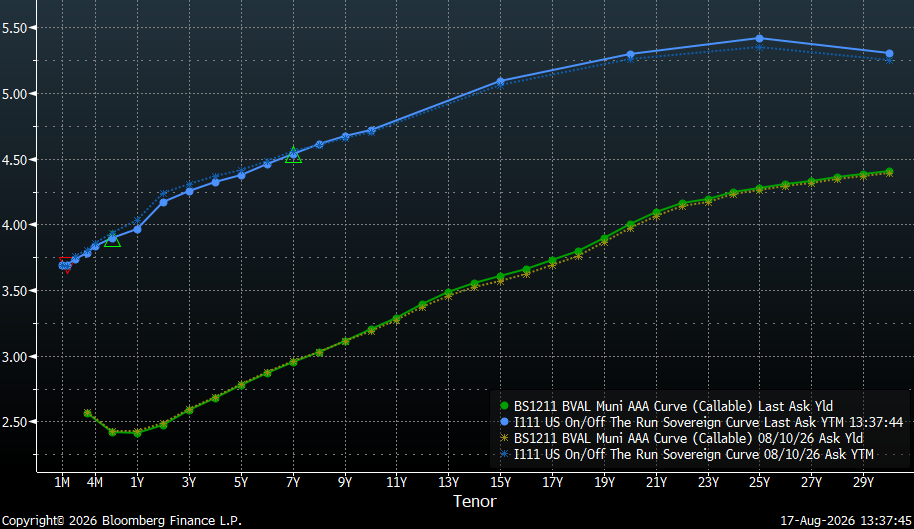
Despite shifting muni/Treasury ratios, slopes along the municipal yield curve continue to reward extending duration.  Investors are encouraged to extend out the yield curve with appealingly steep yields in the four to 12-year range, with an overall slope of 87 bps.  Furthermore, the steepest slopes along the yield curve are currently around the 17- 20-year maturities with approximately 12-bps per year of additional yield for extending in this range.  However, the yield curve becomes very flat past 20-years, with a total slope of 24 bps from 20-30-years.

Ratios for muni maturities shorter than 1-year are yielding almost 65% of Treasuries while 30-year munis are now yielding over 90% of equivalent Treasuries.  Although ratios past 20-years are attractively priced relative to Treasuries, the yield curve remains very flat over these longer tenors.  Due to the flat tail, municipal bond investors can currently buy maturities under 20-years that yield almost 90% of the 30-year curve.  For investors seeking to maximize curve positioning with relative value, the 17 to 20-year part of the municipal yield curve has become very tempting with a combination of steep slopes and attractive relative yields.

This week, a combination of a more modest new issue calendar and $19.7 billion in maturing principal and interest coming due on April 1, should conspire to create a more favorable environment for munis.  Notable deals include: Black Belt Energy Gas District, which plans to sell $1 billion; East Bay municipal Utility District is scheduled to sell $694.3 million, and the Michigan State Housing Development Authority is expected to sell $568 million.  According to LSEG Lipper Global Fund Flows, investors pulled roughly $600 million from municipal bond funds last week.  Long-term funds reportedly saw outflows of $905 million and high-yield funds saw outflows of $606 million while intermediate-maturity funds received $193 million.  Considering recent developments in muni/Treasury ratios, it should come as no surprise that the majority of inflows are going to intermediate funds.

Herbert J. Sims & Co. Inc. is a SEC registered broker-dealer, a member of FINRA, SIPC. The information contained herein has been prepared based upon publicly available sources believed to be reliable; however, HJ Sims does not warrant its completeness or accuracy and no independent verification has been made as to its accuracy or completeness. The information contained has been prepared and is distributed solely for informational purposes and is not a solicitation or an offer to buy or sell any security or instrument or to participate in any trading or investment strategy, and is subject to change without notice. All investments include risks. Nothing in this message or report constitutes or should be construed to be accounting, tax, investment or legal advice.
Curve Commentary: March 23, 2026

Overview

Day-to-day volatility remains high in the fixed income markets with the war in the Middle East continuing to dominate headlines.  At the Fed’s meeting last week, the Committee decided to maintain the target range for the federal funds rate at 3-1/2 to 3-3/4 percent.  The Fed Chair expressed a cautious outlook, noting that current inflation levels are being driven by factors pre-dating the conflict in Iran and estimating that between half and three-quarters of total core inflation is actually tariffs.  In addition, the Chair commented that typically the Fed looks through energy shocks and expects to see inflation improving around the middle of this year.  The current uncertainty has resulted in a choppy Fed funds futures market with current pricing not indicating any rate cuts over the next 12-months.

Over the past week, both munis and Treasuries have generally sold-off with Treasuries outperforming as munis catch-up.  Since the outbreak of the war in the Middle East, munis and Treasuries have sold-off by roughly 30 to 40 bps for maturities longer than 20-years.  The largest moves in Treasuries have not been around the policy sensitive 2-4 year maturities, where Treasuries have sold-off roughly 45 bps.  However, municipals have experienced their biggest moves around the 8 to 14-year maturities where they have sold-off by close to 50 bps from February 28, at the beginning of the war with Iran.

Insights and Strategy

On the trade desk we have noted that a combination of new issue supply and a lack of inquiry has lead to weakness around the 10-year maturity, while trading has become relaxed on the short-end with muni/Treasury ratios loosening up.  As a result, municipal/Treasury ratios have increasingly become more appealing in the 5 to 10-year tenors with ratios now approaching 70% and making this a significantly more appealing portion of the curve to position.  Despite shifting muni/Treasury ratios, slopes along the municipal yield curve continue to reward extending duration.  Investors are currently incented to move out the yield curve with steepening yields around the 11-20 year range, with an overall slope of 109 bps.  However, the yield curve becomes very flat past 20-years, with a total slope of only 24 bps for 20-30-years.  Currently, the steepest slopes on the municipal curve are available from 17 to 21-years where investors can pick-up approximately 60 bps.

Although municipal ratios past 20-years remain attractive relative to Treasuries, the yield curve remains very flat over these longer tenors.  Due to the flat tail that has formed at the end of the municipal yield curve, investors can currently buy maturities under 20-years that yield almost 90% of the 30-year curve.  For investors seeking to maximize curve positioning with relative value, the 17 to 20-year part of the municipal yield curve offers progressively improving opportunities with slopes of 12 to 13-bps per year.

The new issue municipal calendar picks-up this week and is expected to include $15.9 billion of new issues.  Notable deals include: the City of New York, which plans to sell $2.58 billion; the State of Illinois is scheduled to sell $1.4 billion, and the UPMC Obligated Group is expected to sell $1.2 billion.  According to LSEG Lipper Global Fund Flows, investors added roughly $1.8 billion to municipal bond funds last week.  Long-term funds reportedly received $1.5 billion and high-yield funds added about $651 million.  Considering current muni/Treasury ratios, it is not surprising that the majority of inflows are going to intermediate and long-term muni funds.

Herbert J. Sims & Co. Inc. is a SEC registered broker-dealer, a member of FINRA, SIPC. The information contained herein has been prepared based upon publicly available sources believed to be reliable; however, HJ Sims does not warrant its completeness or accuracy and no independent verification has been made as to its accuracy or completeness. The information contained has been prepared and is distributed solely for informational purposes and is not a solicitation or an offer to buy or sell any security or instrument or to participate in any trading or investment strategy, and is subject to change without notice. All investments include risks. Nothing in this message or report constitutes or should be construed to be accounting, tax, investment or legal advice.
Curve Commentary: March 16, 2026

Overview

The war in the Middle East continues to dominate headlines, leading to a high degree of volatility in oil prices and pressuring the stock and the bond markets alike.  The Fed funds futures market is currently indicating the Fed will not adjust the overnight lending rate at its meeting later this week.  Due to the high degree of uncertainty from the war in the Middle East, this is not surprising.  Furthermore, current pricing anticipates the Fed will hold rates steady until January of next year.  

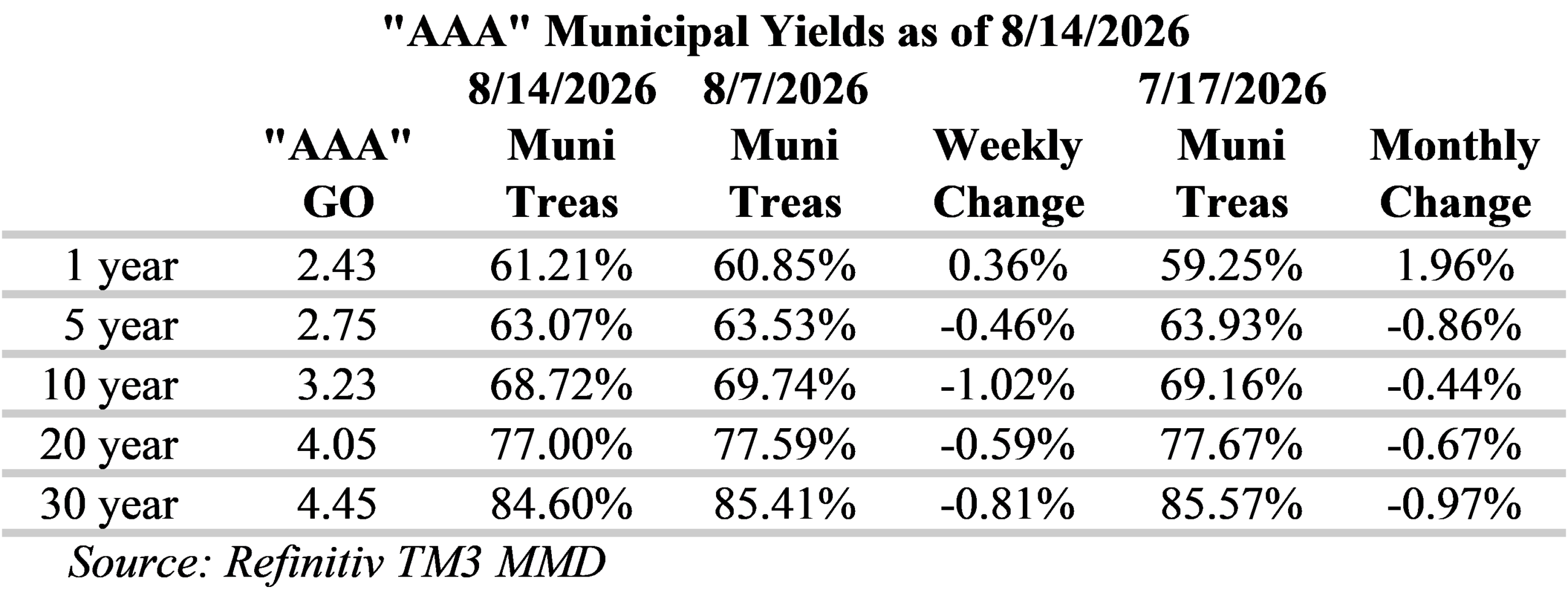
Bond investors are currently asking for more compensation for the risk of holding long-dated Treasuries.  Over the past week, Treasury yields have increased by approximately 16 bps for the 30-year maturity while the extreme short-end, around 1-month, remains virtually unchanged.  Munis have responded similarly, although to a lesser degree, with rates roughly 9 bps higher on the long-end.  However, the largest moves in the municipal scale were in the intermediate maturities from 8 to 12-years.  As a result, municipal/Treasury ratios have become more appealing in the in the 5 and 10-year tenors with ratios on the long-end and short-end becoming more rich, characterized by lower relative yields.  Currently, ratios for maturities shorter than 1-year are back in the 50’s while 30-year munis are now yielding less than 90% of equivalent Treasuries.


Insights and Strategy

Despite shifting muni/Treasury ratios, slopes along the municipal yield curve continue to reward extending duration.  Investors are currently incentivized to move out the yield curve with appealingly steep yields in the 10-20 year range, with a slope of 102 bps, versus only 74 bps from 1-10 years.  Currently, the steepest slopes on the municipal curve are available from 16 to 20-years where investors can pick-up approximately 51 bps.  However, caution is advised for tenors past 20-years, where there is only 25 bps to be gained by extending out to 30-years.  It is also notable that although municipal curve slopes remain appealingly steep, they have moderated in certain portions of the curve over the past week.

Although ratios have compressed on the long-end, due to the flat tail, municipal bond investors can currently buy maturities under 20-years that yield almost 90% of the 30-year curve.  With muni/Treasury ratios for 10-year maturities, although improved, still quite rich at around 65%.  While the yield curve remains very flat over these longer tenors, ratios past 20-years remain attractive relative to Treasuries.  For investors seeking to maximize curve positioning with relative value, the 17 to 20-year part of the municipal yield curve has become very tempting with slopes of 12 to 14-bps per year.

The new issue municipal calendar is a bit lighter this week and is expected to bring $8.27 billion of new issues.  Notable deals include: Black Belt Energy Gas District, which plans to sell $1.23 billion; New York City Water & Sewer System is scheduled to sell $983.1 million, and Cleveland Clinic Health System Obligated Group is expected to sell $530.8 million.  According to LSEG Lipper Global Fund Flows, investors added roughly $216 million to long-term municipal bond funds and $280 million to intermediate maturity funds.  Considering current muni/Treasury ratios, it is not surprising that the majority of inflows are going to intermediate and long-term muni funds.

Herbert J. Sims & Co. Inc. is a SEC registered broker-dealer, a member of FINRA, SIPC. The information contained herein has been prepared based upon publicly available sources believed to be reliable; however, HJ Sims does not warrant its completeness or accuracy and no independent verification has been made as to its accuracy or completeness. The information contained has been prepared and is distributed solely for informational purposes and is not a solicitation or an offer to buy or sell any security or instrument or to participate in any trading or investment strategy, and is subject to change without notice. All investments include risks. Nothing in this message or report constitutes or should be construed to be accounting, tax, investment or legal advice.