Curve Commentary: November 17, 2025

Overview

Following a record 43-day shutdown, the President signed legislation to reopen the government last Wednesday.  Although the government has reopened, there is a sizable backlog of government economic data that was not available during the shutdown. The bond market is currently bracing for a flood of data as traders anxiously pare December rate cut expectations.  As of this morning, the Fed funds futures market was only pricing-in a 41% chance of a 25 basis-point cut in December.  Current rate expectations have declined significantly from last week, when the implied probability was in the 60’s.  The tone has turned decidedly more hawkish as several FOMC members have recently cited heightened inflation concerns, which prompted a sell-off in Treasuries last Thursday.

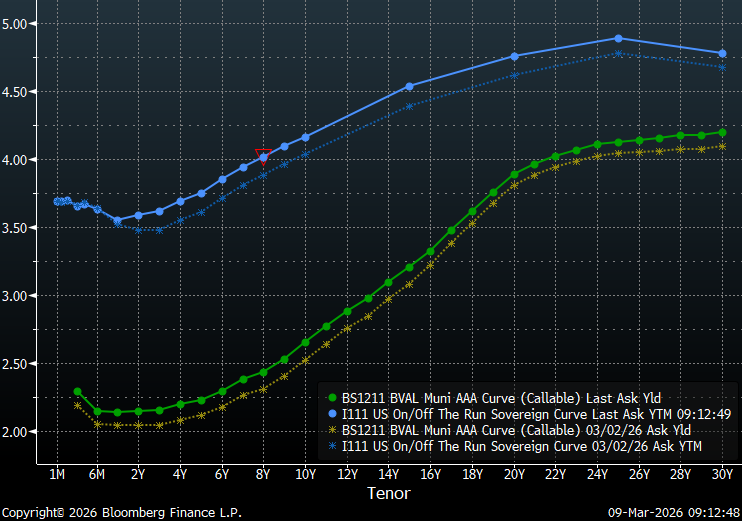
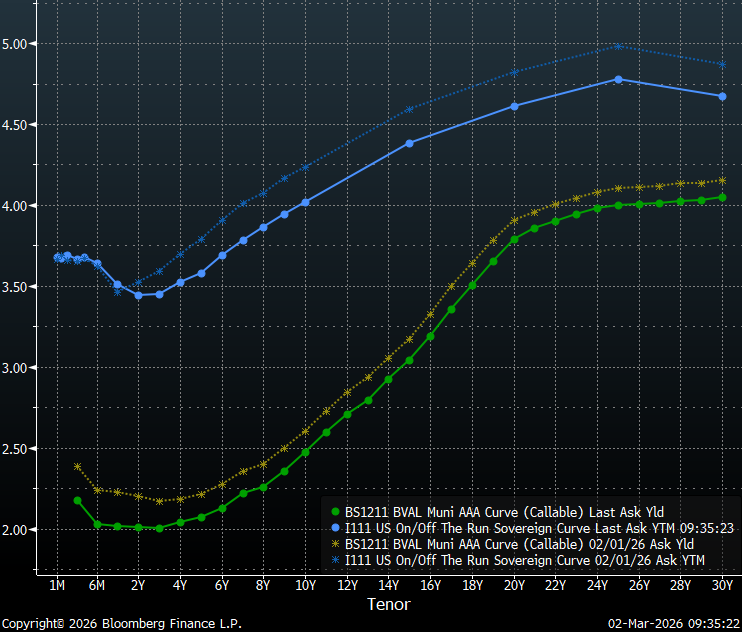
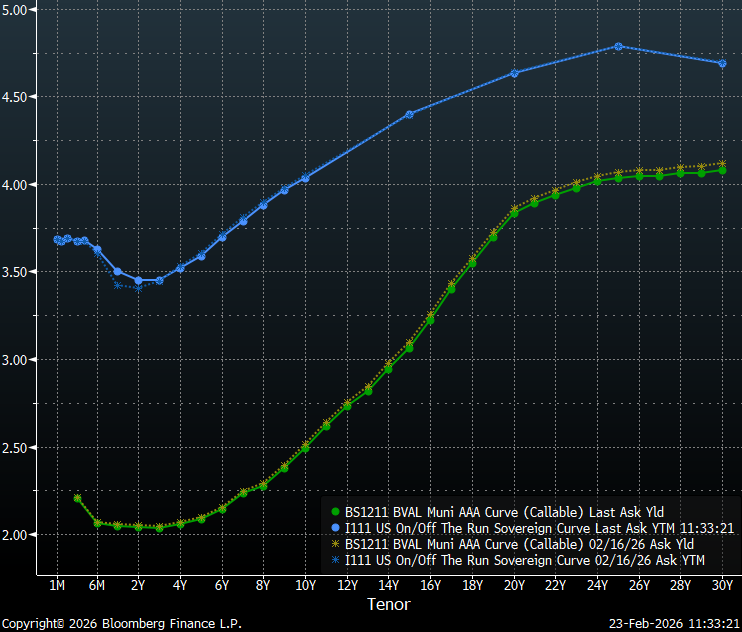
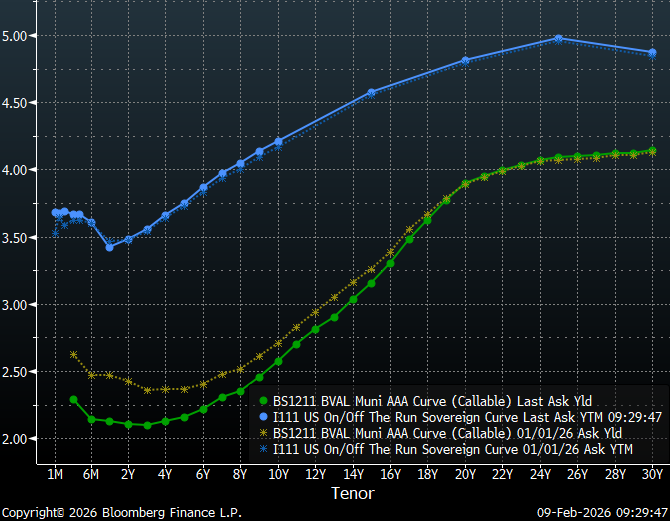
Not surprisingly, this irresolute sentiment has resulted in Treasury yields that remain little changed from when the shut-down began on October 1.  However, the municipal market has demonstrated more conviction with steady demand and appealing relative yields weighing on the long-end while shifting dynamics on the short-end have led to municipals selling-off.  As a result, we have seen the municipal yield curve flatten, resulting in declining slopes and less incentive to extend duration.


Insights and Strategy

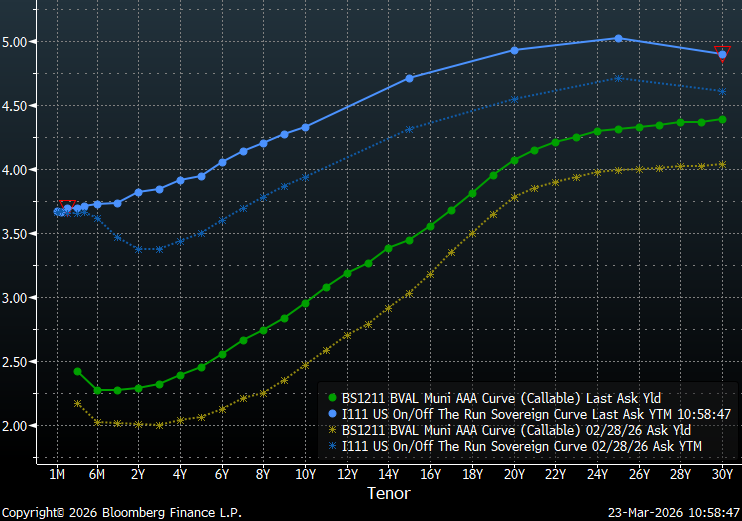
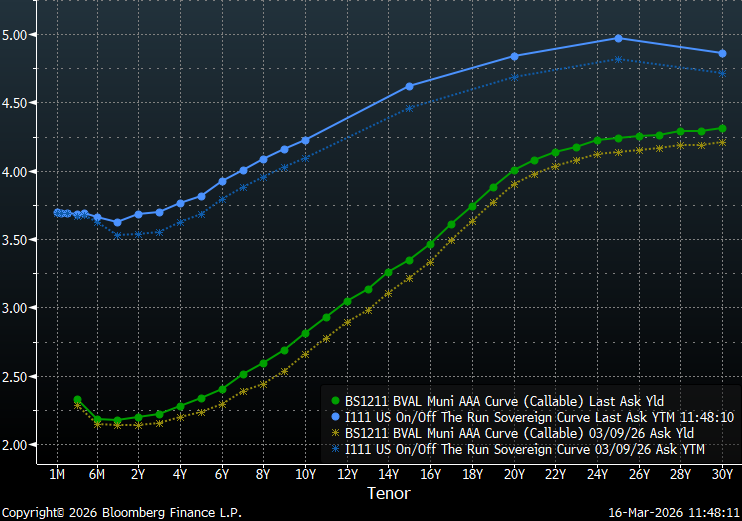
Slopes along the municipal yield curve are currently steepest around the 17-year tenor, with almost 75 bps in slope from 13 to 19-years.  This is a significant change from earlier last month, when the steepest slopes were around the 10-year tenor.  This shift has increased the reward to investors for extending from the 10-year range to the 15-20-year range.  Although the municipal yield curve rewards duration, the long-end continues to be very flat with steadily declining slopes from 20 to 30-years and only a basis point or so per year past 25-years.  However, as a result of this flat tail, municipal bond investors can buy maturities under 20-years that yield over 90% of the 30-year curve. 

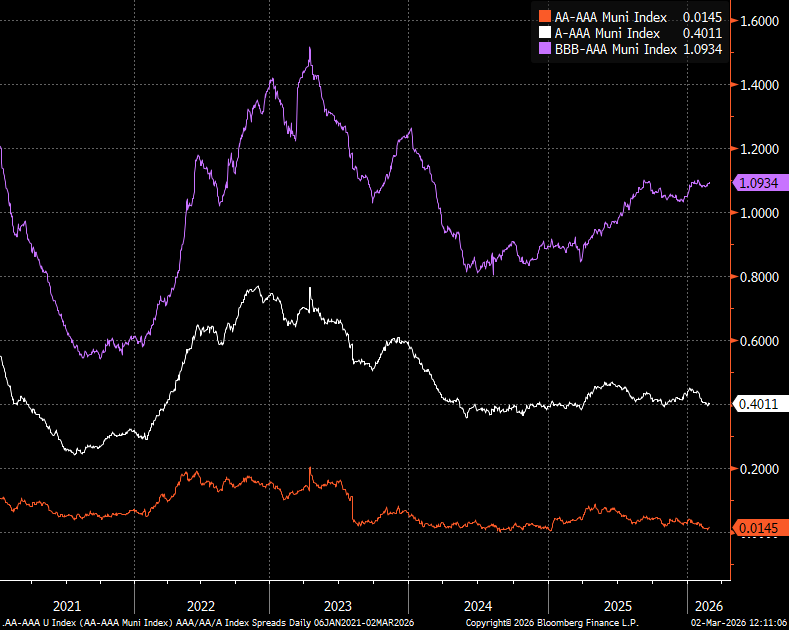
Municipal credit spreads, which are the difference in yield between the ‘AAA’ yields and riskier bonds of equivalent maturities, continue to reward risk in lower investment grade securities while ‘AA’ and ‘A’ bonds have been trading fairly tightly this year.  In recent months we have seen lower investment grade credit spreads fluctuate as economic concerns have emerged prompting investors to demand more yield to compensate for the additional risk.  While current credit spreads are appealing for ‘BBB’ rated bonds, caution is still warranted as these spreads can widen significantly during economic events.


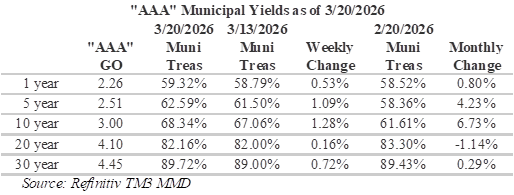
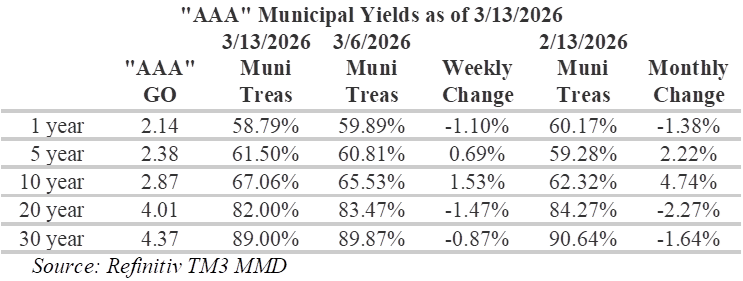
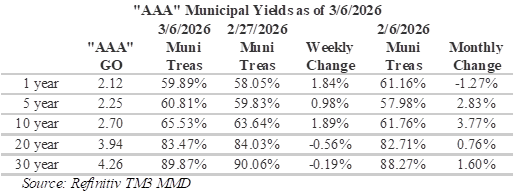
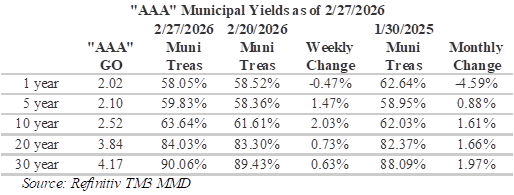
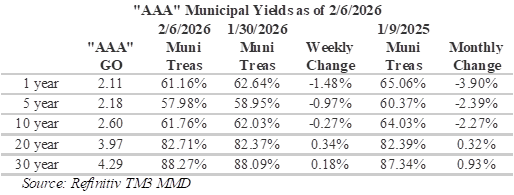
The muni/Treasury ratio is a widely watched measure that provides a sense of how tax-exempt munis fare against taxable fixed-income options.  Crossover investors, which seek to identify the best opportunities in the fixed income universe on an after-tax basis, closely follow this ratio.  Over the past month, the biggest moves have been in maturities around the 10-year mark where ratios have become over 4% richer, with ratios now around 66%.  From a historical perspective, the 10-year mean for the 10-year maturity is 82.59%, which shows how richly valued municipals have become in this art of the curve.  For investors seeking to maximize curve positioning with relative value, extending to the 18-year part of the municipal yield curve provides almost 90% of the 30-year maturity and almost 80% of equivalent Treasury yields.  

Herbert J. Sims & Co. Inc. is a SEC registered broker-dealer, a member of FINRA, SIPC. The information contained herein has been prepared based upon publicly available sources believed to be reliable; however, HJ Sims does not warrant its completeness or accuracy and no independent verification has been made as to its accuracy or completeness. The information contained has been prepared and is distributed solely for informational purposes and is not a solicitation or an offer to buy or sell any security or instrument or to participate in any trading or investment strategy, and is subject to change without notice. All investments include risks. Nothing in this message or report constitutes or should be construed to be accounting, tax, investment or legal advice.

SAN TAN MONTESSORI Case Study (June 2025)

$40,650,000 | June 2025 | Gilbert, AZ

“Our experience with the HJ Sims team has been consistently positive. They are very knowledgeable in the municipal bond space, well-organized throughout the process, and maintain a professional approach from start to finish. We value their reliability and clear communication, and we look forward to continuing to work with their team.

Partnered Right®

San Tan Montessori School (“San Tan”) operates two charter schools in Gilbert, AZ. Together, the campuses serve over 900 students from preschool
through grade 12. San Tan received approval from the Arizona State Board for Charter Schools to open a third campus, the Signal Butte School.
To support this growth, Sims was selected for its deep charter school experience and leading track record in underwriting below investment grade
bonds. Sims collaborated closely with school management aligning on goals to build out a third campus while optimizing financing for its existing
operations.

Structured Right®

The $40.65 million financing proceeds were designed to support the construction of the new Signal Butte Campus, refinance existing debt,
and fund capital improvements. The structure featured multiple long-term maturities for the four term bonds, extending out to 2065, allowing for
manageable annual debt service. The bonds also included capitalized interest to support the school through the initial enrollment ramp-up.

Executed Right®

Despite a challenging market backdrop during pricing, Sims successfully brought the transaction to the market. The offering received indications of interest from 10 institutional investors, and bonds were ultimately allotted across 6 of them — a strong result given volatility in the high-yield
municipal market.

Financed Right®

In June 2025, HJ Sims successfully placed $40.65 million in unrated, tax-exempt revenue bonds with institutional investors. The transaction enables San Tan to expand capacity and continue serving a growing student population across the Phoenix metro area.

Aksjai Patel

602.476.4934

For more information, please contact:

Testimonials may not be representative of the experience of other clients. Past performance is no guarantee of future results

Curve Commentary: November 10, 2025

Overview

Today marks the 41st day of the longest government shutdown in US history, and it appears a resolution is potentially close at hand.  On Sunday, eight Senate Democrats joined Republicans in a push to advance a short-term funding measure that would extend government funding through January.  However, the legislation still requires a final vote by the Senate and needs to pass the House before the shutdown can end.  Following this news, the Treasury market has slid with 10-year Treasuries rising as much as 5 basis points to near 4.15% amid optimism .  Some caution is also warranted since the re-opening may potentially trigger volatility as a surge of delayed data releases.  This absence of government data has made policymakers more cautious about cutting rates, which will likely fade as data is released upon re-opening.  The Fed funds futures market is currently pricing-in a 65% chance of a 25 basis-point cut in December.  This is down significantly from just a few weeks ago when the implied probability was closer to 95%.


While Treasuries have generally sold-off month-to-date, particularly on the longer-end of the curve where the market has sold-off as much as 6 basis points, municipal bonds have held firmly with yields staying within a basis point of November 1 yields.  Over the past week, mixed labor data has driven volatility in Treasuries with Munis being more resistant due to reinvestment demand and continued inflows from institutions.  However, the one- to six-year yield municipal yield curve remains inverted, which is an important consideration for investors managing bond portfolios.  However, this also creates opportunities for swaps, particularly for those investors with losses on the short-end that would like to extend duration.

Insights and Strategy

Although the municipal yield curve continues to reward duration, the long-end has become very flat with steadily declining slopes from 20 to 30-years and only a basis point or so per year past 25-years.  However, as a result of this flat tail, municipal bond investors can buy maturities under 20-years that yield over 90% of the 30-year curve.   Slopes along the municipal yield curve are currently steepest around the 17-year tenor, with almost 75 bps in slope from 13 to 19-years.  This is a significant change from earlier last month, when the steepest slopes were around the 10-year tenor.  This shift increases the reward to investors for extending from the 10-year range to the 15-20-year range.  Despite recent uncertainty regarding a December rate cut, this steepness is likely to persist amid government shutdown uncertainty and demand for longer durations.

The muni/Treasury ratio is a widely watched measure that provides a sense of how tax-exempt munis fare against taxable fixed-income options.  Crossover investors, which seek to identify the best opportunities in the fixed income universe on an after-tax basis, closely follow this ratio.  Over the past month, the biggest moves have been in maturities under 1-year and around the 10-year mark where ratios have become over 3% richer, with ratios now around 67%.  Although this part of the curve had become significantly more appealing from a relative value perspective, ratios are now less appealing.   From a historical perspective, the 10-year mean for the 10-year maturity is 82.69%.  On the other hand, the 1-year tenor has become over 3% more attractive with ratios now approximately 70%, but the 10-year mean for this part of the curve is 94.57%.  For investors seeking to maximize curve positioning with relative value, the 18-year part of the municipal yield curve currently provides almost 90% of the 30-year maturity and over 80% of equivalent Treasury yields.  


Herbert J. Sims & Co. Inc. is a SEC registered broker-dealer, a member of FINRA, SIPC. The information contained herein has been prepared based upon publicly available sources believed to be reliable; however, HJ Sims does not warrant its completeness or accuracy and no independent verification has been made as to its accuracy or completeness. The information contained has been prepared and is distributed solely for informational purposes and is not a solicitation or an offer to buy or sell any security or instrument or to participate in any trading or investment strategy, and is subject to change without notice. All investments include risks. Nothing in this message or report constitutes or should be construed to be accounting, tax, investment or legal advice.

Curve Commentary: November 3, 2025

Overview

Today marks the 34th day of the US government shutdown, and despite the lack of government economic data and the continuous flow of headlines, there has been little response by the Treasury market.  Yields on Treasuries are little changed over the past month with the biggest changes on tenors under 6 months and the rest of the curve virtually unchanged.  Munis in tenors past 6-years have rallied as much as 20-basis points over the past month with the Bloomberg Municipal Index reporting a 1.24% return, which is the best October performance since 1995.  This performance was despite $55 billion of tax-exempt issuance.  Municipal tenors shorter than 6-years sold-off as demand shifted from the front end of the yield curve to the long-end as investors locked-in yields in anticipation of Fed rate cuts.  

Insights and Strategy

Slopes along the municipal yield curve are currently steepest around the 17-year tenor, with almost 75 bps in slope from 13 to 19-years.  This is a significant change from earlier last month, when the steepest slopes were around the 10-year tenor.  This shift increases the reward to investors for extending from the 10-year range to the 15-20-year range.  Although the municipal yield curve continues to reward duration, the long-end continues to be very flat with steadily declining slopes from 20 to 30-years and only a basis point or so per year past 25-years.  However, as a result of this flat tail, municipal bond investors can buy maturities under 20-years that yield 93% of the 30-year curve.  Despite recent uncertainty regarding a December rate cut, this steepness is likely to persist amid government shutdown uncertainty and demand for longer durations

The muni/Treasury ratio is a widely watched measure that provides a sense of how tax-exempt munis fare against taxable fixed-income options.  Crossover investors, which seek to identify the best opportunities in the fixed income universe on an after-tax basis, closely follow this ratio.  Over the past month, the biggest moves have been around the 10-year maturity where ratios have become over 4% richer, with ratios now approaching 66%.  Although this part of the curve had become significantly more appealing from a relative value perspective, ratios are now less appealing.   From a historical perspective, the 10-year mean for the 10-year maturity is 82.69%.  On the other hand, the 1-year tenor has become over 3% more attractive with ratios now approaching 70% but the 10-year mean for this part of the curve is 94.57%.  For investors seeking to maximize curve positioning with relative value, the 18-year part of the municipal yield curve currently provides almost 90% of the 30-year maturity and almost 80% of equivalent Treasury yields.

Herbert J. Sims & Co. Inc. is a SEC registered broker-dealer, a member of FINRA, SIPC. The information contained herein has been prepared based upon publicly available sources believed to be reliable; however, HJ Sims does not warrant its completeness or accuracy and no independent verification has been made as to its accuracy or completeness. The information contained has been prepared and is distributed solely for informational purposes and is not a solicitation or an offer to buy or sell any security or instrument or to participate in any trading or investment strategy, and is subject to change without notice. All investments include risks. Nothing in this message or report constitutes or should be construed to be accounting, tax, investment or legal advice.

Curve Commentary: October 20, 2025

Overview

The shutdown, which is now the third longest government shutdown in U.S. history, continues to populate headlines.  In addition, markets are operating without the usual government sourced economic data from the Bureau of Labor Statistics and the Bureau of Economic Analysis.  Absent this data, the markets have been looking to private sources and anecdotal data from businesses for guidance.  However, data from these sources is less than optimal and is typically not as broad or representative of the economy as government data sets.  Due to the weakening job market and a lack of updated government data to demonstrate otherwise, the markets are operating under the assumption the Fed will make another quarter of a point cut at its meeting next week.  Last week, Fed chair Jerome Powell indicated that economic concerns of the Fed had not changed during the data blackout.  The Fed funds futures market is currently indicating an almost certain 94.6% chance of a 25bps rate cut at the Fed’s October 29 meeting and an additional 25bps cut in December.

Over the past week, Treasury and municipal markets have been largely unphased by the shutdown or the regional bank distress with yields experiencing minimal change on the long end of the yield curve.  Treasury yields rallied about 4.55 bps versus 5.5 bps for munis.  On the more policy sensitive short tenors under 2-years, yields differed with Treasuries selling-off a little over 5 bps and munis rallying around 3 bps.  Treasuries have lately been responding to haven buying, trade tensions and anxiety related to regional bank credit exposure.


Insights and Strategy

Slopes along the municipal yield curve are currently steepest around the 17-year tenor, with over 61 bps in slope from 13 to 18-years.  This is a significant change from earlier this month, when the steepest slopes were around the 10-year tenor.  This shift increases the reward to investors for extending from the 10-year range to the 15-20-year range.  Although the municipal yield curve continues to reward duration, the long-end has become very flat with steadily declining slopes from 20 to 30-years and only a basis point or so per year past 25-years.  However, as a result of this flat tail, municipal bond investors can buy maturities under 20-years that yield over 92% of the 30-year curve.

The muni/Treasury ratio is a widely watched measure that provides a sense of how tax-exempt munis fare against taxable fixed-income options.  Crossover investors, which seek to identify the best opportunities in the fixed income universe on an after-tax basis, closely follow this ratio.  Over the past month, the biggest moves have been around the 10-year maturity where ratios have cheapened close to 10% with ratios now approaching 70%.  Although this part of the curve has become significantly more appealing from a relative value perspective, ratios are still rich from a historical perspective with a 10-year mean for this part of the curve at 94.59%.  For investors seeking to maximize curve positioning with relative value, the 18-year part of the municipal yield curve currently provides almost 90% of the 30-year maturity and over 80% of equivalent Treasury yields. 

Month-to-date, lower-coupon 4s have outperformed in October, benefiting from their longer duration and greater sensitivity to the rally in rates.  Against the backdrop of falling yields, lower coupon bonds have recently experienced stronger price appreciation versus higher coupon bonds, which are less responsive in a declining rate environment.  However, this week we are anticipating a full municipal calendar with over $15 billion in new issues.  Overall, with the potential for Treasury volatility amid the government shutdown and heavy supply from the municipal calendar, continued outperformance from lower coupon bonds may prove challenging this week.

Herbert J. Sims & Co. Inc. is a SEC registered broker-dealer, a member of FINRA, SIPC. The information contained herein has been prepared based upon publicly available sources believed to be reliable; however, HJ Sims does not warrant its completeness or accuracy and no independent verification has been made as to its accuracy or completeness. The information contained has been prepared and is distributed solely for informational purposes and is not a solicitation or an offer to buy or sell any security or instrument or to participate in any trading or investment strategy, and is subject to change without notice. All investments include risks. Nothing in this message or report constitutes or should be construed to be accounting, tax, investment or legal advice.

BridgePrep Academy Case Study (July 2025)

BridgePrep Academy Logo_resized (002)

Partnered Right®

  • BridgePrep Academy (“BPA”) currently operates 20 schools; the Series 2025 Bonds included nine of BPA’s schools
  • The nine schools included in the 2025 financing serve approximately 6,200 K-12 students, with enrollment projected to exceed 7,000 by 2030 
  • HJ Sims collaborated with SMART Management (BPA’s education management organization) to optimize the financing around its existing operations

Structured Right®

  • Proceeds of the Series 2025 Bonds were used to 1) fund the acquisition of multiple charter school facilities, 2) fund various capital expenditures, 3) payoff an existing bank loan, 4) fund a debt service reserve fund, and 5) pay bond issuance costs
  • The Series 2025 Bonds have a 40-year maturity and were structured with five tax-exempt term maturities and one taxable term maturity
  • The Series 2025 Bonds are callable in seven years @ 102%, with the call premium declining to par in nine years 

Executed Right®

  • HJ Sims successfully priced the Series 2025 Bonds despite a volatile market environment
  • The underwriting syndicate secured $486.5 million in orders, a 2.4x oversubscription
  • Individual maturities were oversubscribed 1.4 – 5.7x
  • 16 institutional investors submitted orders for the Series 2025 Bonds

Financed Right®

  • HJ Sims delivered a 40-year fixed rate “Ba1” rated financing for BPA at a true interest cost of 6.35%
  • The Series 2025 Bonds enables BridgePrep Academy to continue to expand its capacity to serve students in Florida

Robert Nickell

214.681.0952

Richard Harmon

614.335.7052

For more information, please contact:

Testimonials may not be representative of the experience of other clients. Past performance is no guarantee of future results