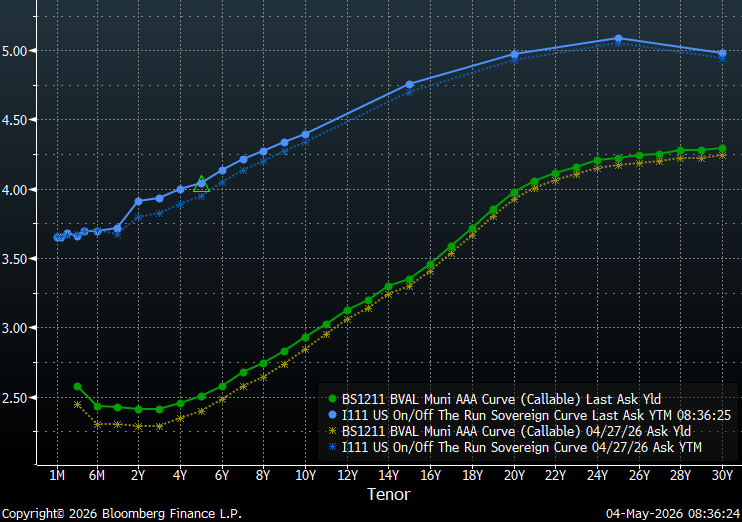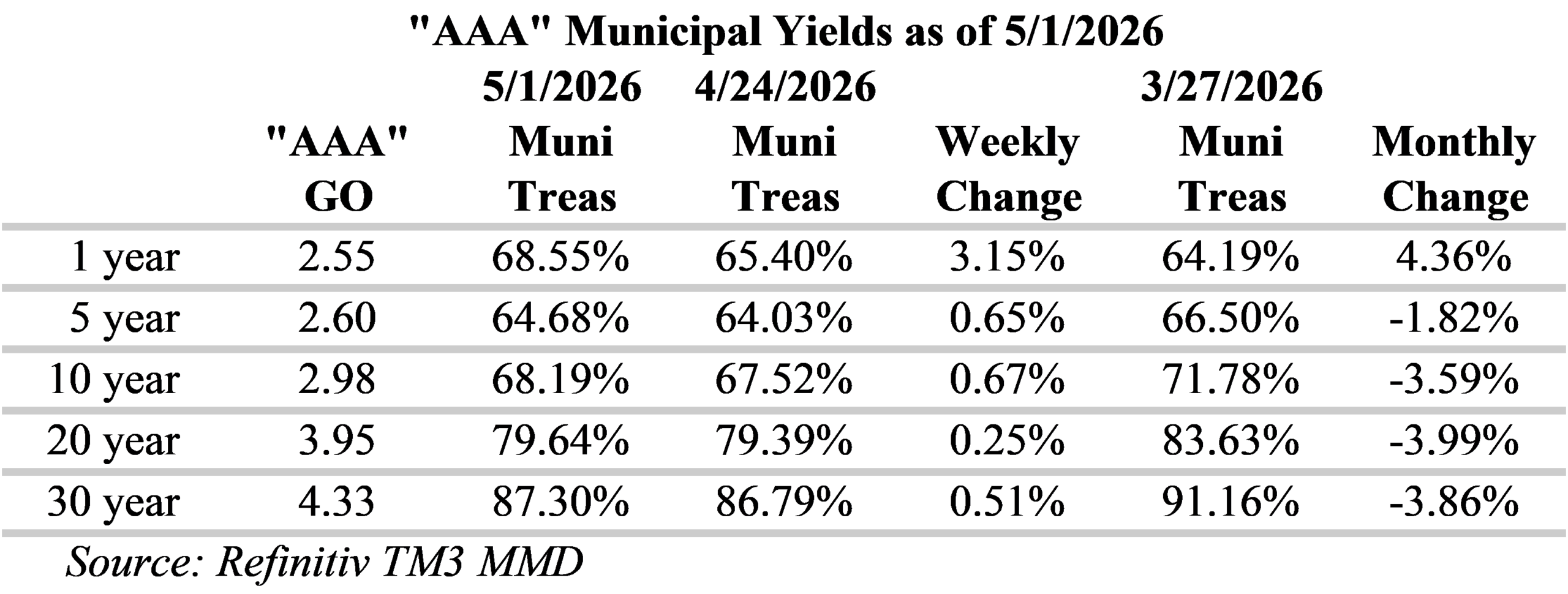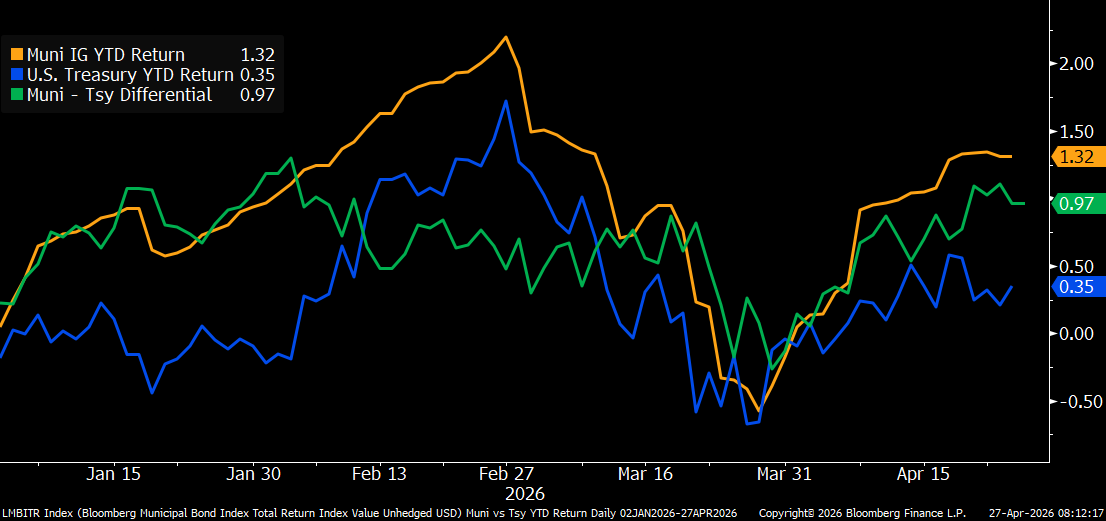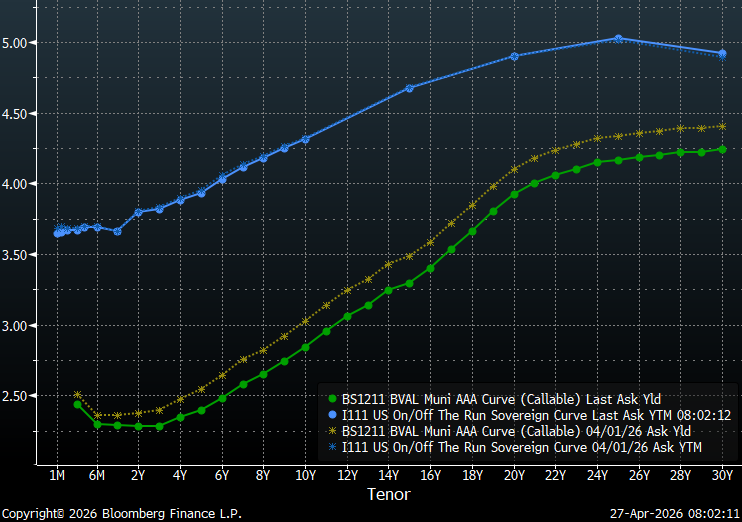
Curve Commentary: December 8, 2025

Overview

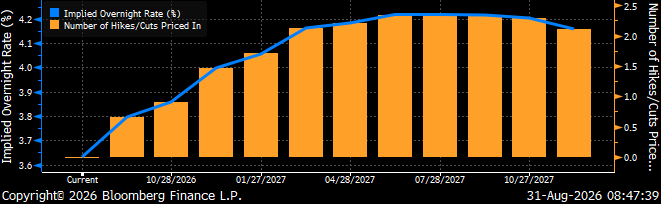
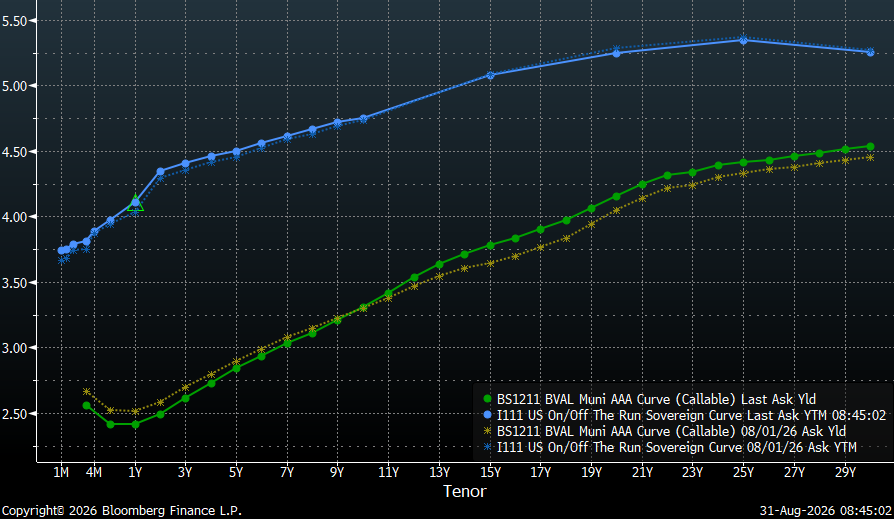
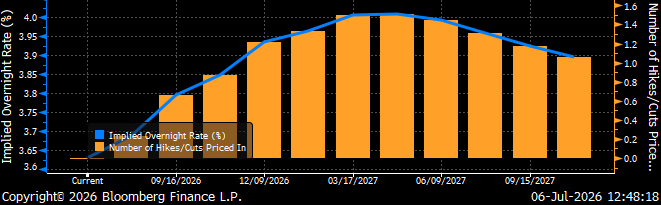
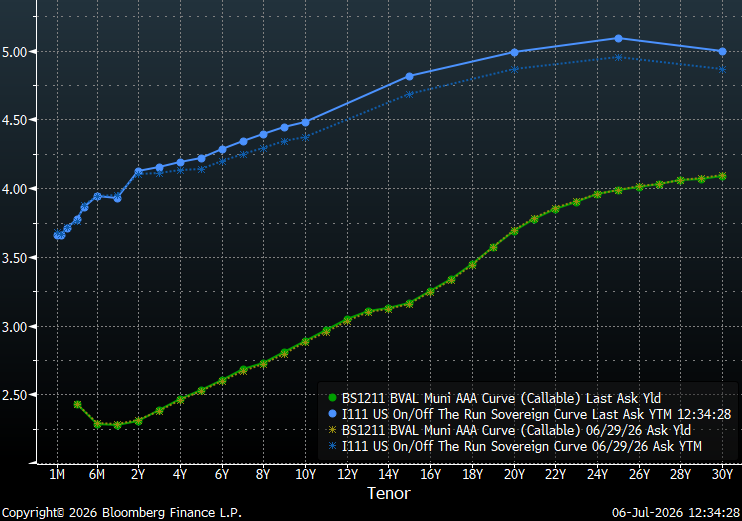
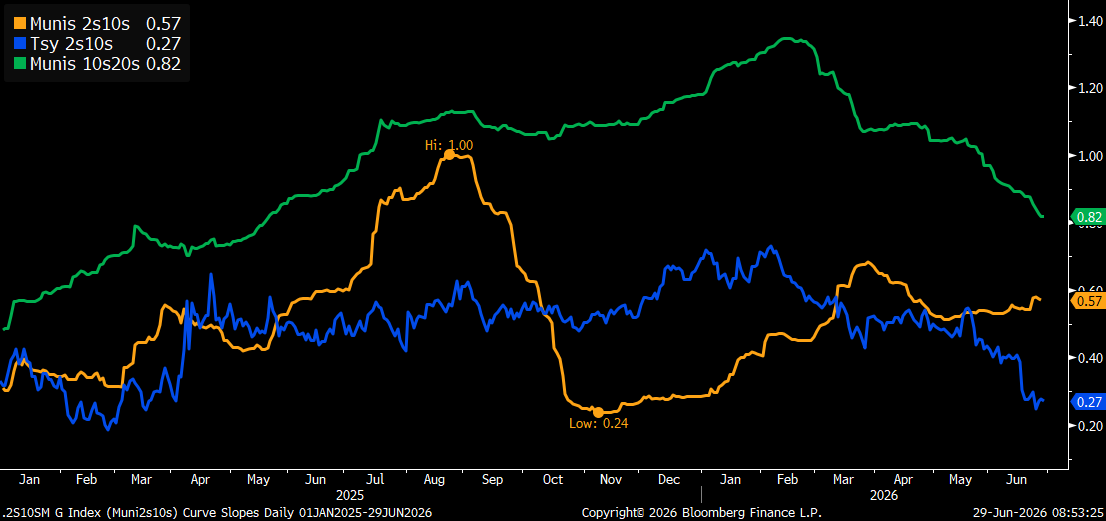
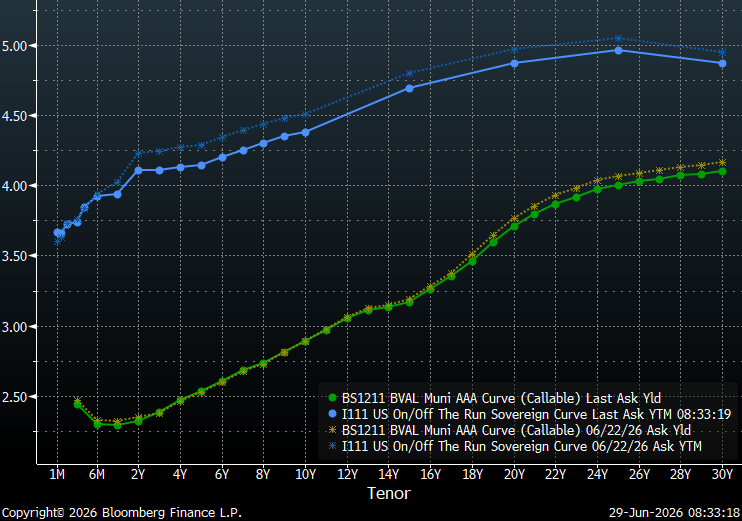
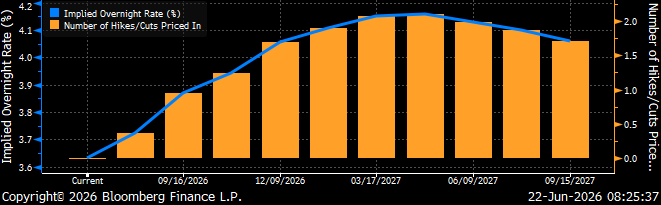
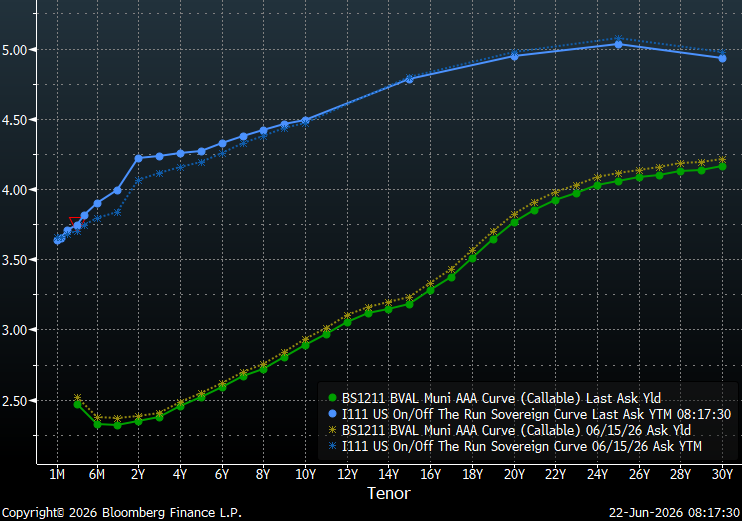
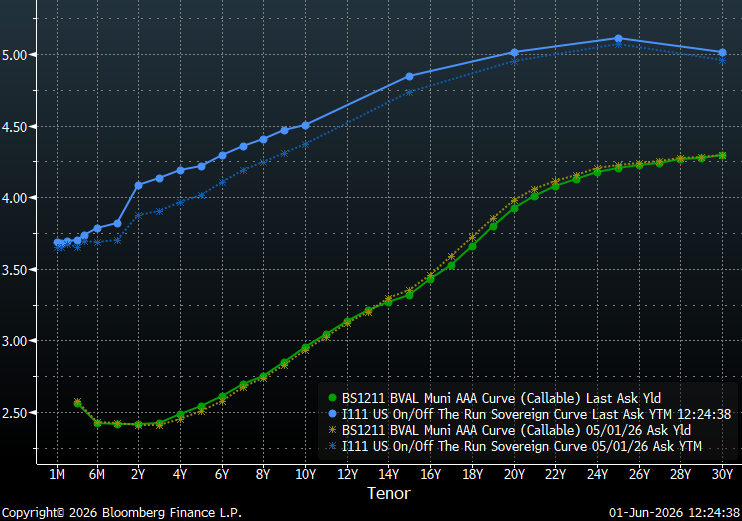
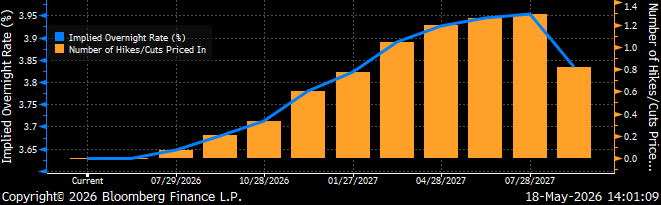
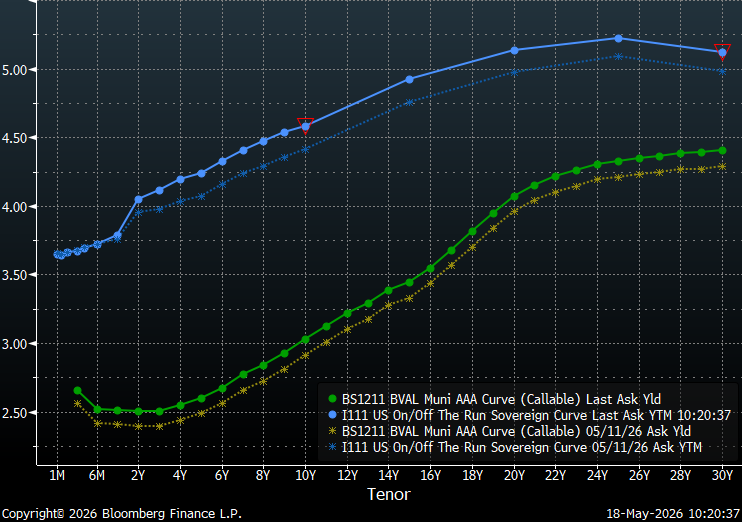
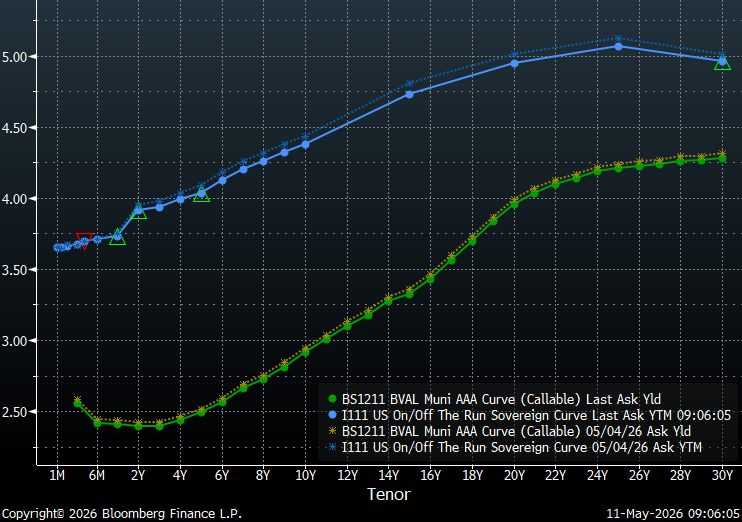
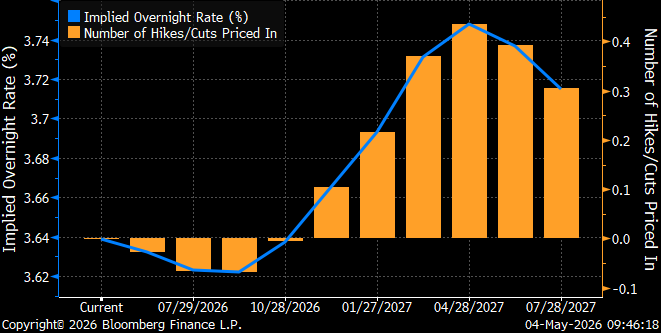
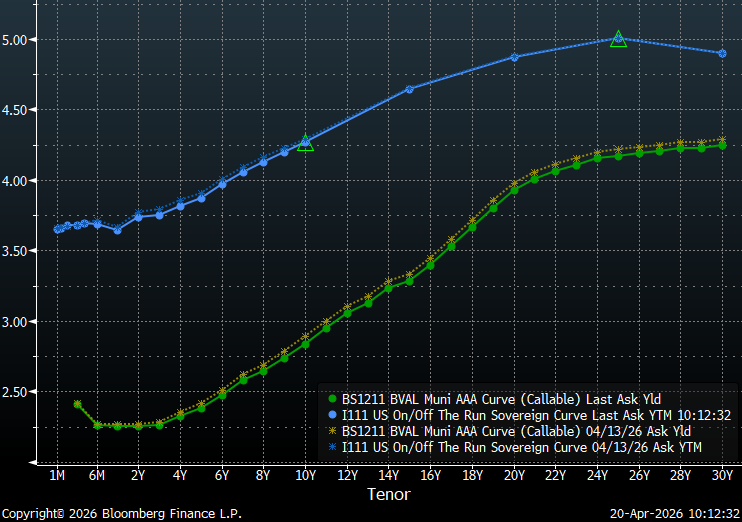
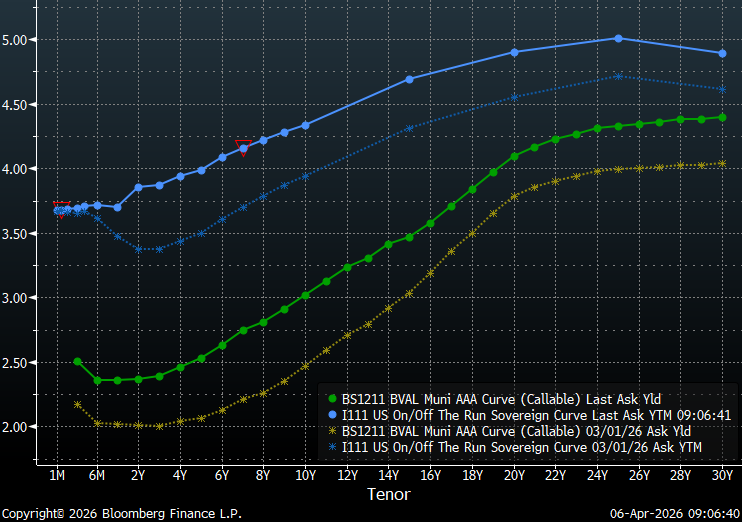
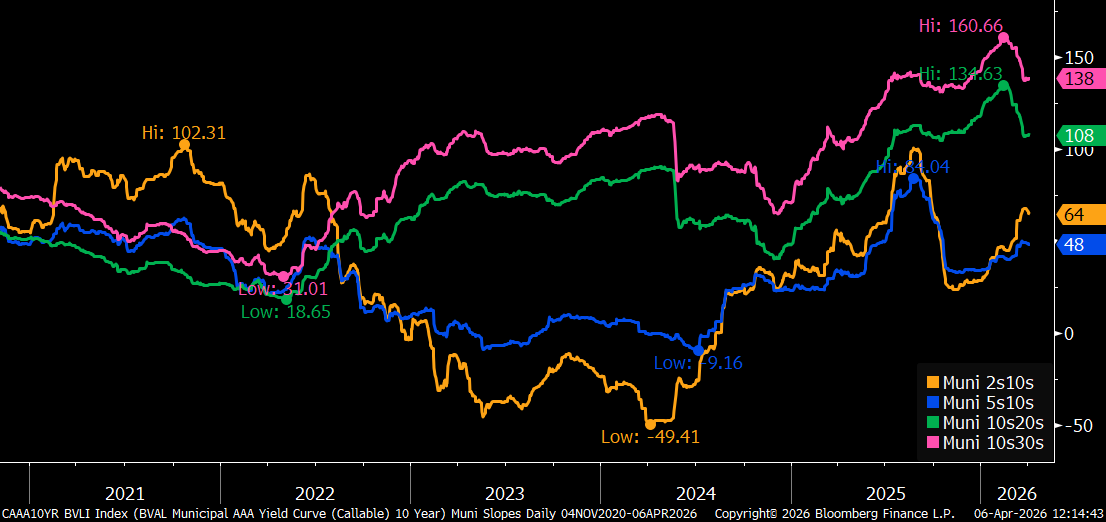
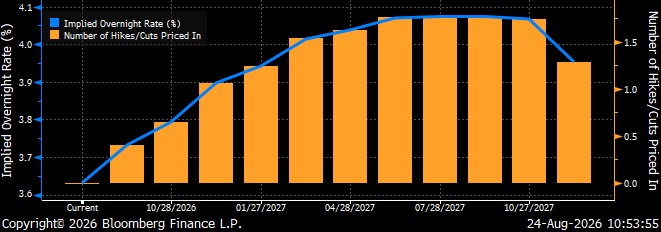
This past week, the Treasury curve shifted up eight to nine basis points in a parallel fashion from two years out while municipal yields remain essentially unchanged with the long end only about a basis point higher.  The result is a steeper Treasury curve with municipal bonds generally outperforming Treasuries.  Perhaps the most meaningful developments occurred in Treasuries on the extreme short-end with one-month and two-month yields rallying 10 to 20 basis points in anticipation of a Fed rate cut this week.  However, following last Friday’s release of the delayed core personal consumption expenditures price index form the Bureau of Economic Analysis, inflation concerns were reinforced with prices up 0.2% from August and 2.8% from the prior year.  As a result, the rate cut expected at the Fed’s final 2025 meeting later this week could potentially accelerate inflation concerns on the long-end.

Moreover, the balance of the year has the potential to be more dynamic than previous years for the fixed income markets.  As a result of the shutdown, the traditional data-release schedules have been pushed-back this year.  November payroll data will not be published until next Tuesday on December 16, November’s CPI is scheduled for release two days later on December 18 and third quarter GDP is scheduled to be released just two days before Christmas.  In addition, the Supreme Court could release their decision on the IEEPA tariff case later this month.

Insights and Strategy

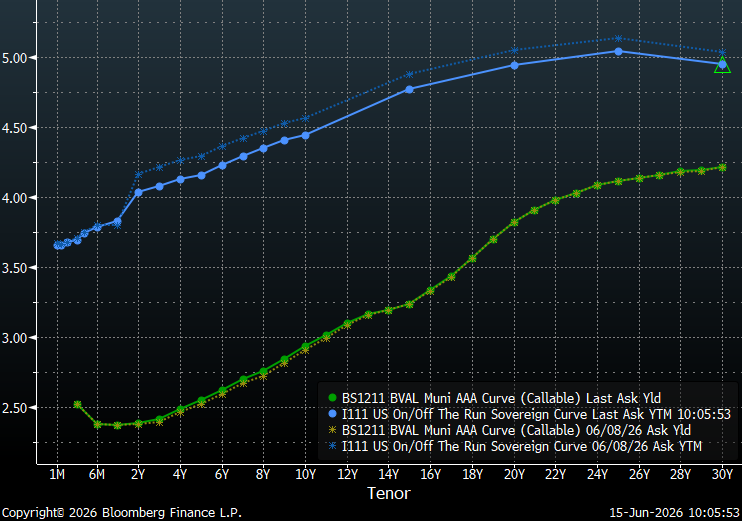
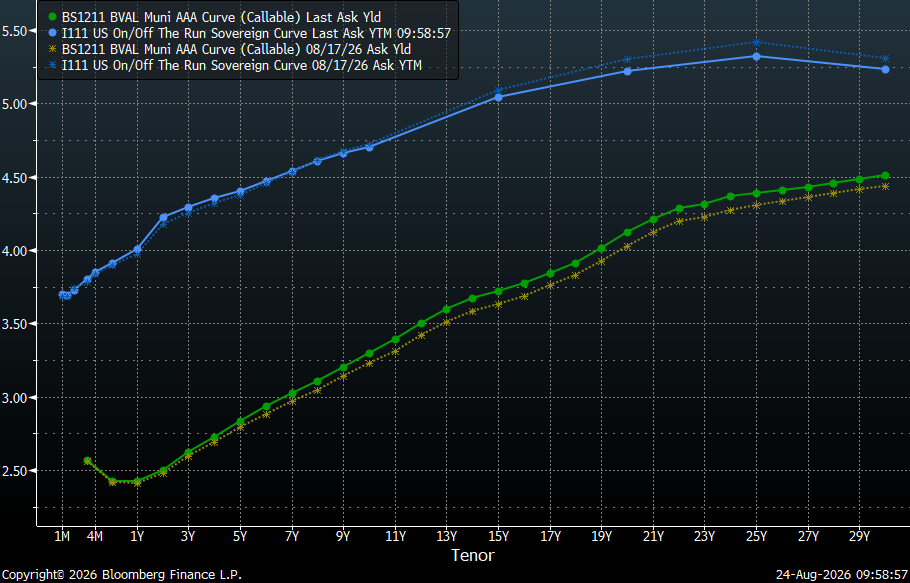
Slopes along the municipal yield curve continue to be steepest around the 16-year tenor, with over 100 bps in slope from 10 to 19-years.  This is a significant change from earlier last month, when the steepest slopes were around the 10-year tenor.  This shift has increased the reward to investors for extending from the 10-year range to the 15-20-year range.  In addition, investors benefit from a steep roll-down over time.  Although the municipal yield curve is currently rewarding duration, investors should be cautious when extending to maturities past 20-years, where the long-end becomes very flat.  As a result of this flat tail, municipal bond investors can buy maturities under 20-years that yield over 90% of the 30-year curve.  

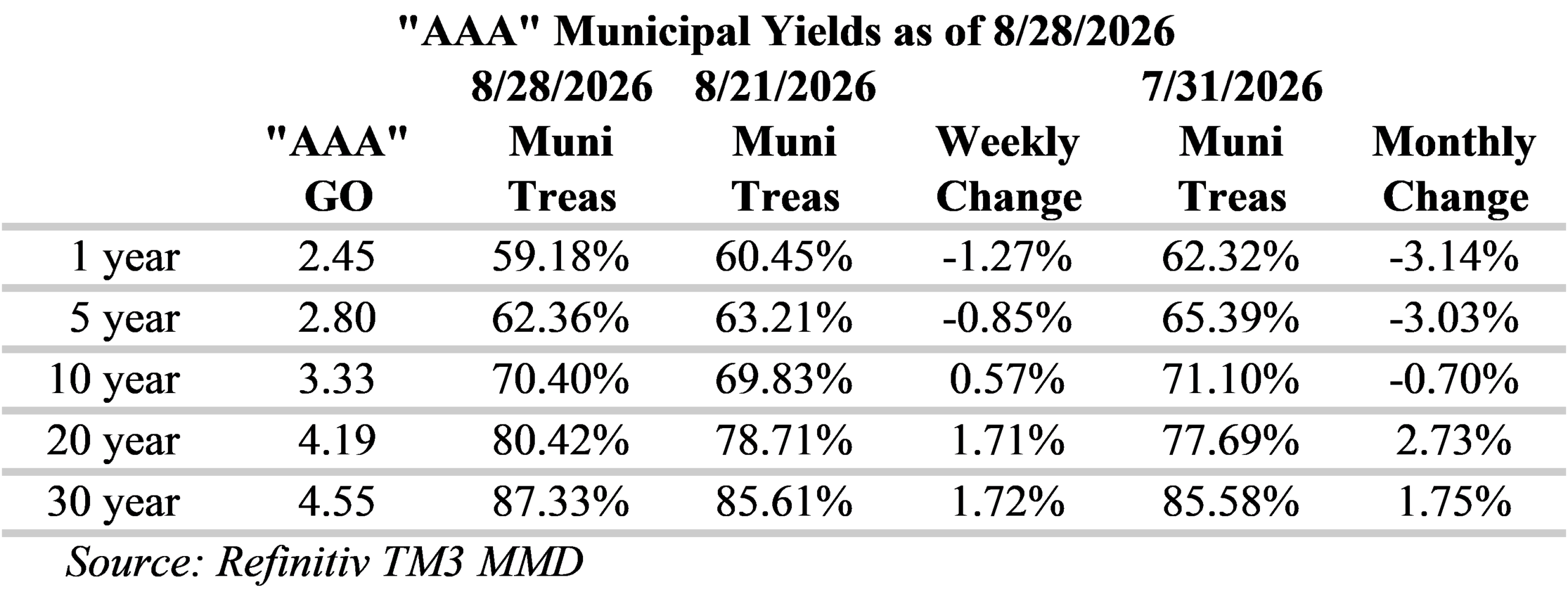
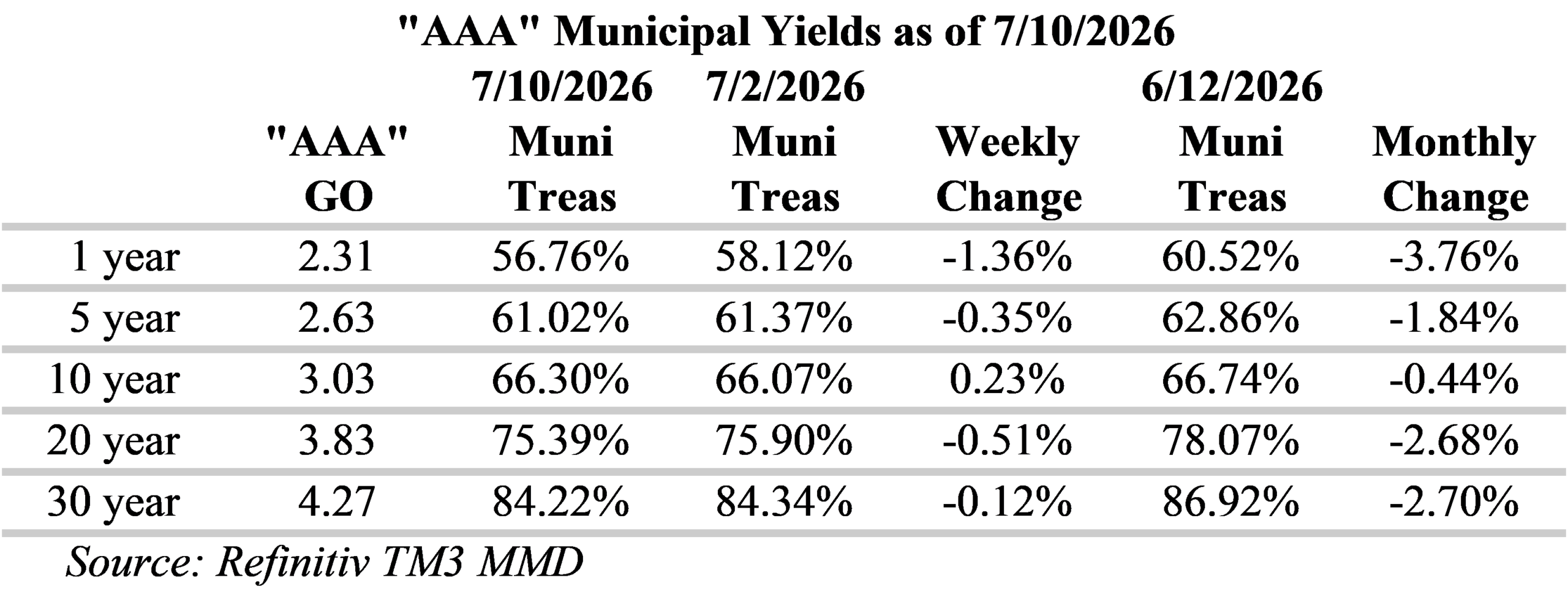
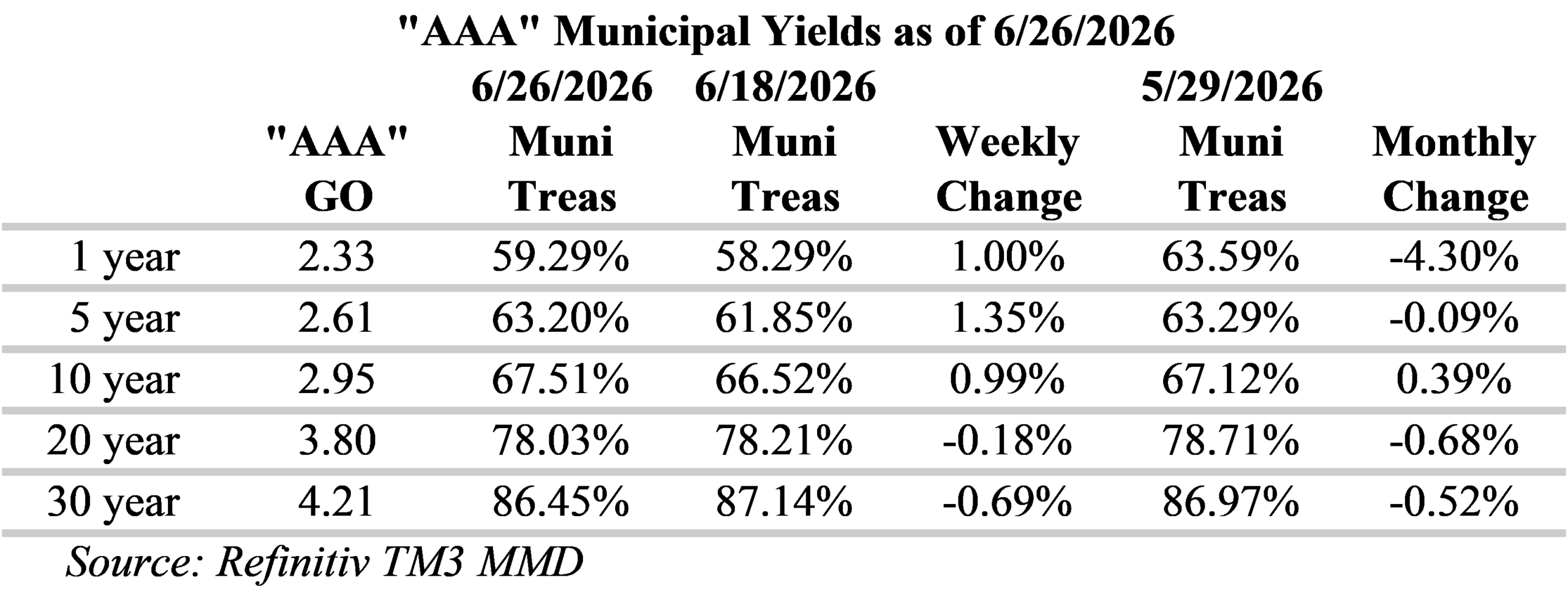
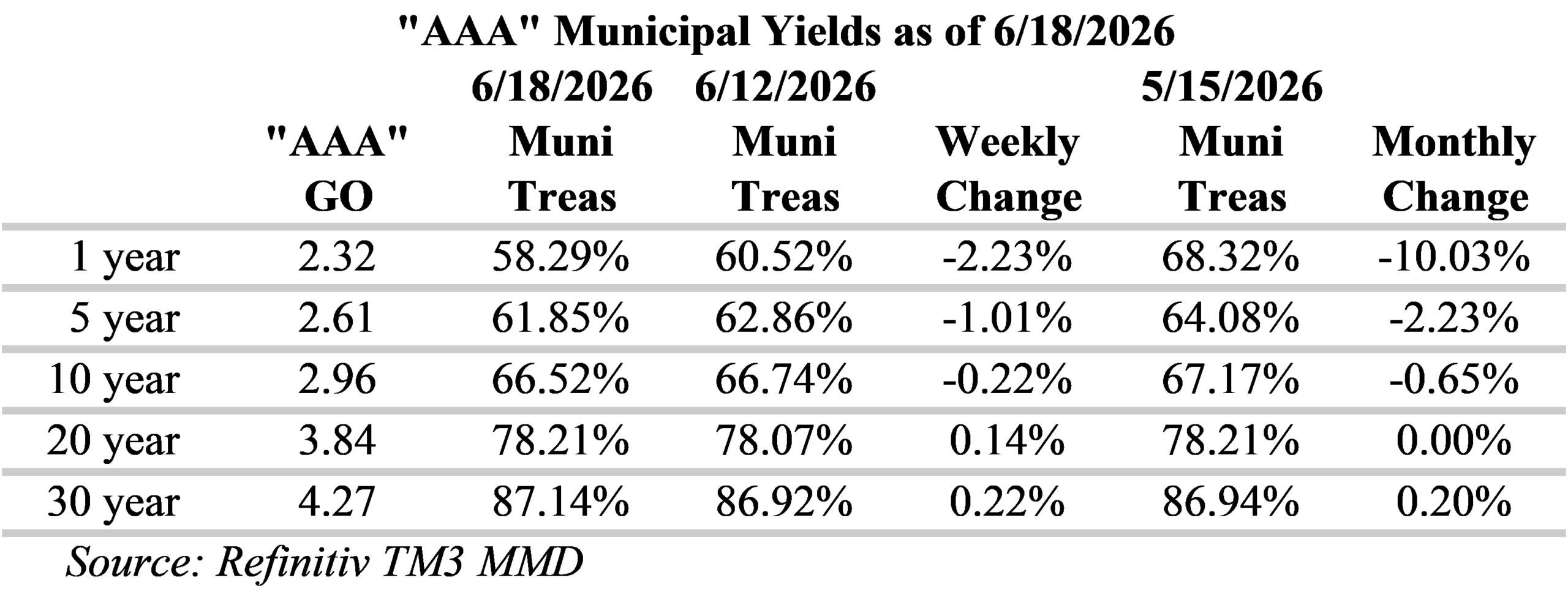
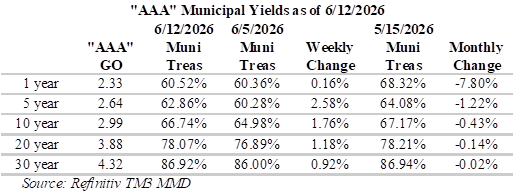
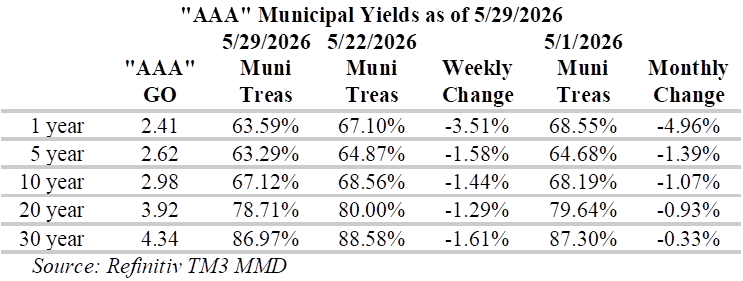
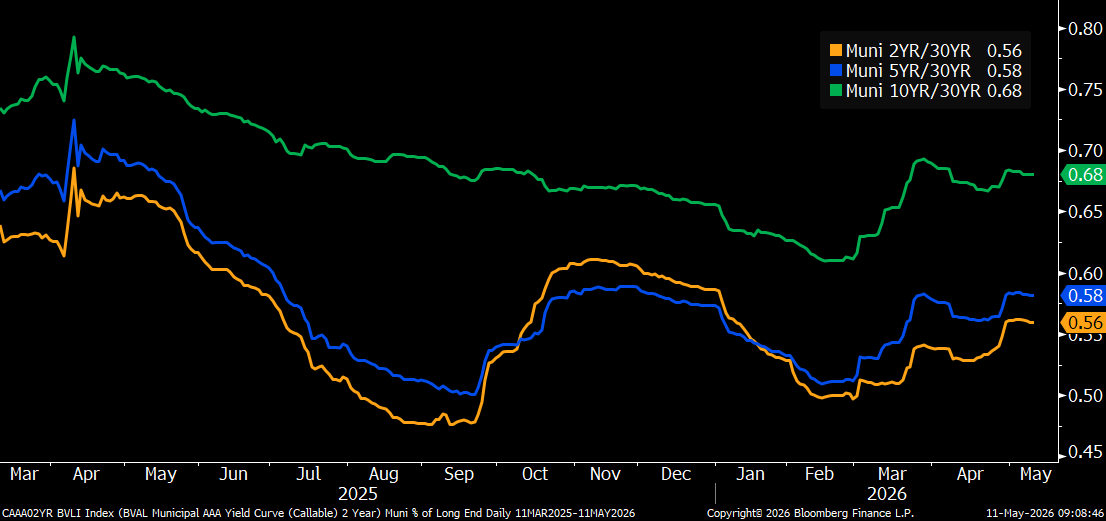
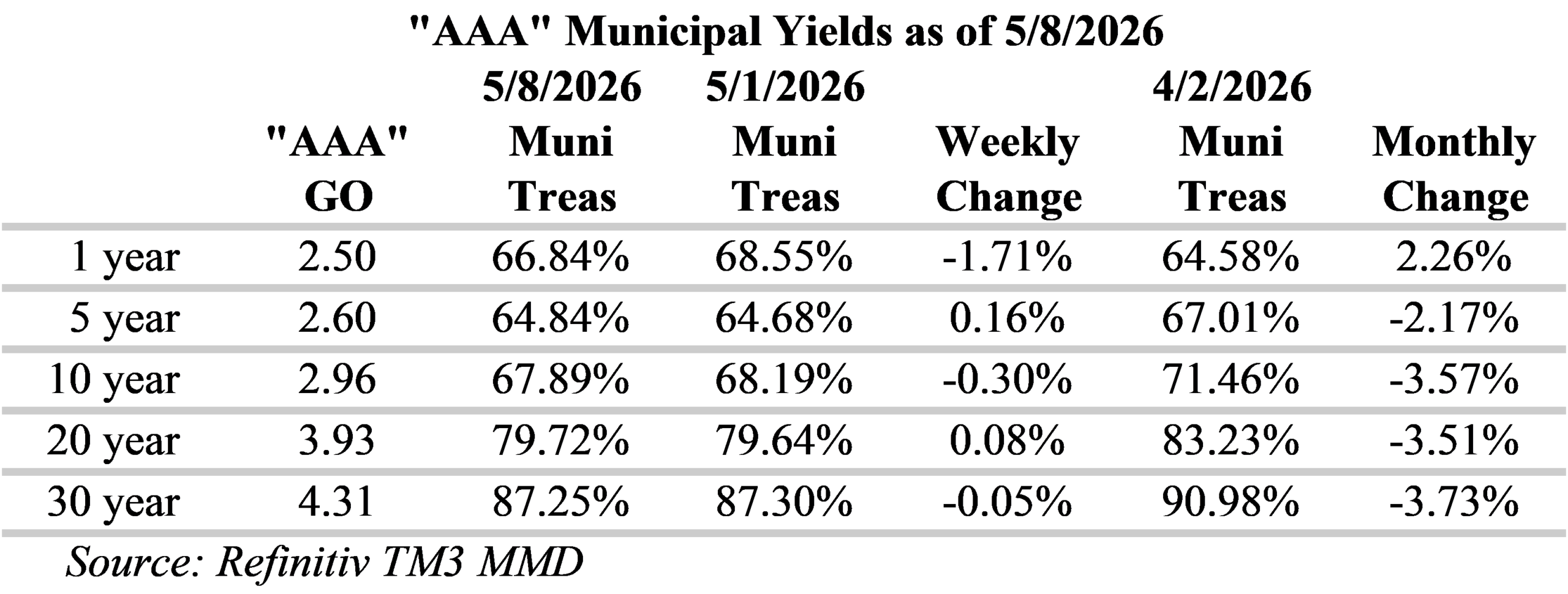
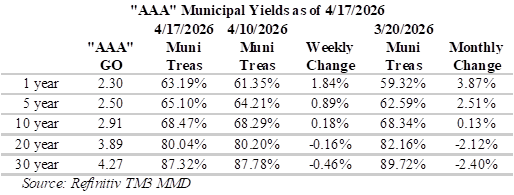
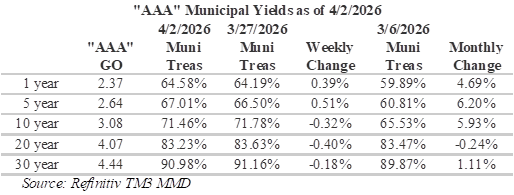
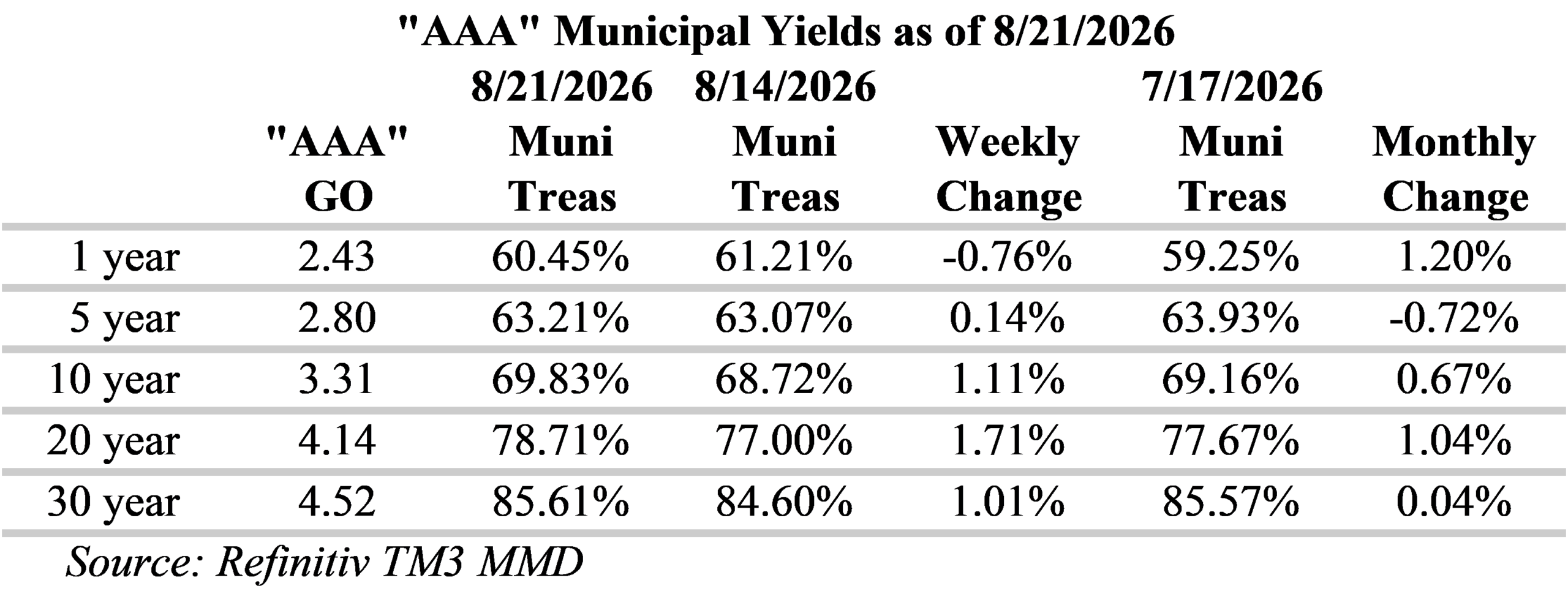
Elevated municipal tax-equivalent yields on the long-end continue to reward investors, although not by as much as they did last week.  Muni/Treasury ratios have generally dropped a bit over the past week, with the biggest moves around the 10-year maturity where ratios have declined 1.5% to 66.91%.  Ratios of this level are historically rich and primarily appeal to individuals investors in the top tax brackets.  Not surprisingly, over the past month, the biggest moves have been on the extreme short-end of the curve where the Fed exerts its greatest influence.  One-year ratios are now 1.27% richer as ratios have dropped to 68.70%.  For investors seeking to maximize curve positioning with relative value, extending to the 18-year part of the municipal yield curve provides 88% of the 30-year maturity and 77.5% of equivalent Treasury yields.


This week, the municipal bond market is expected to offer more than $10 billion in new issues following a $15 billion calendar last week.  Notable deals this week include: $2 billion Regents of the University of California Revenue Bonds, $1 billion Chicago O’Hare International Airport and New York Housing Development Corp. with $753 million.  Fund flows have generally been supportive over the past month.  LSEG Lipper Global Fund Flows reported that intermediate-maturity municipal bond funds saw inflows of $133 million last week while high-yield municipal bond funds experienced inflows of about $253 million and long-term muni funds saw inflows of about $320 million.

Herbert J. Sims & Co. Inc. is a SEC registered broker-dealer, a member of FINRA, SIPC. The information contained herein has been prepared based upon publicly available sources believed to be reliable; however, HJ Sims does not warrant its completeness or accuracy and no independent verification has been made as to its accuracy or completeness. The information contained has been prepared and is distributed solely for informational purposes and is not a solicitation or an offer to buy or sell any security or instrument or to participate in any trading or investment strategy, and is subject to change without notice. All investments include risks. Nothing in this message or report constitutes or should be construed to be accounting, tax, investment or legal advice.
Curve Commentary: December 1, 2025

Overview

Despite uncertainty regarding the reopening of the U.S. government, conflicting information from Fed policymakers and the wild swings in market sentiment regarding the prospects of another rate cut, yields on municipal bonds and Treasuries have changed relatively little over the past month.  Municipal yields for all tenors were generally within a basis point or less of their yields from the beginning of November and Treasuries were also relatively unchanged with a slight steepening as rates rallied modestly from 6-weeks to 5-years and sold off 7 to 10-basis points in tenors past 15-years.  The stability in the fixed income markets can partially be attributed to the lack of key economic data during the shutdown and the continuation of long-term trends with structural labor market concerns and continued stubbornly high inflation.

This morning the Fed funds futures market was pricing-in the probability of a third rate cut this year at over 100%, which is a dramatic shift from just a few weeks ago when the probability was in the high 20% range.  Although recent economic data has been largely supportive of a rate cut, should the Fed maintain current rates we will likely see some turbulence given implied rates.  Lately business activity has been slowing.  Today’s ISM Manufacturing Index contracted for the 9th straight month with activity shrinking by the most in four months.  However, the employment picture is still not clear.  The BLS will not be publishing the October employment report until after the Fed issues its decision, which is also when it will be releasing November data.

Insights and Strategy

Slopes along the municipal yield curve are currently steepest around the 16-year tenor, with over 100 bps in slope from 10 to 19-years.  This is a significant change from earlier last month, when the steepest slopes were around the 10-year tenor.  This shift has increased the reward to investors for extending from the 10-year range to the 15-20-year range.  In addition, investors benefit from a steep roll-down over time.  Although the municipal yield curve is currently rewarding duration, the long-end has become very flat with steadily declining slopes from 20 to 30-years and only a basis point or so per year past 25-years.  As a result of this flat tail, municipal bond investors can buy maturities under 20-years that yield over 90% of the 30-year curve.  

Elevated municipal tax-equivalent yields on the long-end continue to reward investors, with ratios generally cheapening over the past week.  The muni/Treasury ratio is a widely watched measure that provides a sense of how tax-exempt munis fare against taxable fixed-income options.  Crossover investors, which seek to identify the best opportunities in the fixed income universe on an after-tax basis, closely follow this ratio.  Over the past week, the biggest moves have been on the long-end of the curve, where ratios are approaching 90%.  Over the past month, the biggest moves have been around the 5-year maturity where ratios are approaching 3% richer.  For investors seeking to maximize curve positioning with relative value, extending to the 18-year part of the municipal yield curve provides almost 90% of the 30-year maturity and almost 80% of equivalent Treasury yields.

This week, the municipal bond market is expected to price more than $14.6 billion in new issues.  Notable deals this week include: State of Connecticut Special Tax Revenue Bonds with $1.56 billion, Long Island Lighting Company with $1.02 billion and City of San Antonio TX Electric & Gas Systems Revenue with $599.8 million.  Fund flows have also generally been supportive over the past month.  ICI data reported that exchange-traded funds saw inflows of $366 million during the holiday week Last week following a staggering $2.735 billion of inflows the week prior.

Herbert J. Sims & Co. Inc. is a SEC registered broker-dealer, a member of FINRA, SIPC. The information contained herein has been prepared based upon publicly available sources believed to be reliable; however, HJ Sims does not warrant its completeness or accuracy and no independent verification has been made as to its accuracy or completeness. The information contained has been prepared and is distributed solely for informational purposes and is not a solicitation or an offer to buy or sell any security or instrument or to participate in any trading or investment strategy, and is subject to change without notice. All investments include risks. Nothing in this message or report constitutes or should be construed to be accounting, tax, investment or legal advice.
Curve Commentary: November 24, 2025

Overview

Economic data releases resumed last Thursday with the U.S. Department of Labor’s (BLS) release of the long-delayed September employment report.  The BLS report did not deliver the clarity that markets are seeking regarding the central bank’s likely path.  Although nonfarm payroll employment came in stronger than expected with 119,000 jobs added in September, the report also showed the jobless rate edging-up to the highest level in nearly four years to 4.4%.  The increase in the jobless rate is not all that surprising, given the widely reported agency-by-agency filings showing the administration attempted to terminate a total of 3,605 employees during the shutdown.  Employment gains were driven by health care, food services and drinking places, and social assistance.  To add to the market’s uncertainty, the BLS will not be publishing the October employment report until after the Fed issues its decision on December 10 which is also when it will be releasing November data. 

Rate expectations have varied widely in recent weeks due to conflicting information from Fed policymakers and a lack of clear signals on jobs and inflation.  Last Wednesday, the Fed funds futures market was pricing-in the probability of a third rate cut this year in the high 20% range.  Following comments from New York Fed President John Williams on Friday indicating the possibility of lower interest rates in the near-term as the labor market softens, investors boosted the odds of a rate cut to around 70%.  As the Thanksgiving holiday approaches and traders look to the Federal Reserve for indications of policy easing, traders are fully pricing in a quarter-point cut at the January meeting and an additional cut by the June 2026 meeting. 

Insights and Strategy

Slopes along the municipal yield curve are currently steepest around the 16-year tenor, with almost 75 bps in slope from 13 to 19-years.  This is a significant change from earlier last month, when the steepest slopes were around the 10-year tenor.  This shift has increased the reward to investors for extending from the 10-year range to the 15-20-year range.  In addition, investors benefit from a steep roll-down over time.  Although the municipal yield curve is currently rewarding duration, the long-end has become very flat with steadily declining slopes from 20 to 30-years and only a basis point or so per year past 25-years.  As a result of this flat tail, municipal bond investors can buy maturities under 20-years that yield over 90% of the 30-year curve. 

Elevated municipal tax-equivalent yields on the long-end continue to reward investors, with ratios generally cheapening over the past week.  The muni/Treasury ratio is a widely watched measure that provides a sense of how tax-exempt munis fare against taxable fixed-income options.  Crossover investors, which seek to identify the best opportunities in the fixed income universe on an after-tax basis, closely follow this ratio.  Over the past week, the biggest moves have been in maturities around the 5 to 10-year mark where ratios have become almost 2% richer, with ratios now around 66.5% at 5-years.  Over the past month, the biggest moves have been around the 20-year maturity where ratios are now about 2% richer.  For investors seeking to maximize curve positioning with relative value, extending to the 18-year part of the municipal yield curve provides almost 90% of the 30-year maturity and almost 80% of equivalent Treasury yields. 

Last week, the municipal bond market experienced uncharacteristically weak technical conditions as high deal volume was met by the largest outflows since the week ending April 16.  Investors pulled $965.8 million from municipal bond mutual funds.  This week, state and local governments bond issuance is expected to drop to $1.48b, due to the holiday week, with new issues expected to slow over the month.  Notable deals this week include: Pennsylvania Housing Finance Agency selling $275 million and Keller Independent School District/Texas selling $99 million.  

Herbert J. Sims & Co. Inc. is a SEC registered broker-dealer, a member of FINRA, SIPC. The information contained herein has been prepared based upon publicly available sources believed to be reliable; however, HJ Sims does not warrant its completeness or accuracy and no independent verification has been made as to its accuracy or completeness. The information contained has been prepared and is distributed solely for informational purposes and is not a solicitation or an offer to buy or sell any security or instrument or to participate in any trading or investment strategy, and is subject to change without notice. All investments include risks. Nothing in this message or report constitutes or should be construed to be accounting, tax, investment or legal advice.
Curve Commentary: November 17, 2025

Overview

Following a record 43-day shutdown, the President signed legislation to reopen the government last Wednesday.  Although the government has reopened, there is a sizable backlog of government economic data that was not available during the shutdown. The bond market is currently bracing for a flood of data as traders anxiously pare December rate cut expectations.  As of this morning, the Fed funds futures market was only pricing-in a 41% chance of a 25 basis-point cut in December.  Current rate expectations have declined significantly from last week, when the implied probability was in the 60’s.  The tone has turned decidedly more hawkish as several FOMC members have recently cited heightened inflation concerns, which prompted a sell-off in Treasuries last Thursday.

Not surprisingly, this irresolute sentiment has resulted in Treasury yields that remain little changed from when the shut-down began on October 1.  However, the municipal market has demonstrated more conviction with steady demand and appealing relative yields weighing on the long-end while shifting dynamics on the short-end have led to municipals selling-off.  As a result, we have seen the municipal yield curve flatten, resulting in declining slopes and less incentive to extend duration.


Insights and Strategy

Slopes along the municipal yield curve are currently steepest around the 17-year tenor, with almost 75 bps in slope from 13 to 19-years.  This is a significant change from earlier last month, when the steepest slopes were around the 10-year tenor.  This shift has increased the reward to investors for extending from the 10-year range to the 15-20-year range.  Although the municipal yield curve rewards duration, the long-end continues to be very flat with steadily declining slopes from 20 to 30-years and only a basis point or so per year past 25-years.  However, as a result of this flat tail, municipal bond investors can buy maturities under 20-years that yield over 90% of the 30-year curve. 

Municipal credit spreads, which are the difference in yield between the ‘AAA’ yields and riskier bonds of equivalent maturities, continue to reward risk in lower investment grade securities while ‘AA’ and ‘A’ bonds have been trading fairly tightly this year.  In recent months we have seen lower investment grade credit spreads fluctuate as economic concerns have emerged prompting investors to demand more yield to compensate for the additional risk.  While current credit spreads are appealing for ‘BBB’ rated bonds, caution is still warranted as these spreads can widen significantly during economic events.


The muni/Treasury ratio is a widely watched measure that provides a sense of how tax-exempt munis fare against taxable fixed-income options.  Crossover investors, which seek to identify the best opportunities in the fixed income universe on an after-tax basis, closely follow this ratio.  Over the past month, the biggest moves have been in maturities around the 10-year mark where ratios have become over 4% richer, with ratios now around 66%.  From a historical perspective, the 10-year mean for the 10-year maturity is 82.59%, which shows how richly valued municipals have become in this art of the curve.  For investors seeking to maximize curve positioning with relative value, extending to the 18-year part of the municipal yield curve provides almost 90% of the 30-year maturity and almost 80% of equivalent Treasury yields.  

Herbert J. Sims & Co. Inc. is a SEC registered broker-dealer, a member of FINRA, SIPC. The information contained herein has been prepared based upon publicly available sources believed to be reliable; however, HJ Sims does not warrant its completeness or accuracy and no independent verification has been made as to its accuracy or completeness. The information contained has been prepared and is distributed solely for informational purposes and is not a solicitation or an offer to buy or sell any security or instrument or to participate in any trading or investment strategy, and is subject to change without notice. All investments include risks. Nothing in this message or report constitutes or should be construed to be accounting, tax, investment or legal advice.
Curve Commentary: November 10, 2025

Overview

Today marks the 41st day of the longest government shutdown in US history, and it appears a resolution is potentially close at hand.  On Sunday, eight Senate Democrats joined Republicans in a push to advance a short-term funding measure that would extend government funding through January.  However, the legislation still requires a final vote by the Senate and needs to pass the House before the shutdown can end.  Following this news, the Treasury market has slid with 10-year Treasuries rising as much as 5 basis points to near 4.15% amid optimism .  Some caution is also warranted since the re-opening may potentially trigger volatility as a surge of delayed data releases.  This absence of government data has made policymakers more cautious about cutting rates, which will likely fade as data is released upon re-opening.  The Fed funds futures market is currently pricing-in a 65% chance of a 25 basis-point cut in December.  This is down significantly from just a few weeks ago when the implied probability was closer to 95%.

While Treasuries have generally sold-off month-to-date, particularly on the longer-end of the curve where the market has sold-off as much as 6 basis points, municipal bonds have held firmly with yields staying within a basis point of November 1 yields.  Over the past week, mixed labor data has driven volatility in Treasuries with Munis being more resistant due to reinvestment demand and continued inflows from institutions.  However, the one- to six-year yield municipal yield curve remains inverted, which is an important consideration for investors managing bond portfolios.  However, this also creates opportunities for swaps, particularly for those investors with losses on the short-end that would like to extend duration.

Insights and Strategy

Although the municipal yield curve continues to reward duration, the long-end has become very flat with steadily declining slopes from 20 to 30-years and only a basis point or so per year past 25-years.  However, as a result of this flat tail, municipal bond investors can buy maturities under 20-years that yield over 90% of the 30-year curve.   Slopes along the municipal yield curve are currently steepest around the 17-year tenor, with almost 75 bps in slope from 13 to 19-years.  This is a significant change from earlier last month, when the steepest slopes were around the 10-year tenor.  This shift increases the reward to investors for extending from the 10-year range to the 15-20-year range.  Despite recent uncertainty regarding a December rate cut, this steepness is likely to persist amid government shutdown uncertainty and demand for longer durations.

The muni/Treasury ratio is a widely watched measure that provides a sense of how tax-exempt munis fare against taxable fixed-income options.  Crossover investors, which seek to identify the best opportunities in the fixed income universe on an after-tax basis, closely follow this ratio.  Over the past month, the biggest moves have been in maturities under 1-year and around the 10-year mark where ratios have become over 3% richer, with ratios now around 67%.  Although this part of the curve had become significantly more appealing from a relative value perspective, ratios are now less appealing.   From a historical perspective, the 10-year mean for the 10-year maturity is 82.69%.  On the other hand, the 1-year tenor has become over 3% more attractive with ratios now approximately 70%, but the 10-year mean for this part of the curve is 94.57%.  For investors seeking to maximize curve positioning with relative value, the 18-year part of the municipal yield curve currently provides almost 90% of the 30-year maturity and over 80% of equivalent Treasury yields.  

Herbert J. Sims & Co. Inc. is a SEC registered broker-dealer, a member of FINRA, SIPC. The information contained herein has been prepared based upon publicly available sources believed to be reliable; however, HJ Sims does not warrant its completeness or accuracy and no independent verification has been made as to its accuracy or completeness. The information contained has been prepared and is distributed solely for informational purposes and is not a solicitation or an offer to buy or sell any security or instrument or to participate in any trading or investment strategy, and is subject to change without notice. All investments include risks. Nothing in this message or report constitutes or should be construed to be accounting, tax, investment or legal advice.
Curve Commentary: November 3, 2025

Overview

Today marks the 34th day of the US government shutdown, and despite the lack of government economic data and the continuous flow of headlines, there has been little response by the Treasury market.  Yields on Treasuries are little changed over the past month with the biggest changes on tenors under 6 months and the rest of the curve virtually unchanged.  Munis in tenors past 6-years have rallied as much as 20-basis points over the past month with the Bloomberg Municipal Index reporting a 1.24% return, which is the best October performance since 1995.  This performance was despite $55 billion of tax-exempt issuance.  Municipal tenors shorter than 6-years sold-off as demand shifted from the front end of the yield curve to the long-end as investors locked-in yields in anticipation of Fed rate cuts.  

Insights and Strategy

Slopes along the municipal yield curve are currently steepest around the 17-year tenor, with almost 75 bps in slope from 13 to 19-years.  This is a significant change from earlier last month, when the steepest slopes were around the 10-year tenor.  This shift increases the reward to investors for extending from the 10-year range to the 15-20-year range.  Although the municipal yield curve continues to reward duration, the long-end continues to be very flat with steadily declining slopes from 20 to 30-years and only a basis point or so per year past 25-years.  However, as a result of this flat tail, municipal bond investors can buy maturities under 20-years that yield 93% of the 30-year curve.  Despite recent uncertainty regarding a December rate cut, this steepness is likely to persist amid government shutdown uncertainty and demand for longer durations

The muni/Treasury ratio is a widely watched measure that provides a sense of how tax-exempt munis fare against taxable fixed-income options.  Crossover investors, which seek to identify the best opportunities in the fixed income universe on an after-tax basis, closely follow this ratio.  Over the past month, the biggest moves have been around the 10-year maturity where ratios have become over 4% richer, with ratios now approaching 66%.  Although this part of the curve had become significantly more appealing from a relative value perspective, ratios are now less appealing.   From a historical perspective, the 10-year mean for the 10-year maturity is 82.69%.  On the other hand, the 1-year tenor has become over 3% more attractive with ratios now approaching 70% but the 10-year mean for this part of the curve is 94.57%.  For investors seeking to maximize curve positioning with relative value, the 18-year part of the municipal yield curve currently provides almost 90% of the 30-year maturity and almost 80% of equivalent Treasury yields.

Herbert J. Sims & Co. Inc. is a SEC registered broker-dealer, a member of FINRA, SIPC. The information contained herein has been prepared based upon publicly available sources believed to be reliable; however, HJ Sims does not warrant its completeness or accuracy and no independent verification has been made as to its accuracy or completeness. The information contained has been prepared and is distributed solely for informational purposes and is not a solicitation or an offer to buy or sell any security or instrument or to participate in any trading or investment strategy, and is subject to change without notice. All investments include risks. Nothing in this message or report constitutes or should be construed to be accounting, tax, investment or legal advice.
Curve Commentary: October 20, 2025

Overview

The shutdown, which is now the third longest government shutdown in U.S. history, continues to populate headlines.  In addition, markets are operating without the usual government sourced economic data from the Bureau of Labor Statistics and the Bureau of Economic Analysis.  Absent this data, the markets have been looking to private sources and anecdotal data from businesses for guidance.  However, data from these sources is less than optimal and is typically not as broad or representative of the economy as government data sets.  Due to the weakening job market and a lack of updated government data to demonstrate otherwise, the markets are operating under the assumption the Fed will make another quarter of a point cut at its meeting next week.  Last week, Fed chair Jerome Powell indicated that economic concerns of the Fed had not changed during the data blackout.  The Fed funds futures market is currently indicating an almost certain 94.6% chance of a 25bps rate cut at the Fed’s October 29 meeting and an additional 25bps cut in December.

Over the past week, Treasury and municipal markets have been largely unphased by the shutdown or the regional bank distress with yields experiencing minimal change on the long end of the yield curve.  Treasury yields rallied about 4.55 bps versus 5.5 bps for munis.  On the more policy sensitive short tenors under 2-years, yields differed with Treasuries selling-off a little over 5 bps and munis rallying around 3 bps.  Treasuries have lately been responding to haven buying, trade tensions and anxiety related to regional bank credit exposure.


Insights and Strategy

Slopes along the municipal yield curve are currently steepest around the 17-year tenor, with over 61 bps in slope from 13 to 18-years.  This is a significant change from earlier this month, when the steepest slopes were around the 10-year tenor.  This shift increases the reward to investors for extending from the 10-year range to the 15-20-year range.  Although the municipal yield curve continues to reward duration, the long-end has become very flat with steadily declining slopes from 20 to 30-years and only a basis point or so per year past 25-years.  However, as a result of this flat tail, municipal bond investors can buy maturities under 20-years that yield over 92% of the 30-year curve.

The muni/Treasury ratio is a widely watched measure that provides a sense of how tax-exempt munis fare against taxable fixed-income options.  Crossover investors, which seek to identify the best opportunities in the fixed income universe on an after-tax basis, closely follow this ratio.  Over the past month, the biggest moves have been around the 10-year maturity where ratios have cheapened close to 10% with ratios now approaching 70%.  Although this part of the curve has become significantly more appealing from a relative value perspective, ratios are still rich from a historical perspective with a 10-year mean for this part of the curve at 94.59%.  For investors seeking to maximize curve positioning with relative value, the 18-year part of the municipal yield curve currently provides almost 90% of the 30-year maturity and over 80% of equivalent Treasury yields. 

Month-to-date, lower-coupon 4s have outperformed in October, benefiting from their longer duration and greater sensitivity to the rally in rates.  Against the backdrop of falling yields, lower coupon bonds have recently experienced stronger price appreciation versus higher coupon bonds, which are less responsive in a declining rate environment.  However, this week we are anticipating a full municipal calendar with over $15 billion in new issues.  Overall, with the potential for Treasury volatility amid the government shutdown and heavy supply from the municipal calendar, continued outperformance from lower coupon bonds may prove challenging this week.

Herbert J. Sims & Co. Inc. is a SEC registered broker-dealer, a member of FINRA, SIPC. The information contained herein has been prepared based upon publicly available sources believed to be reliable; however, HJ Sims does not warrant its completeness or accuracy and no independent verification has been made as to its accuracy or completeness. The information contained has been prepared and is distributed solely for informational purposes and is not a solicitation or an offer to buy or sell any security or instrument or to participate in any trading or investment strategy, and is subject to change without notice. All investments include risks. Nothing in this message or report constitutes or should be construed to be accounting, tax, investment or legal advice.
Curve Commentary: October 6, 2025

Overview

Although the U.S. government shutdown last week, Treasury and municipal markets were largely undaunted with yields experiencing only minimal change.  However, the shutdown has resulted in the Bureau of Labor Statistics postponing its Employment Situation report, which is ordinarily delivered on the first Friday of the month, to report on employment levels and unemployment.  Despite the lack of data, Treasury yields only moved down by about 4 bps on the short-end and up by about 5 basis points on the long-end with the 5-year tenor essentially unchanged.  Muni yields moved in almost the opposite direction, with short yields climbing 2 basis points and long yields falling about 3.5 basis points and, like Treasuries, 5-year yields were essentially unchanged.  Furthermore, the Fed funds futures market is currently indicating an almost certain 94.6% chance of a 25bps rate cut at the Fed’s October 29 meeting.

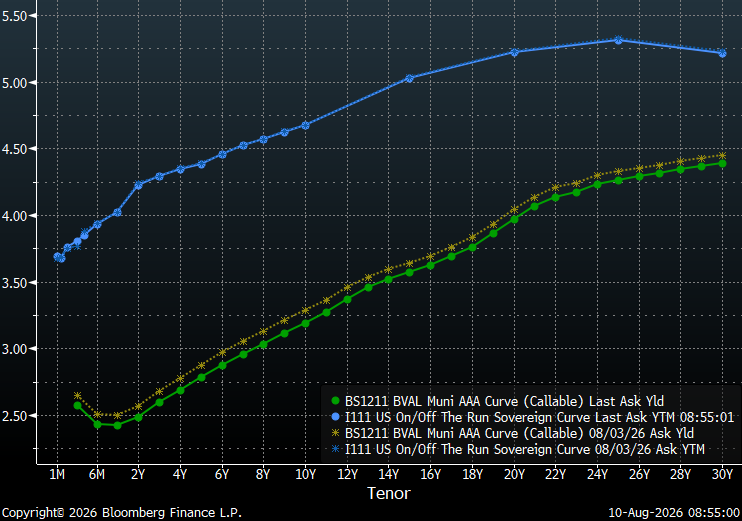
Overall, the Treasury curve is about 9 bps steeper over this past week and the muni curve is about 5.5 bps flatter.  Slopes along the municipal yield curve are steepest around the 10-year tenor, with over 50 bps in slope from 8 to 12-years.  Although the municipal yield curve continues to reward duration, the long-end has become very flat with steadily declining slopes from 15 to 30-years and only a basis point per year past 25-years.  As a result of the flat tail, municipal bond investors can buy maturities under 20-years that yield over 90% of the 30-year curve.  

Insights and Strategy

Muni/Treasury ratios, which provide a sense of how tax-exempt munis fare against taxable fixed-income options, have generally cheapened over the past week.  Crossover investors, which seek to identify the best opportunities in the fixed income universe on an after-tax basis, closely follow this ratio.  While shorter ratios have cheapened the most, they remain only narrowly appealing even to individual investors in the top tax brackets.  The 10-year historical mean for the 5-year tenor is 74.71% versus 62.7% today.  Ratios on the longer end of the curve continue to reward investors for extending duration with 30-year ratios approaching 90%.  Although ratios in this part of the curve are meaningfully richer than they were a month ago, they continue to provide compelling value.  For investors seeking to maximize curve positioning with relative value, the 12 to 18-year part of the municipal yield curve provides as much as 90% of the 30-year maturity and over 80% of equivalent Treasury yields.

This week, municipal issuers are expected to sell more $12.9 billion in new issues with year-to-date issuance levels eclipsing $436 billion, which is 13.5% more than had been issued last year at this time.  Transportation issues dominate the calendar this week with the Texas Transportation Corp. selling $1.8 billion, the State of Maryland Department of Transportation selling $842.7 million and the North Texas Tollway offering 627.2 million.  This supply will likely be met with strong demand with $11.8 billion in municipal bonds expected to mature in the next 30-days, $5 billion in calls announced over the next 30-days and LSEG Lipper Global Fund Flows reporting weekly inflows of $1.1 billion last week.

Herbert J. Sims & Co. Inc. is a SEC registered broker-dealer, a member of FINRA, SIPC. The information contained herein has been prepared based upon publicly available sources believed to be reliable; however, HJ Sims does not warrant its completeness or accuracy and no independent verification has been made as to its accuracy or completeness. The information contained has been prepared and is distributed solely for informational purposes and is not a solicitation or an offer to buy or sell any security or instrument or to participate in any trading or investment strategy, and is subject to change without notice. All investments include risks. Nothing in this message or report constitutes or should be construed to be accounting, tax, investment or legal advice.

Curve Commentary: September 29, 2025

Overview

With government funding set to expire Tuesday, the shadow of a potential government shutdown continues to loom over the bond market bringing yields down across the Treasury curve.  In addition, the shutdown threatens to delay the release of key economic data, including Friday’s nonfarm payroll employment data and unemployment rate from the Bureau of Labor Statistics.  This data is critical to current rate forecasts as weakening employment data was an influential factor in the Fed’s decision to cut rates earlier this month.  The Fed has recently commented that labor demand, and the recent pace of job creation, appear to be running below the “breakeven” rate needed to maintain current unemployment levels.  The Fed funds futures market is currently indicating an 88.7% chance of a 25bps rate cut at its October 29 meeting.

Last week, Treasuries were largely unchanged with the threat of a government shutdown drawing a haven bid while the front-end of the muni curve experienced the majority of the movement.  Muni yields in this part of the curve have become quite rich with muni/Treasury ratios in the 50’s for one to five years.  At these levels, yields are only narrowly appealing even to individual investors in the top tax brackets.  Following last week’s moves, ratios popped-up to the low to mid-60’s on the front-end of the muni curve with significant pressure from institutional investors positioning portfolios ahead of the quarter-end.  

Insights and Strategy

Although the muni curve remains steeper than the Treasury curve, last week’s sell-off resulted in considerable flattening for munis maturing within 10-years.  Over the past 2-months we have experienced significant compression of spread relationships in this portion of the curve.  However, it is notable that the steepest portion of the municipal yield curve is currently the 9 to 11-year stretch with a slope of 46 bps.  Although the municipal yield curve remains positively sloped, investors should exercise caution to manage duration risk by buying bonds where the yield curve has sufficient slope to reward risk.

Nevertheless, long munis continue to provide compelling relative value with 20-year munis yielding almost 85% of Treasuries and 30-year munis yielding almost 90% of Treasuries.  Even the 12-year tenor, which is less than half of the 30-year curve, is yielding 75% of the 30-year maturity, making this an appealing place to position new purchases.  Past 20-years, the slope tapers significantly to just a basis point or two per year.  For investors with longer mandates, I would consider buying shorter in the 12 to 17-year range and wait to see if the long-end steepens before extending.  

Herbert J. Sims & Co. Inc. is a SEC registered broker-dealer, a member of FINRA, SIPC. The information contained herein has been prepared based upon publicly available sources believed to be reliable; however, HJ Sims does not warrant its completeness or accuracy and no independent verification has been made as to its accuracy or completeness. The information contained has been prepared and is distributed solely for informational purposes and is not a solicitation or an offer to buy or sell any security or instrument or to participate in any trading or investment strategy, and is subject to change without notice. All investments include risks. Nothing in this message or report constitutes or should be construed to be accounting, tax, investment or legal advice.
Curve Commentary: September 15, 2025

Overview

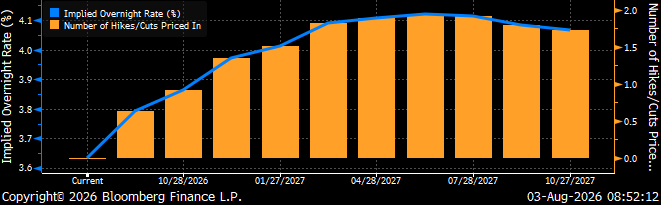
Attentions are focused on the Fed this week with their rate decision scheduled to be announced on Wednesday.  Traders are positioning ahead of Wednesday’s meeting with Fed funds futures continuing to demonstrate conviction of a 25 bps cut.  However, inflation has been creeping higher in recent months and is keeping the Fed cautious.  Last week, the Consumer Price Index for All Urban Consumers increased 0.4% on a seasonally adjusted basis for August after rising 0.2% in July.  The all-items index rose 2.9 percent for the 12-month period ending August, which is significantly above the Fed’s 2% inflation target.  However, many traders are arguing that weaker jobs data outweighs concerns of higher prices.  Last week the Bureau of Labor Statistics reported the U.S. labor market added 911,000 fewer jobs than previously reported, which many in the bond market are interpreting as additional justification for the Fed to cut rates later this week.

Not surprisingly, both the Treasury market and the muni market rallied last week as investors rush to maximize yields ahead of the anticipated Fed rate cut.  Treasury yields are now about 4.5 basis points lower on the long-end while munis experienced more meaningful moves with long munis now about 15.5 basis points lower than at the start of last week.  These moves have resulted in muni/Treasury ratios grinding lower with the largest adjustments around the 10-year tenor and a weekly change of over 4% in this range.  Nevertheless, long munis continue to provide compelling relative value with 20-year munis yielding almost 87% of Treasuries and 30-year munis yielding over 90% of Treasuries.  

Insights and Strategy

From a strategy perspective, caution is warranted where risk is not rewarded.  Investors should exercise caution when extending duration to avoid those parts of the yield curve where extension is not rewarded with additional yield.  Tenors past 20-years, particularly in the high-yield sectors, should be approached with caution around the inflection points where yield tapers-off, particularly around the 20-Year mark.  Currently, the steepest slopes along the muni curve are from 5 to 7-years and from 8 to 12 years, where investors can expect to pick-up approximately 17 basis points for each year they extend.  Munis in the 20-year tenor are yielding 95% of the 30-year curve, making this a very appealing place to position new purchases.  Even the 12-year tenor, less than half of the 30-year curve, is yielding 75% of the 30-year maturity.  Past 20-years, the slope tapers significantly to just a basis point or two per year.  For investors with longer mandates, I would consider buying shorter in the 15 to 20-year range and wait until the long-end steepens to extend.  

Travelling down the credit ladder, lower rated munis experienced even larger moves with 10-12 year and 25-30-year ‘BBB’ rated hospital bonds rallying 25 bps.  These moves have lead to credit spreads compressing and the yield curve flattening on the long-end as investors squeeze out the remaining marginal yield with ‘AAA’ munis yielding an almost ruler flat 80% of ‘BBB’ hospitals past 20-years.  This part of the market has historically been very sensitive to liquidity and changing sentiment.  However, performance in the high yield space has been inconsistent with ‘BB/B’ –‘BBB’ spreads widening while ‘non-rated’-‘BB/B’ credit spreads compressed.

Herbert J. Sims & Co. Inc. is a SEC registered broker-dealer, a member of FINRA, SIPC. The information contained herein has been prepared based upon publicly available sources believed to be reliable; however, HJ Sims does not warrant its completeness or accuracy and no independent verification has been made as to its accuracy or completeness. The information contained has been prepared and is distributed solely for informational purposes and is not a solicitation or an offer to buy or sell any security or instrument or to participate in any trading or investment strategy, and is subject to change without notice. All investments include risks. Nothing in this message or report constitutes or should be construed to be accounting, tax, investment or legal advice.
Curve Commentary: September 9, 2025

Overview

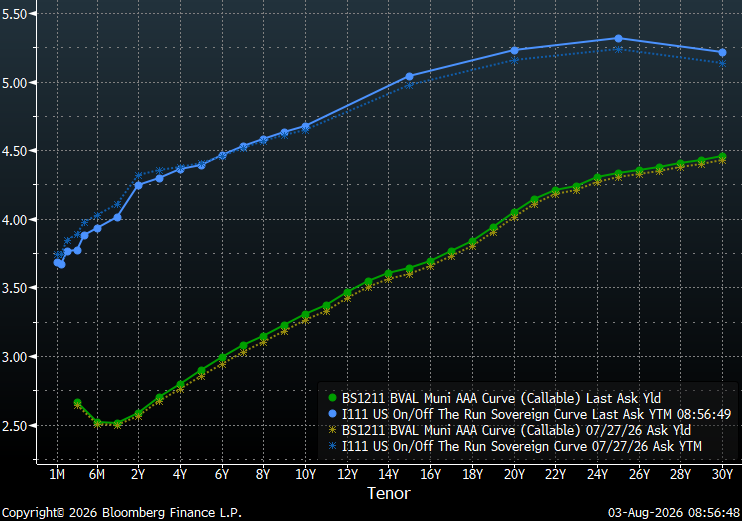
Over the past week, both municipal bonds and Treasuries have experienced a meaningful rally which shifted rates lower as sentiment intensifies in anticipation of a Fed rate cut.  Momentum picked-up as the week progressed, with 10-year Treasury yields charging through key support levels on Thursday and Friday.  Ultimately, the largest moves happened on Friday following the release of nonfarm payrolls by the Bureau of Labor Statistics which contributed to bumps in the municipal yield curve ranging from 2 bps in 2026 to 12 bps in 2055.  Prior to the data release, economists surveyed by Dow Jones were anticipating payrolls would rise by 75,000 jobs in August versus the actual survey report of only 22,000 jobs.  In addition to a disappointment versus the survey, this is a significant slowdown from July’s 79,000 job increase.  While the labor market is showing meaningful signs of cooling, unemployment remains at a historically healthy 4.3% and total non-farm payroll continues to set new monthly records.  This morning, the Fed funds futures market is pricing-in a 112% chance of a 25 bps cut at next week’s meeting.

Although the Fed only sets the overnight lending rate, we are seeing the majority of the movement at the long-end of the curve as investors lock-in long rates.  The biggest weekly moves in Treasuries over the past week were in maturities past 15-years, where the market rallied from 20 to 22 bps.  Munis largely echoed Treasuries with yields dropping a fairly steady 15 bps past 15-years with more muted moves on the short-end.  

Insights and Strategy

Following last week’s moves, muni/Treasury ratios are generally slightly less compelling.  Although ratios have improved significantly in the 1-year tenor at 60%, this remains rich to the 10-year mean of 94.78%.  Progressing out the yield curve produces increasingly appealing ratios with 30-year ratios at 92.68% versus a 10-year mean of 93.92%.  From a strategy perspective, this remains a good time to extend portfolio durations and take advantage of the additional yield offered by longer maturities.  However, caution is warranted as the slope tapers-off significantly after 20-years to just a basis point or two per year.  For investors with longer mandates, I would consider buying shorter in the 15 to 20-year range and wait until the long-end steepens to extend.  Investors around the 20-year tenor are collecting almost 90% of equivalent Treasury yields and 95% of the 30-year curve, making this a very appealing place to position new purchases.

Municipal issuance is expected to be approximately $9.5 billion this week.  The Atlanta Department of Aviation plans to sell a $1.03 billion issue and Black Belt Energy Gas District has a $925 million issue on the calendar.  With $20 billion in scheduled maturities and redemptions over the next 30-days and $672 million of municipal-bond fund inflows last week, this week’s new issues will likely continue to face a strong inquiry.  Recent inflows have favored long and high-yield strategies.

Herbert J. Sims & Co. Inc. is a SEC registered broker-dealer, a member of FINRA, SIPC. The information contained herein has been prepared based upon publicly available sources believed to be reliable; however, HJ Sims does not warrant its completeness or accuracy and no independent verification has been made as to its accuracy or completeness. The information contained has been prepared and is distributed solely for informational purposes and is not a solicitation or an offer to buy or sell any security or instrument or to participate in any trading or investment strategy, and is subject to change without notice. All investments include risks. Nothing in this message or report constitutes or should be construed to be accounting, tax, investment or legal advice.

Curve Commentary: August 25, 2025

Overview

Jerome Powell delivered his highly anticipated keynote address at the Jackson Hole Economic Policy Symposium last Friday.  Prior to the meeting, the bond market’s forecast of a 25 basis point cut at the Fed’s September 16-17 meeting had been diminishing, with Fed Funds Futures indicating the likelihood in the mid-70’s.  Although Powell’s comments were largely cautious, the markets have interpreted his comments as a dovish shift with the probability of a rate cut now pricing in the low 80’s.  Important takeaways from the speech include the conflicting position the Fed faces, amid mounting political pressures, with inflation pegged stubbornly above its 2% target and a languishing labor market.  Perhaps more importantly, and generally ignored by the media, Powell outlined a new framework to guide future Fed decisions.  The Fed’s revised framework is designed to evolve with changes in the structure of the economy and how the Fed interprets those changes.  To accomplish this objective, the language in the existing framework was revised to shift focus away from the effective lower bound and remove some of the communications challenges the Fed has faced in the past with regard to the labor market.

Although the anticipation leading up to the Jackson Hole speech was significant, Powell’s comments did not surprise the market and yields were largely unchanged.  Over the past week, the muni yield curve has steepened a bit further with a rally on the short-end and the Treasury curve has rallied a bit in continued anticipation of a rate cut next month.  However, yield adjustments on both curves were fairly modest, with the biggest moves between 15 and 20 years on the muni curve as the market sold-off around 6 bps in this range.

Insights and Strategy

The steepening of the municipal yield curve has become particularly pronounced in the 5 to 10-year range with around 100bps of slope.  This is a notable change from the beginning of the year when the muni curve had 24 bps of slope in this range.  By comparison, the Treasury curve only has around 55 bps of slope in this range with munis having almost double the slope.  From a strategy perspective, this is a good time to extend portfolio durations and take advantage of the additional yield offered by longer maturities.  However, caution is warranted as the slope tapers-off significantly after 20-years to just a basis point or two per year.  For investors with longer mandates, I would consider buying shorter in the 15 to 20-year range and wait until the long-end steepens to extend.  Investors around the 20-year tenor are collecting roughly 95% of the 30-year curve, making this a very appealing place to position new purchases.

Although the markets have priced-in a September rate cut, the Fed remains concerned about tariff fueled inflation and sees its current policy stance as an appropriate guard against inflation.  The yield differentials between municipals and Treasuries have cheapened a bit over this past week with Treasuries outperforming munis.   One-year ratios were the exception, with muni yields a bit richer in anticipation of a Fed rate cut in September.  Currently, levels are now solidly in the mid-50’s, which is a level that only narrowly appeals to individual investors in the top tax brackets.  Ratios on the long-end remain relatively cheap with 20-year ratios over 90%.

This week is anticipated to be relatively light in terms of municipal issuance with around $7.4 billion in new issues on the calendar.  The State of Illinois plans to sell a $1.78 billion general obligation bond and Bay Area Rapid Transit has a $929.8 million issue on the calendar.  With $22.4 billion in scheduled maturities and redemptions over the next 30-days and $2.5 billion of municipal-bond fund inflows last week, this week’s new issues will likely face a strong inquiry.  Recent inflows have favored long and high-yield strategies.

Herbert J. Sims & Co. Inc. is a SEC registered broker-dealer, a member of FINRA, SIPC. The information contained herein has been prepared based upon publicly available sources believed to be reliable; however, HJ Sims does not warrant its completeness or accuracy and no independent verification has been made as to its accuracy or completeness. The information contained has been prepared and is distributed solely for informational purposes and is not a solicitation or an offer to buy or sell any security or instrument or to participate in any trading or investment strategy, and is subject to change without notice. All investments include risks. Nothing in this message or report constitutes or should be construed to be accounting, tax, investment or legal advice.
Curve Commentary: August 18, 2025

Overview

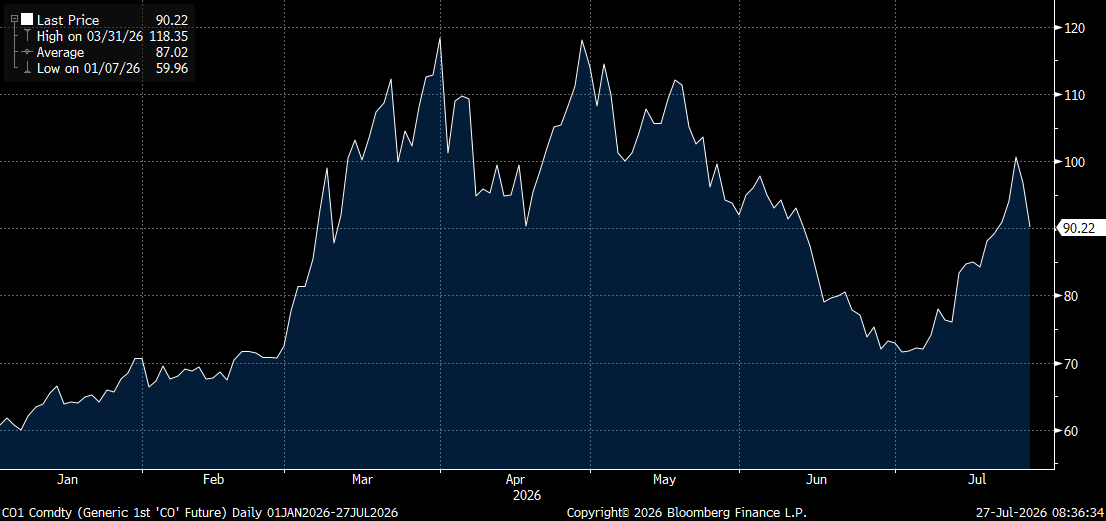
Inflation comes into a closer focus today in the Treasury market with Fed Funds Futures now reflecting an 84% chance of the Fed cutting rates next month.  This is down significantly from last week when the probability was over 100%.  Last week, the credit markets continued to focus on the August 1st Bureau of Labor Statistics nonfarm payrolls report, which included a cumulative downward adjustment of 258,000 jobs and convinced capital markets that a September rate cut was certain.  However, the release of last week’s Producer Price Index, which jumped 0.9% on the month, compared with the Dow Jones estimate for a 0.2% gain, has markets casting doubt.  Although the jobs data was striking, last week’s PPI is the biggest monthly increase we have seen since June 2022 and has the markets re-calibrating expectations.

Insights and Strategy

The municipal yield curve steepened a little over the past week with long maturities trending higher and maturities within 5-years rallying a bit.  Treasuries also steepened over this past week, with the market selling-off as much as 8.5bpps on the long-end.  On the trade desk, we continue to see aggressive bidding on the short-end with buyers continuing to anticipate a September Fed rate cut.  Investors seeking optimal placement in the intermediate portion of the yield curve will be lured out to the 10-12-year tenor with relatively steep slopes and appealing yields versus the long-end of the curve.  Currently the municipal curve has 52bps of slope from 2033 to 2036 with the 2036-year maturity yielding 74% of the 30-year curve.  Extending an additional 7-years to the 20-year maturity brings yields to 95% of the 30-year curve.  However, going much past this point marginal yields diminish to just 1- basis point per year for the last several years.

Although long-term ratios remain appealing, the yield differentials between municipals and Treasuries have once again richened over the past week.  Despite the PPI recent print, muni/ Treasury ratios at the short-end of the curve continue to compress in anticipation of a September rate cut.  Currently, levels are now well into to 50’s, which is a level that narrowly appeals to individual investors in the top tax brackets.  While the markets have priced-in a September rate cut, the Fed remains concerned about tariff fueled inflation and sees its current policy stance as an appropriate guard against inflation.  Ratios on the long-end remain relatively cheap with 20-year ratios approximately 90%. 

Credit spreads have been widening in the lower investment grade and non-rated sectors.  Although economic concerns are weighing on the lower end of the credit spectrum, recent issuance has included several notably large non-rated and low-rated deals satisfying inquiries.  Last week Florida’s Brightline private railroad rolled-over $985 million of junior debt at a yield of 14.89%.  Low ridership and lagging revenue projections lead to S&P dropping its rating for some of the bonds issued on behalf of Brightline two steps to ‘BB-‘ from ‘BB+’ and Fitch lowering the senior debt to ‘B’ from ‘BB+’ at the end of last month.  Recent ‘Baa’ credit spreads have widened to over 200 basis points, a 50 bps increase from the beginning of the year, and the Bloomberg High Yield municipal bond index is over 270 basis points wider than ‘AAA’ equivalents, a 40bps increase from early April following Liberation Day.

Herbert J. Sims & Co. Inc. is a SEC registered broker-dealer, a member of FINRA, SIPC. The information contained herein has been prepared based upon publicly available sources believed to be reliable; however, HJ Sims does not warrant its completeness or accuracy and no independent verification has been made as to its accuracy or completeness. The information contained has been prepared and is distributed solely for informational purposes and is not a solicitation or an offer to buy or sell any security or instrument or to participate in any trading or investment strategy, and is subject to change without notice. All investments include risks. Nothing in this message or report constitutes or should be construed to be accounting, tax, investment or legal advice.
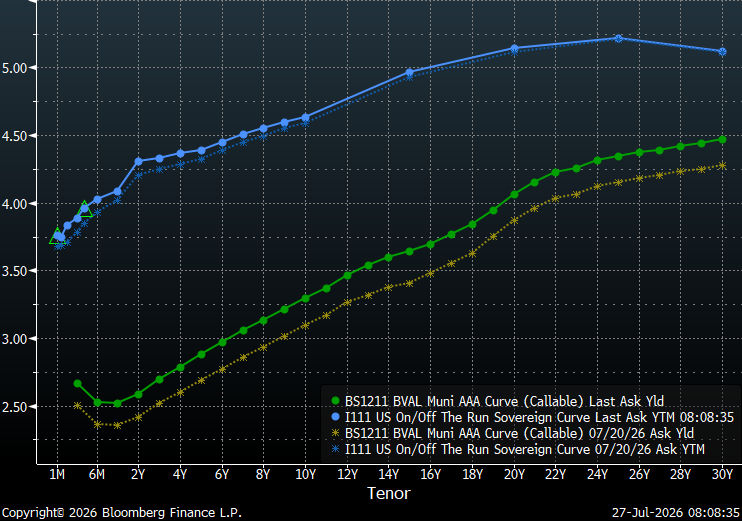
Curve Commentary: August 11, 2025

Overview

The municipal yield curve steepened over the past week with a rally in the muni market driving yields down across the curve amid aggressive bidding on the short-end in anticipation of a September Fed rate cut.  Inquiries on the trade desk continue to be concentrated within 10-years and maturities under 5-years are pricing at notably tight levels.  Treasuries, in contrast, flattened over the past week with the market selling-off from 6-months to 30-years with yields rising with greater consequence on the short-end than the long-end.  The August 1st Bureau of Labor Statistics nonfarm payrolls report continues to weigh on the markets with traders focusing on softer payrolls data as justification for the Fed to cut rates at its next meeting.  In addition, the nomination of Council of Economic Advisers Chairman Stephen Miran to serve out the final few months of Adriana Kugler’s seat following her surprise resignation last week has been viewed by the markets as a potentially dovish development.

Today, the municipal yield curve continues to price to richer levels with bumps on the short-end as the long-end remains relatively cheap.  Curve slopes in the more intermediate range continue to steepen with muni 2s10s continuing to steepen as the flattening treasury curve and steepening muni curve diverge.  Recent movements highlight the uncorrelated nature of the two asset classes as a benefit of adding munis to fixed income portfolios.  Investors seeking optimal placement in the intermediate portion of the yield curve will be lured out to the 11-13-year tenor with relatively appealing yields and steep slopes versus longer maturities.  Currently the municipal curve has 80bps of slope from 8-13 years with the 13-year maturity yielding 80% of the 30-year curve.  Extending an additional 7-years to the 20-year maturity brings yields to 95% of the 30-year curve.  However, past this point marginal yields diminish to just 1- basis point per year for the last several years.

Insights and Strategy

Although long-term ratios remain appealing, the yield differentials between municipals and Treasuries have richened over the past week.  Muni/Treasury ratios at the short-end of the curve continue to compress in anticipation of a September rate cut.  Currently, percentages are now well into to 50’s, which is a level that mainly appeals to individual investors in the top tax brackets.  Although the markets have priced-in a September rate cut, the Fed has not been shy about concerns regarding tariff fueled inflation and sees its current policy stance as an appropriate guard against inflation.  However, ratios on the long-end remain relatively cheap with 20-year ratios in the 90’s.  Although risks and rewards need to carefully evaluated, the municipal yield curve is currently rewarding extension.

Last week, long-term municipal issue volumes hit $21.7 billion, which is the biggest weekly total since 2017, while steady inflows and a supportive interest-rate backdrop drove a modest rally.  LSEG Lipper Global Fund Flows reported that over $2.6 billion have been added to municipal bond mutual funds over the last 2-weeks.  This week municipal bond issuance is expected to be less than half of last week at $10.4 billion with $1.14 billion expected to be sold by the Port Authority of New York & New Jersey and $750 million from Long Island Power Authority.  In addition, this week’s CPI data is facing heightened scrutiny by market participants following the removal of the US Bureau of Labor Statistics Commissioner earlier this month.  This week’s CPI could prove pivotal amid anticipation that CPI shows inflation moving further away from the Fed’s 2% target.

Herbert J. Sims & Co. Inc. is a SEC registered broker-dealer, a member of FINRA, SIPC. The information contained herein has been prepared based upon publicly available sources believed to be reliable; however, HJ Sims does not warrant its completeness or accuracy and no independent verification has been made as to its accuracy or completeness. The information contained has been prepared and is distributed solely for informational purposes and is not a solicitation or an offer to buy or sell any security or instrument or to participate in any trading or investment strategy, and is subject to change without notice. All investments include risks. Nothing in this message or report constitutes or should be construed to be accounting, tax, investment or legal advice.
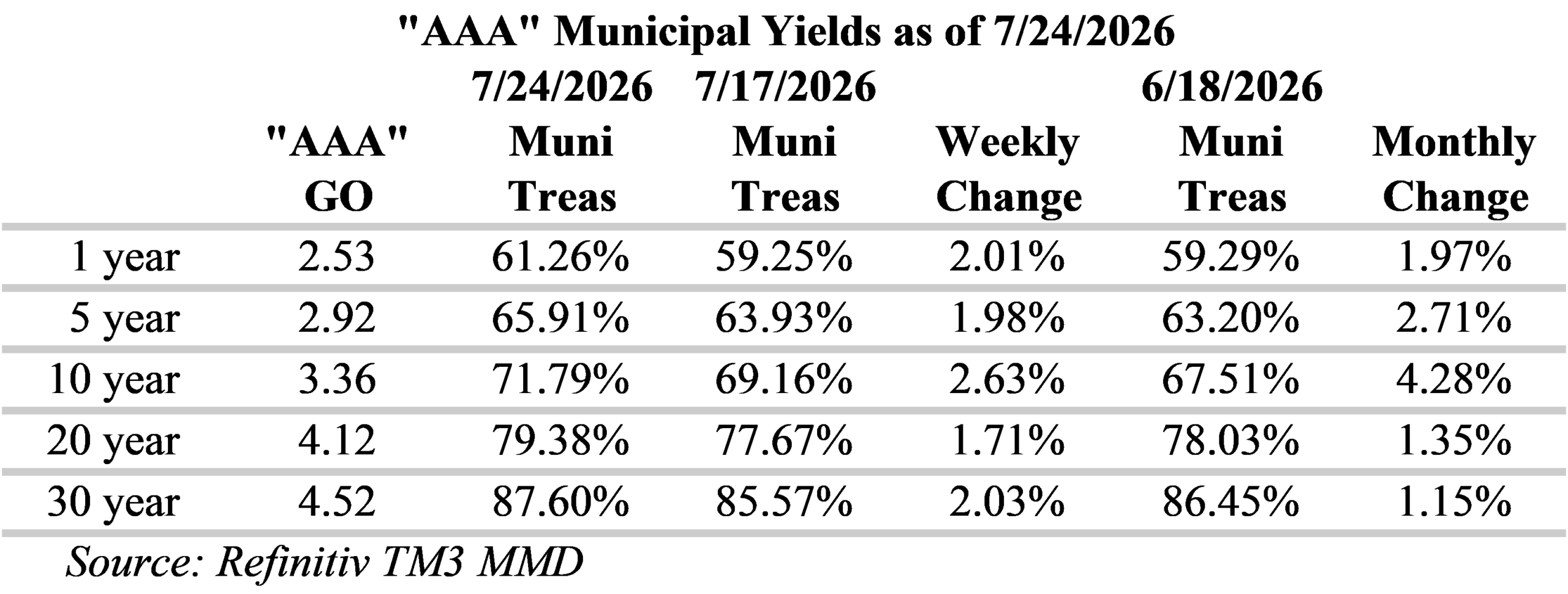
Curve Commentary: August 4, 2025

Overview

With the August 1 tariff deadline, a full economic calendar and an FOMC meeting, last week was bound to be a dynamic week.  However, it was Friday’s nonfarm payroll report that proved most impactful.  Total nonfarm payrolls disappointed with little change reported in July with an additional 73,000 jobs, well below Dow Jones’ expectation of 100,000.  Furthermore, the unemployment rate ticked up to 4.2% alongside another decrease in the labor force participation rate.  However, the revisions to May and June were more impactful, with totals revised sharply lower, by a combined 258,000 jobs from previously announced levels.  Markets subsequently repriced the policy outlook for the Fed’s next rate cut with the futures market pricing in the probability of a September rate hike over 90%.  The news was promptly absorbed by the municipal yield curve without prejudice of maturity, with a 7 bps bump per year from 2026 to 2055, resulting in a parallel drop lower in yields.  The Treasury market also responded with yields dropping, largely in the policy sensitive 2-year note, which fell as much as 28 bps.

Throughout the month of July, both the Treasury and municipal yield curves experienced meaningful steepening.  Munis steepened more than Treasuries, largely due to yields falling on the short-end of the curve rather than yields climbing on the long-end.  For the Treasury curve, the steepening was less pronounced as 30-year yields climbed only 2.5 bps and yields around the 1-year mark dropped a significant 16bps.  Currently, the municipal curve is at its steepest around the 10-year tenor with 51 bps of slope from 8 to 11-years.  In addition, after this past week, the curve has steepened notably around the 5-year tenor with 33 basis points of slope from 4 to 7-years.  Overall, the steepness of both curves provides significant incentive for duration extension.

Insights and Strategy

Over the past week, muni/Treasury ratios have generally cheapened, particularly around the 10-year tenor.  Over the past month, ratios in the longer intermediate and on the long-end have cheapened with short to short intermediate ratios a bit richer.  Over the past month, the biggest changes have occurred around the 20-year tenor, which has gone from being in the high 80’s to the low 90’s.  Over the past week, the biggest changes have been around the 10-year tenor as ratios approach 80%.  Overall, the 10-year and 20-year portions of the curve are strategically appealing with a combination of compelling ratios and yield curve slopes that reward extension.  However, past this point the yield curve discourages extension by flattening to just a basis point or two per year.  As a result, extending out to the 20-year maturity allows investors to capture over 95% of the 30-year municipal curve.

This week, the municipal bond calendar includes more than $17 billion in new issues, according to data compiled by Bloomberg.  Large issues on the calendar include: the City of New York, NY, which plans to sell $1.78b of bonds, Brightline Florida Holdings LLC, which is scheduled to sell $985 million, and Beth Israel Lahey Health Obligated Group, which plans to offer $930 million.  In addition, there are 34 school districts in Texas planning to sell bonds backed by the Texas Permanent School bond guarantee fund.  This supply will likely be met with strong demand following last week’s addition of $937 million by municipal bond mutual funds, as reported by LSEG Lipper Global Fund Flows.  In addition, municipal bond redemptions and maturities are expected to be $21.6 billion in the next 30-days.

Herbert J. Sims & Co. Inc. is a SEC registered broker-dealer, a member of FINRA, SIPC. The information contained herein has been prepared based upon publicly available sources believed to be reliable; however, HJ Sims does not warrant its completeness or accuracy and no independent verification has been made as to its accuracy or completeness. The information contained has been prepared and is distributed solely for informational purposes and is not a solicitation or an offer to buy or sell any security or instrument or to participate in any trading or investment strategy, and is subject to change without notice. All investments include risks. Nothing in this message or report constitutes or should be construed to be accounting, tax, investment or legal advice.
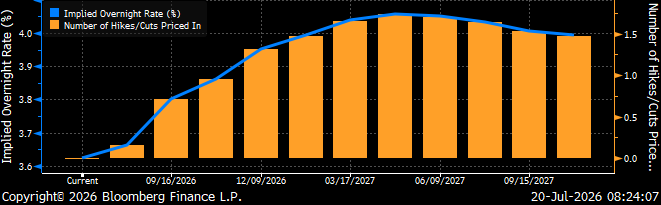
Curve Commentary: July 28, 2025

Overview

US seasonally adjusted initial jobless claims dropped to 217,000 last week, which marks a 3-month low, supporting speculation the Federal Reserve will keep rates unchanged at this week’s meeting.  Currently, the futures market is pricing-in only a 3% chance of a rate cut at this week’s meeting with the first cut of the year not anticipated until October.  However, the job market may not be as robust as it initially appears.  As noted during our Trader’s Strategic Ideas session earlier this month, continued jobless claims have been steadily increasing over the past 3-years, indicating jobless workers are taking longer to re-enter the labor force.  Last week, continued claims increased to 2.039 million, an increase of 113,926 from the prior week and an extension of this longer-term trend.  Following the Fed’s meeting later this week, we hope to have more clarity on the Fed’s assessment of recent employment and inflation data.

Strategy and Insights

Municipal bonds outperformed Treasuries over the past week with both munis and Treasuries experiencing their largest moves in the 1 to 5-year portion of the yield curve, although in opposite directions.  While munis rallied by as much as 7.5 basis points in the 4-year tenor, Treasuries sold-off by as much as 6.7 basis points in the 2-year tenor, flattening the overall Treasury curve.  Maturities past 10-years are essentially unchanged for both curves.  Muni investor sentiment continues to carry a cautious tone as investors target maturities under 5-years in an effort to shorten duration on bond portfolios amid uncertainty regarding future rates.

This divergence between munis and Treasuries has resulted in richer ratios on the front end, with the 5-year tenor falling to just over 65% and the 1-year ratio dropping below 60%.  Ratios on the longer-end have cheapened with the biggest changes around the 20-year tenor, which is presently over 90%.  Slopes along the municipal curve continue to steepen significantly past 5-years, with an overall slope of over 100 basis points from 6 to 12-years.  The 20-year portion of the curve remains appealing on a relative value basis, with yields over 90% of equivalent Treasuries and almost 95% of the entire 30-year municipal curve.  However, past this point the yield curve discourages extension by flattening to just a basis point or two per year.

In addition to the Fed announcement, the economic calendar is rather hefty this week with announcements expected for housing from Case-Shiller, JOLTS job openings, MBA mortgage applications, ADP employment change and PCE.  We also have a hefty bond calendar, particularly for a Fed week, which includes approximately $12 billion in new supply.  Notably, the Public Finance Authority is selling $3.5 billion in senior lien toll revenue bonds to fund the Georgia SR 400 Express Lanes Project.  The Fed meeting combined with economic data and the expiration of the pause on tariffs will likely test demand.

Herbert J. Sims & Co. Inc. is a SEC registered broker-dealer, a member of FINRA, SIPC. The information contained herein has been prepared based upon publicly available sources believed to be reliable; however, HJ Sims does not warrant its completeness or accuracy and no independent verification has been made as to its accuracy or completeness. The information contained has been prepared and is distributed solely for informational purposes and is not a solicitation or an offer to buy or sell any security or instrument or to participate in any trading or investment strategy, and is subject to change without notice. All investments include risks. Nothing in this message or report constitutes or should be construed to be accounting, tax, investment or legal advice.
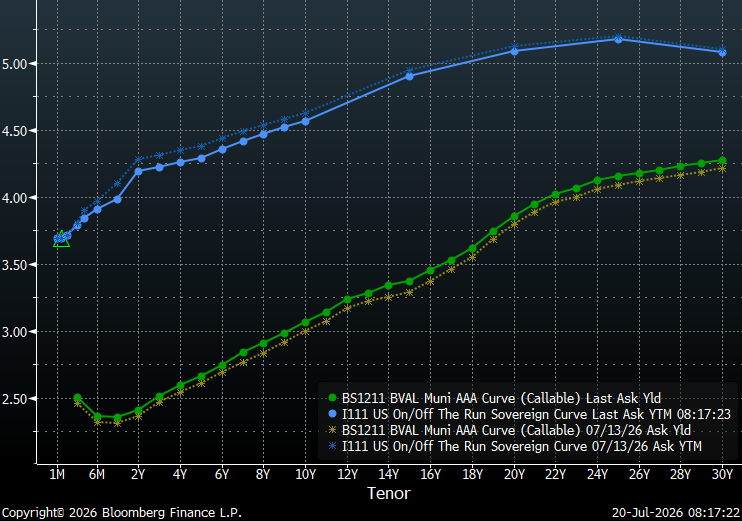
Curve Commentary: July 21, 2025

Overview

Treasuries outperformed munis during this past week, as both markets moved in opposite directions on the long-end.  Although uncertainty remains high, comments from Fed governor Waller supporting a July rate cut have put downward pressure on Treasury rates while the muni market struggles with: weakening fund demand, heavy supply and growing secondary offerings, particularly for maturities beyond the 10-year tenor.  Looking at inflation expectations via inflation swaps, the market’s concerns become increasingly evident with two-year inflation swaps now over 3%, which is a level we haven’t seen since early 2023.  In addition, with potentially higher tariffs being implemented on August 1, inflation anxiety is likely to be a significant factor this week.

Over the past week, Treasury yields past 10-years have generally declined by approximately 5 basis points while shorter Treasury yields survived the week essentially unchanged, resulting in a flatter Treasury curve.  The municipal yield curve, on the other hand, moved higher with continued strong issuance and diminishing institutional demand paving a path to higher yields by approximately 15 to 23 basis points for tenors past 10-years.  Looking at the 2s10s spread, which is the difference between the 10-year yield and the 2-year yield as an indicator of the steepness of the yield curve, the municipal curve has recently reached the steepest slope in over 2-years.  This is an invitation for bond investors to extend duration.

Strategy and Insights

Slopes along the municipal curve continue to steepen significantly past 5-years, with an overall slope of 92 basis points from 6 to 11-years.  Although the 20-year portion of the curve remains appealing on a relative value basis, with yields at 90% of equivalent Treasuries and almost 95% of the entire 30-year municipal curve.  However, past this point the yield curve discourages extension by flattening to just a basis point or two per year.

Muni/Treasury ratios have generally cheapened during this past week.  Currently, 10-year munis are yielding over 75% of equivalent Treasuries and 30-year munis are yielding over 95% of equivalent Treasuries.  Although ratios are rewarding extension out to the long-end of the yield curve, the slope of the curve flattens out significantly past 20-years which diminishes the reward to a traditional muni investors of duration extension.

Herbert J. Sims & Co. Inc. is a SEC registered broker-dealer, a member of FINRA, SIPC. The information contained herein has been prepared based upon publicly available sources believed to be reliable; however, HJ Sims does not warrant its completeness or accuracy and no independent verification has been made as to its accuracy or completeness. The information contained has been prepared and is distributed solely for informational purposes and is not a solicitation or an offer to buy or sell any security or instrument or to participate in any trading or investment strategy, and is subject to change without notice. All investments include risks. Nothing in this message or report constitutes or should be construed to be accounting, tax, investment or legal advice.
Curve Commentary: July 14, 2025

Overview

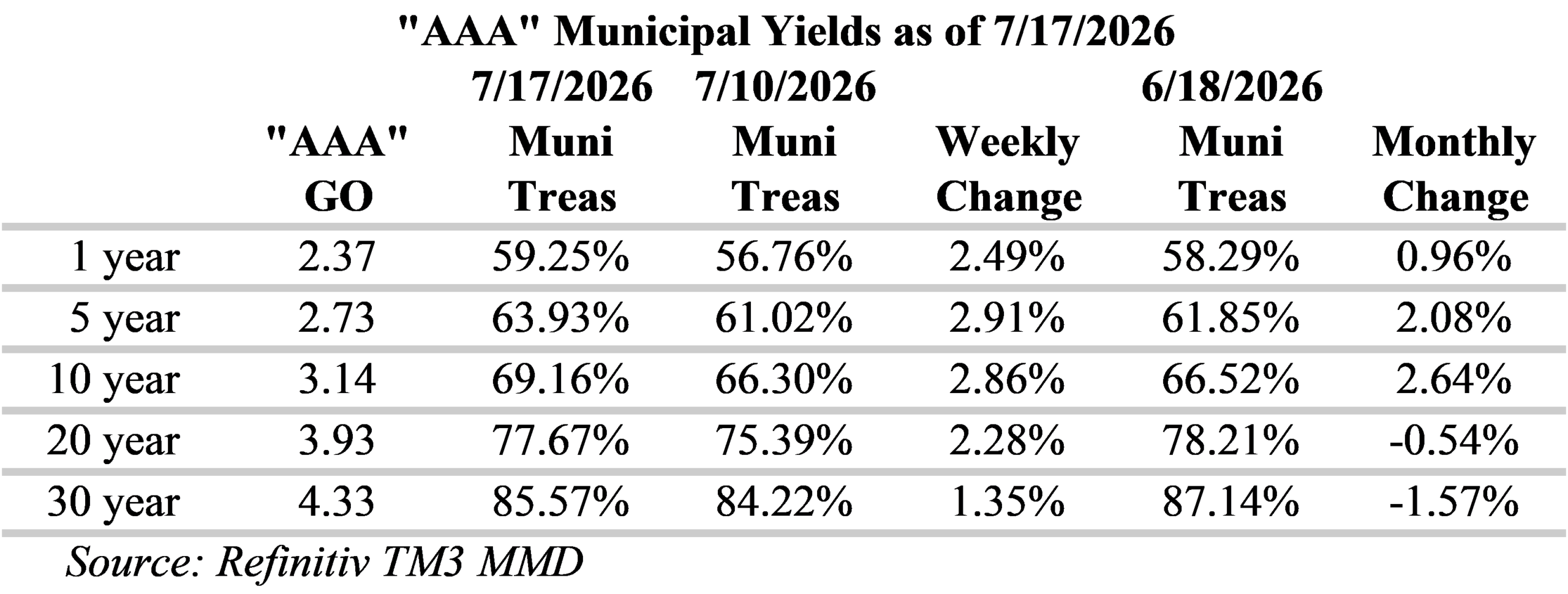
Over the past week, a combination of tariff announcements, fiscal deficit anxiety and inflation concerns have driven long-term Treasury and municipal bond yields higher.  Treasury yields past 10-years have generally risen by 3 to 4 basis points while shorter Treasury yields are generally 1 to 2 basis points lower, resulting in a steeper Treasury curve.  The municipal yield curve exhibited a similar steepening with yields under 10-years generally 2 to 4 basis points lower and yields past 10-years generally 3 to 4 basis points higher.  Looking at the 2s10s spread, which is the difference between the 10-year yield and the 2-year yield as an indicator of the steepness of the yield curve, the municipal curve has recently reached the steepest slope in over 2-years.  This is an invitation for bond investors to extend duration.

Strategy and Insights

Recently, slopes along the municipal curve have steepened significantly from 5 to 7-years, with an overall slope of 27 basis points, and remain steepest from 8 to 13-years, with an overall slope of 74 basis points.  Although the 15 to 18-year portion of the curve remains appealing on a relative value basis, the overall slope is less appealing with a slope of only 45 basis points or 11.25 basis points per year.  At the longer-end of the yield curve, extension is discouraged by the slope flattening to just a basis point or two per year.  However, this flattening does create the opportunity for investors to pick-up 13-year maturities with yields that are 80% of the 30-year municipal yield and 18-year maturities with yields that are over 90% of the 30-year municipal yield.

Muni/Treasury ratios have generally become less attractive over the past week.  However, the longer end of the municipal curve remains appealing.  Currently, 10-year munis are yielding just under 75% of equivalent Treasuries and 30-year munis are yielding around 92% of equivalent Treasuries.  Although ratios are rewarding extension out to the long-end of the yield curve, the slope of the curve flattens out significantly past 20-years to just a basis point or two per year.  On a relative basis, positioning around the 13-year maturity yields an intriguing combination of 75% of equivalent Treasuries and 80% of the 30-year municipal curve.

Over the week ahead, municipal issuers are expected to sell more than $14 billion of bonds with year-to-date municipal bond issuance levels eclipsing $300 billion, which is the earliest ever.  Some of the larger issues on the calendar are from the California Community Choice Financing Authority, which plans to sell $1 billion in bonds, the City & County of Honolulu, which plans to sell $733.4 million, and the City of Salt Lake Utah Airport, which plans to sell $450 million.  This supply will likely be met with strong demand with $23.4 billion in municipal bonds expected to mature in the next 30-days and $5.6 billion in calls announced over the next 30-days.

Herbert J. Sims & Co. Inc. is a SEC registered broker-dealer, a member of FINRA, SIPC. The information contained herein has been prepared based upon publicly available sources believed to be reliable; however, HJ Sims does not warrant its completeness or accuracy and no independent verification has been made as to its accuracy or completeness. The information contained has been prepared and is distributed solely for informational purposes and is not a solicitation or an offer to buy or sell any security or instrument or to participate in any trading or investment strategy, and is subject to change without notice. All investments include risks. Nothing in this message or report constitutes or should be construed to be accounting, tax, investment or legal advice.
Curve Commentary: July 7, 2025

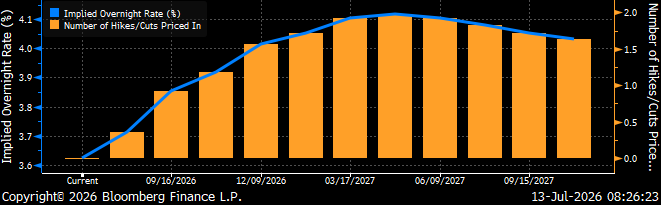
Overview

Last week, the President signed into law his “Big Beautiful Bill,” which reportedly contains roughly $4.5 trillion in tax cuts, and protects the tax exemption for municipal bonds and private activity bonds.  The Bill also creates a new category of private activity bonds for “spaceports” and includes a few additional bond-related provisions.  The preservation of the tax-exemption is of critical importance to the municipal bond market.

Strategy and Insights

Muni and Treasury yields moved slightly higher over this past week with the long end of the Treasury curve remaining notable steep.  The municipal yield curve steepened with yields dropping roughly 3 basis points per year on the short/short-intermediate potion of the yield curve and climbing by the same magnitude on the long-end with yields pivoting around the 10-year mark.  Thursday’s jobs data, released by the Bureau of Labor Statistics, dashed the markets hopes of a July rate cut with nonfarm payroll employment increasing by 147,000 jobs in June, beating the census forecast of 110,000 jobs from economists polled by Dow Jones.  Furthermore, the unemployment rate fell slightly from 4.2% to 4.1%.  As a result, Treasury yields generally climbed throughout the curve over the past week, with an almost parallel shift upward of 13 to 16-basis points.

This week, municipal issuers are expected to sell more than $12.7 billion of bonds, following last week’s truncated holiday calendar.  This supply will likely be met with strong demand following last week’s infusion of $958.89 million to municipal bond mutual funds, as reported by LSEG Lipper Global Fund Flows.  In addition, $24.2 billion in municipal bonds are expected to mature in the next 30-days and $4.2 billion in calls have been announced over the next 30-days.  Overall, technical conditions in the municipal bond market have been supportive of new issues and we expect this trend to continue.

Herbert J. Sims & Co. Inc. is a SEC registered broker-dealer, a member of FINRA, SIPC. The information contained herein has been prepared based upon publicly available sources believed to be reliable; however, HJ Sims does not warrant its completeness or accuracy and no independent verification has been made as to its accuracy or completeness. The information contained has been prepared and is distributed solely for informational purposes and is not a solicitation or an offer to buy or sell any security or instrument or to participate in any trading or investment strategy, and is subject to change without notice. All investments include risks. Nothing in this message or report constitutes or should be construed to be accounting, tax, investment or legal advice.
Curve Commentary: June 30, 2025

Overview

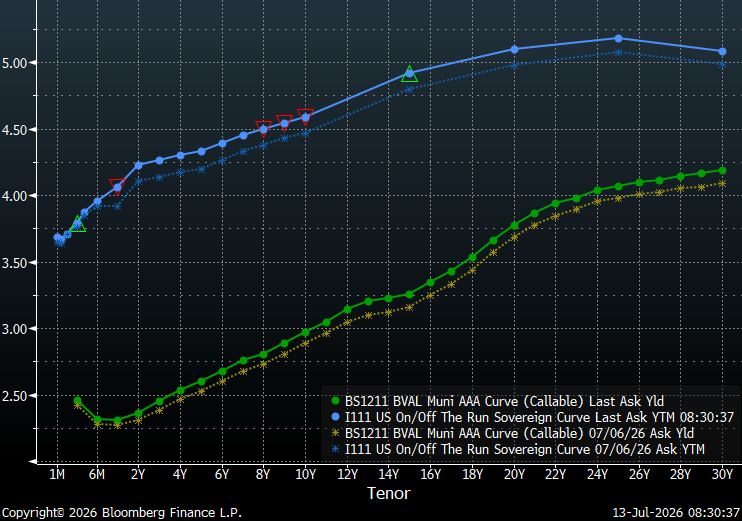
Treasury and municipal market yields rallied over this past week as the market fixated on the potential for the Fed to cut rates earlier than previously forecast.  Sentiment was driven by dovish Fedspeak from Fed governors Bowman and Waller, first quarter GDP revisions to -0.5% and a benign May PCE report, all of which bolstered rate cut expectations.  The futures market is now anticipating the Fed could cut rates as soon as September.  However, Fed Chair Powell’s comments made last week to the House Financial Services Committee were clear, that the Fed is well positioned to wait citing elevated inflation and intensifying price pressures.  Powell also commented that signs of weakness in the labor market would change the Fed’s stance.  As a result, we may see some volatility in the capital markets following this week’s employment data releases on Tuesday and Thursday.

Ratios and Strategy

Over the past month, Treasury yields have rallied roughly 15-basis points from 2 to 10-years with a steeper dip of 23 basis points around the 15-year mark.  While municipal yields held relatively steady, with declines of approximately 10 to 15-basis points from 2 to 10-years and 1 to 2 basis points for maturities past 15-years.  As a result, muni/Treasury ratios have generally become more attractive with ratios enticing investors to extend portfolio durations with significantly higher ratios on longer maturities.  Currently, 10-year munis are yielding over 76% of equivalent Treasuries and 30-year munis are yielding over 93% of equivalent Treasuries.  The slope of the municipal yield curve is also rewarding extension with multiple spans along the yield curve in excess of 10 basis points per year.  The steepest slopes have formed around the 10-year maturity, with an overall slope of 45 basis points from 9 to 11-years.  Further out the municipal yield curve, slopes remain steep from 15 to 18-years, with an overall slope of 45 basis points.  Slopes after this point taper off dramatically to just a basis point or two on the extreme long-end.  The flattening on the longer-end of the yield curve allows investors to buy 17-year maturities with yields that are 90% of the 30-year municipal maturity.

Although municipal bond mutual fund flows have been steadily weakening, supply/demand technical conditions remain strong with nine consecutive weeks of positive fund flows and investors anticipating $45 billion of interest payments, maturing and called principal this week.  LSEG Lipper Global Fund Flows reported municipal bond mutual funds saw an additional $76.9 million from investors.  The majority of the inflows were directed to high-yield funds, which registered an additional $45.4 million compared to the previous week’s $57.7 million.  This week, the calendar has contracted to $5.78 billion, which is relatively heavy for a holiday week with an early close.  This past June is anticipated to be the largest June on-record for issuance and year-to-date, municipal issuance has already reached $277.8 billion, which is 17.8% ahead of last -year at this time.

Herbert J. Sims & Co. Inc. is a SEC registered broker-dealer, a member of FINRA, SIPC. The information contained herein has been prepared based upon publicly available sources believed to be reliable; however, HJ Sims does not warrant its completeness or accuracy and no independent verification has been made as to its accuracy or completeness. The information contained has been prepared and is distributed solely for informational purposes and is not a solicitation or an offer to buy or sell any security or instrument or to participate in any trading or investment strategy, and is subject to change without notice. All investments include risks. Nothing in this message or report constitutes or should be construed to be accounting, tax, investment or legal advice.