Curve Commentary: January 26, 2026

Overview

This morning on the trade desk, accounts are distracted by Winter Storm Fern, which has created havoc from Texas to Maine with 24 states declaring emergencies.  In addition to widespread power outages, many roads and highways remain impassable and flight cancellations have reached levels not seen since the early days of the Pandemic.  Despite the inclement weather, Treasuries rose over the five to 30-year tenors resulting in yields dropping to their lowest levels since last week’s volatility.  Following a preliminary announcement by the Commerce Department of stronger than anticipated durable goods orders for November, gains were briefly pared.

Early last week, international events came into focus following instability in the Japanese bond market. Yields surged in the Japanese bond market following a pitch by Japanese Prime Minister Sanae Takaichi to cut taxes on food, which markets interpreted to mean increased government bond issuance.  The result was 40-year Japanese yields jumping to the highest level of any maturity of the nation’s sovereign debt in more than three decades.  In addition, escalating tensions over the control of Greenland with the threat of tariffs on European goods added to the melee.  The municipal bond market responded to the uncertainty with bonds selling-off.  As of the end of the day on Tuesday, MMD ultimately cut yields from 2bps in 2027-28 to 7 bps in 2041-56.

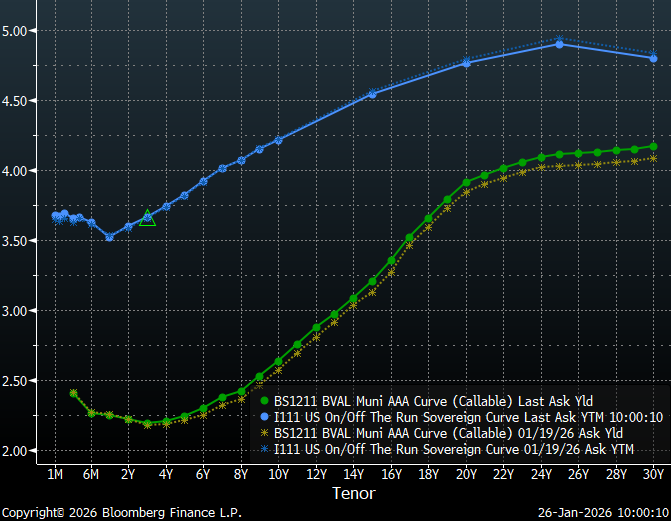
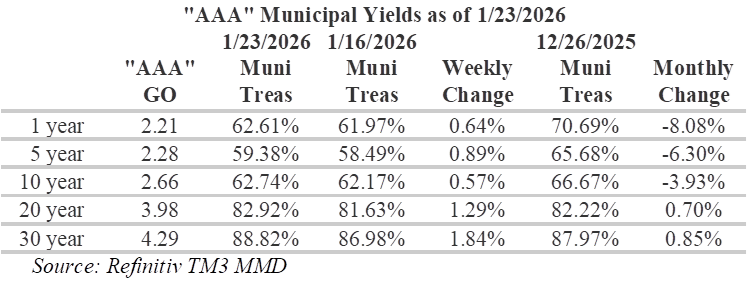
Despite the volatility early in the week, rates were relatively unchanged over the week.  Treasuries outperformed munis with 30-year Treasury bonds rallying 3.3 bps while 30-year munis sold-off 8.7 bps.  The overall result was a flatter Treasury curve and a steeper muni curve.  Slopes along the municipal yield curve are steepest from 11 to 12 years, with 27 bps of slope and from 14 to 20-years, with 95 bps of slope.  In addition, investors benefit from a steep roll-down over time.  Although the municipal yield curve is currently rewarding duration, investors should be cautious when extending to maturities past 20-years, where the long-end becomes very flat.  As a result of this flat tail, municipal bond investors can buy maturities under 20-years that yield over 90% of the 30-year curve.

Insights and Strategy

Muni/Treasury ratios for 10-year and shorter maturities have seen significant declines over the past month due to a concentration of retail demand at the front end of the yield curve.  However, this is a still an improvement from September, when ratios in the 1-year tenor dropped to as low as 56%.  Ratios further out the curve, from 20-years and longer, remain attractive relative to Treasuries due to weaker demand and wider spreads.  For investors seeking to maximize curve positioning with relative value, extending to the 19-year part of the municipal yield curve provides over 90% of the 30-year maturity and over 80% of equivalent Treasury yields.  In the rich belly of the curve, particularly around 5-years, we are hearing reluctance from institutional investors citing these ratios as unappealing relative to the rest of the curve.

Municipal new issuance volume is expected to be relatively quiet this week, with a just over $4 billion on the calendar.  Significant deals include $750 million from the Triborough Bridge & Tunnel Authority and Florida Health Sciences Center Inc. Obligated Group with $369.3 million.  Furthermore, states and local governments are planning to issue just under $9 billion in new supply over the next 30 days, according to data compiled by Bloomberg.  In addition, the FOMC is scheduled to hold its press conference later this week to brief the markets.  Currently, markets expect the Fed to hold rates steady following three straight cuts last year.  In addition, the markets will be looking to the Fed for signals about where rates are headed.

Herbert J. Sims & Co. Inc. is a SEC registered broker-dealer, a member of FINRA, SIPC. The information contained herein has been prepared based upon publicly available sources believed to be reliable; however, HJ Sims does not warrant its completeness or accuracy and no independent verification has been made as to its accuracy or completeness. The information contained has been prepared and is distributed solely for informational purposes and is not a solicitation or an offer to buy or sell any security or instrument or to participate in any trading or investment strategy, and is subject to change without notice. All investments include risks. Nothing in this message or report constitutes or should be construed to be accounting, tax, investment or legal advice.

Curve Commentary: January 12, 2026

Overview

Last week, the Bureau of Labor Statistics reported a drop in the unemployment rate to 4.4% in December, down from 4.5% in November.  However, nonfarm payroll employment levels crept up by 50,000 workers, which was less than the downwardly revised 56,000 in November and short of analyst estimates.  Overall, it was a mixed report that supports the narrative of a low hire, low fire job market and is unlikely to inspire a rate cut at the FOMC meeting later this month.  Although December’s employment data did little to provide the clarity the capital markets are seeking, it was also not sufficiently weak to warrant a rate cut.  Currently, fed funds futures are pricing-in only a 5% change of the Fed cutting rates in January.

The markets responded to this news with Treasuries selling-off, largely around the policy sensitive 2-year tenor with Treasury yields largely unchanged past about 10-years.  Conversely, ‘AAA’ municipal yields fell across the curve, with the largest declines concentrated in the first few years.  The rally in munis was largely supply driven following a modest calendar at year-end and a bit of a slow start to the new year.  However, weekend news of the US central bank being subpoenaed by the Justice Department with threats of criminal indictment have markets concerned about Fed independence.  In addition, this week is a heavy week for economic data with December’s Consumer Price Index scheduled to be released on Tuesday and November’s Producer Price Index scheduled to be released on Wednesday.  As markets digest these events there is heightened level of risk for rate volatility over the next few days.  In addition, as shown below, ACM 10-year Treasury term premium are at about the highest levels seen in over a decade.  This is an indication of some nervousness about future and provides bond investors with a reward for assuming duration.

Slopes along the municipal yield curve are steepest from 14 to 19-years, with over 80 bps of slope.  Like the Treasury curve, the municipal yield curve also rewards investors for extending duration.  Investors benefit from a steep roll-down over time as bonds mature.  Although the municipal yield curve is currently rewarding duration, investors should be cautious when extending to maturities past 20-years, where the long-end becomes very flat.  As a result of this flat tail, municipal bond investors can buy maturities under 20-years that yield over 90% of the 30-year curve.

Insights and Strategy

Muni/Treasury ratios for 5-year and shorter maturities have seen significant declines over the past month due to a concentration of retail demand remains at the front end of the yield curve.  However, this is a still an improvement from September, when ratios in the 1-year tenor dropped to as low as 56%.  Ratios further out the curve, 20-years and longer, remain attractive due to weaker demand and wider spreads.  For investors seeking to maximize curve positioning with relative value, extending to the 19-year part of the municipal yield curve provides over 90% of the 30-year maturity and over 80% of equivalent Treasury yields.  In contrast to the rich belly of the curve, particularly from 5 to 10-years, we should start to see more pressure on the long-end as investors are tempted to extend duration by higher yields and relative value.

Municipal new issuance volume is expected to pick-up this week with over $11 billion in new issues on the calendar, up from approximately $7 billion last week.  The New York City Transitional Finance Authority Future Tax Secured Revenue plans to sell $1.5 billion of bonds, Metropolitan Nashville Airport Authority is on the calendar with $1.28 billion, and California Community Choice Financing Authority is scheduled to offer $850 million.  This past week, municipal bond mutual funds and ETF’s collectively benefitted from a little over $2 billion of inflows.  Furthermore, last week was the fifth straight week that net flows topped $1 billion for municipal ETF’s.  Given the strong fund flows and current relative values, this week’s larger calendar should face a receptive audience.

Herbert J. Sims & Co. Inc. is a SEC registered broker-dealer, a member of FINRA, SIPC. The information contained herein has been prepared based upon publicly available sources believed to be reliable; however, HJ Sims does not warrant its completeness or accuracy and no independent verification has been made as to its accuracy or completeness. The information contained has been prepared and is distributed solely for informational purposes and is not a solicitation or an offer to buy or sell any security or instrument or to participate in any trading or investment strategy, and is subject to change without notice. All investments include risks. Nothing in this message or report constitutes or should be construed to be accounting, tax, investment or legal advice.

2026 LeadingAge MN Institute & Expo

HJ Sims is proud to be attending, speaking, and exhibiting at the 2026 LeadingAge MN Institute & Expo.

Attendees: Lynn Daly

Lynn Daly, Executive Vice President will be speaking on Feb 11 at 8:30am-9:30am.

Session description:

8:30 – 9:30 a.m. CONCURRENT SESSIONS 101 – Board Governance: Best Practices to Maximize Governance Effectiveness (All Settings; Peer Genius) • Understand how boards impact the organization’s ability to achieve strategic and financial goals. • Explore best practices for board governance. • Learn from case studies how things can go right and wrong and the implications of both.

Start a Conversation