

By Gayl Mileszko
Market Commentary
Time Out
Calling a timeout can significantly change the momentum of play on any given field. The bond markets give themselves most of the weekend off, of course, and an average of one holiday breather a month, whether they need it or not. That will change when we move closer to round-the-clock trading and clearing. But for now, investors, bankers, traders, and underwriters are grateful for a break like the one granted on Columbus Day to mull over the latest prints and portfolio repositionings and consider their next moves during the final 50 trading sessions of the year.
Shifting the Outcome
In televised competitions, there are planned two-minute commercial breaks to interrupt play. During these breaks, players not only have a chance to hydrate and rest, make substitutions, and adjust strategy – they can actually mess with the opposition’s psyche. When a team stops the clock, it can often shift the outcome of a game. Major League Baseball does not set a fixed number of stoppages, although mound visits are generally limited to 30 seconds and teams get four each during the nine innings. Only an umpire has the authority to make the call in this sport; players and managers can only request a timeout. Coaches and players have more power in other leagues. The National Basketball Association allows the greatest number: seven, 75-second timeouts per team, callable when the ball is dead or a team has clear possession, although during the final three minutes of the game, teams only have a maximum of two. The National Hockey League permits the least number: only one break for 30 seconds per team per game. In regulation play, the National Football League allows three 30-second timeouts per team per half, but they do not carry over and cannot be called back-to-back.
Outstanding
For the first half of the year, the municipal bond market did not want to take a time out. Investor demand was heavy, issuer supply was never enough, funds had billions of cash inflows, retail buyers saw billions of principal and interest payments roll in, ready for redeployment in a sector with solid fundamentals and oodles of choice. With very few exceptions, tax-exempt local government and nonprofit debt experienced few of the headwinds that U.S. Treasuries did and outperformed most every fixed income class. After all, tax-exempt borrowers have far less debt, produce balanced budgets and generally demonstrate good debt service coverage. Ten to fifteen percent of municipal bonds are rated higher than our own sovereign credit. And, although it is quite impossible to track how each of the $7.4 trillion federal dollars were spent last year, essential public projects funded by muni bonds – hospitals, schools, college dorms, water and sewer infrastructure, senior housing, toll roads, and bridges — are all easy to see. So, what happened over the summer?
Up, Up and Dismay
It is still hard to completely explain the losses in the third quarter because none of the market fundamentals have changed. Yes, there were a few headline defaults like Brightline and the Nassau County Tobacco Securitization Corporation. But they did not cause a selloff that still feels overdone. A number of technical factors, all of which we knew were present or likely to happen, caused a sudden turnabout. New issue volume continued at a record pace at the same time that redemptions dropped off and underwriters were forced to cut prices to clear inventory. Prices were then suddenly lowered in the secondary market as well, and this triggered the kind of tax-loss selling not usually seen until closer to year end. Investors withdrew from traditional mutual funds and moved cash into very liquid exchange traded and mutual funds. These became holding places as investors scoured bid and offering lists for bargains and new issue calendars for higher yielding opportunities. Stronger than expected economic data, the escalation of conflict in the Middle East, heavy federal deficit borrowing, higher oil prices, the rate hike by the Federal Reserve, and the allure of large, highly rated AI bond issues in the corporate market all squeezed Treasury yields, the benchmarks for so many U.S. and foreign securities. Mortgage, auto loan, credit card, and many other rates have risen right alongside. Somehow, only AI spending appears to be unaffected.
Out of Bounds
As seen in the table below, muni bond yields rose sharply during the third quarter, producing the worst performance period since 2008. Investment grade indices posted returns of negative 4.05% in September alone, bringing year-to-date performance down to negative 3.74%. High yield munis lost 4.48% last month, lowering year-to-date returns to 2.29%, just below Treasuries at negative 2.73% and investment grade corporate bonds at negative 2.29%. Munis not only sold off in line with Treasuries, but tax-exempt prices fell harder and faster. Valuations have been adjusted and some very nice discounts are available. Please reach out to your HJ Sims representative for attractive offerings.
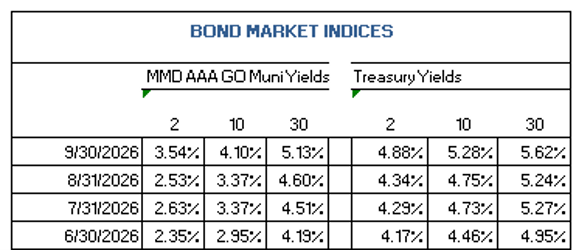
Sources: Bloomberg, Refinitiv/TM3 MMD Curves
This is where yields stand compared to those at year-end going back to 1999:
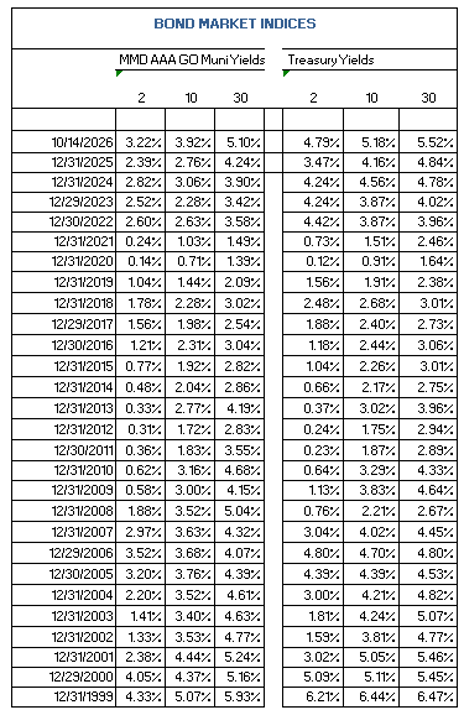
Sources: Bloomberg, Refinitiv/TM3 MMD Curves
This month we have seen some volatility, but rates are trending lower. Trading volume has been heavy since September, and bid-wanted lists remain at record highs. JP Morgan reports that open-end mutual funds have seen outflows for 21 straight weeks, but CreditSights sees that muni ETFs have taken in a net of $56.9 billion this year. There are now 180 muni ETFs with assets under management totaling $236 billion. At this writing, it is the technology sector that is selling off and so there is new safe haven demand buoying munis and Treasuries.
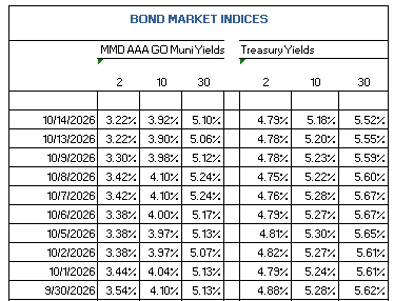
Sources: Bloomberg, Refinitiv/TM3 MMD Curves
Up, Up and Aweigh?
Where to next? Well, we are only 19 days away from November 3, Election Day. Markets detest the kind of uncertainty that precedes elections and typically rally once the results are in, whatever they are, whenever they are finalized. But, in the big picture, there is a lot to pressure rates. Our fiscal challenges are enormous. Inflation is still a problem, and we have a serious affordability crisis in the housing market. Our $2 trillion deficit means heavy Treasury issuance for the foreseeable future. We need a Middle East deal and lower oil prices before the winter is upon us. We await developments during the lame duck session and question what the 120th Congress has in store for us starting on or about January 3, 2027. The Navy uses the rallying cry “anchors aweigh” when the anchor is hoisted off the sea floor and the ship is officially underway. We will see where this next voyage in 2027 takes us.
HJ Sims in the Market with The View at Goodwin Living
In the meantime, we still have two and a half months left in 2026 and the municipal market takes no break. HJ Sims is in the market with a $307.8 million financing for The View at Goodwin Living, a seven-acre campus acquired in 2022 across the street from Goodwin House Alexandria. Bonds are being offered through the Alexandria, Virginia Industrial Development Authority, and are currently oversubscribed. The project will add 217 independent living units, 7 of which are to be designated as affordable, 16 assisted living units and 24 new skilled nursing units. Goodwin Living, the sponsor, is a nonprofit organization that has been active in the Northern Virginia market since 1955 and recently added Forest Hills of DC by Goodwin Living as its first campus outside of The Old Dominion.
Turning Out Okay
This is a holiday-shortened week but the new issue calendar at $12 billion is right at the 52-week average and pointing to a third year of record high volume. Among other transactions planned for this week is a $138.4 million Libertas Academies sale for its three charter school campuses in South Carolina, a $9.2 million BB+ rated bond issue for Orange Springs charter schools in California, and a $59.9 million BB rated Build NYC Resource Corporation issue for Hadran Academy in Brooklyn. In the senior living sector, Givens Estates in Asheville, North Carolina plans an $89.5 million A-minus rated sale, and the Cleveland Cuyahoga County Port Authority is bringing a $25.9 million non-rated issue for Silver Birch of Euclid. Last week, a $29.1 million BB rated Build NYC Resource Corporation issue priced for Neighborhood Charter Schools featuring a 2066 maturity yielding 6.65%. The Colorado Educational and Cultural Facilities Authority sold $7.5 million non-rated bonds for Honor Charter School in Colorado Springs; the maturity due in 2036 had an 8.00% coupon priced to yield 8.774%. And Chiara Housing and Services in Wisconsin came with a $49.9 million non-rated taxable deal due in 2036 that priced at 11.50% to yield 12.95%.
Your HJ Sims representative welcomes your questions on current market conditions and how we can assist in achieving your goals in the final quarter of this year.