Curve Commentary: March 23, 2026

Overview

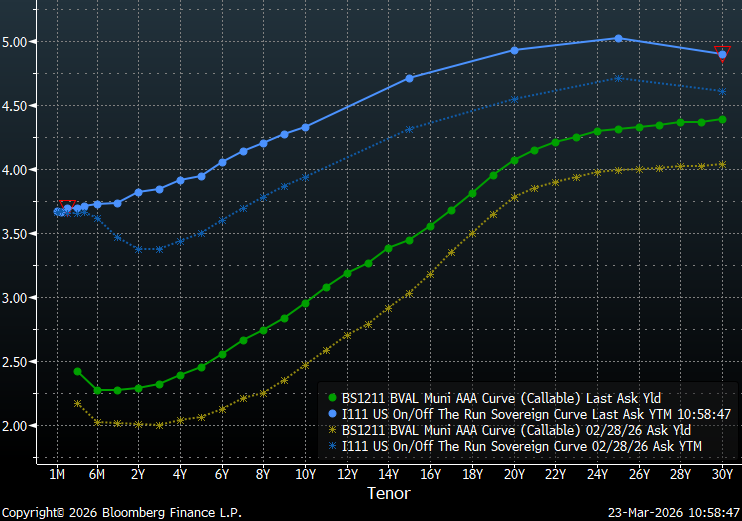
Day-to-day volatility remains high in the fixed income markets with the war in the Middle East continuing to dominate headlines.  At the Fed’s meeting last week, the Committee decided to maintain the target range for the federal funds rate at 3-1/2 to 3-3/4 percent.  The Fed Chair expressed a cautious outlook, noting that current inflation levels are being driven by factors pre-dating the conflict in Iran and estimating that between half and three-quarters of total core inflation is actually tariffs.  In addition, the Chair commented that typically the Fed looks through energy shocks and expects to see inflation improving around the middle of this year.  The current uncertainty has resulted in a choppy Fed funds futures market with current pricing not indicating any rate cuts over the next 12-months.

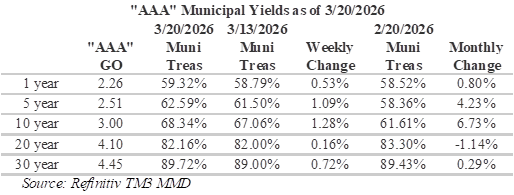
Over the past week, both munis and Treasuries have generally sold-off with Treasuries outperforming as munis catch-up.  Since the outbreak of the war in the Middle East, munis and Treasuries have sold-off by roughly 30 to 40 bps for maturities longer than 20-years.  The largest moves in Treasuries have not been around the policy sensitive 2-4 year maturities, where Treasuries have sold-off roughly 45 bps.  However, municipals have experienced their biggest moves around the 8 to 14-year maturities where they have sold-off by close to 50 bps from February 28, at the beginning of the war with Iran.

Insights and Strategy

On the trade desk we have noted that a combination of new issue supply and a lack of inquiry has lead to weakness around the 10-year maturity, while trading has become relaxed on the short-end with muni/Treasury ratios loosening up.  As a result, municipal/Treasury ratios have increasingly become more appealing in the 5 to 10-year tenors with ratios now approaching 70% and making this a significantly more appealing portion of the curve to position.  Despite shifting muni/Treasury ratios, slopes along the municipal yield curve continue to reward extending duration.  Investors are currently incented to move out the yield curve with steepening yields around the 11-20 year range, with an overall slope of 109 bps.  However, the yield curve becomes very flat past 20-years, with a total slope of only 24 bps for 20-30-years.  Currently, the steepest slopes on the municipal curve are available from 17 to 21-years where investors can pick-up approximately 60 bps.

Although municipal ratios past 20-years remain attractive relative to Treasuries, the yield curve remains very flat over these longer tenors.  Due to the flat tail that has formed at the end of the municipal yield curve, investors can currently buy maturities under 20-years that yield almost 90% of the 30-year curve.  For investors seeking to maximize curve positioning with relative value, the 17 to 20-year part of the municipal yield curve offers progressively improving opportunities with slopes of 12 to 13-bps per year.

The new issue municipal calendar picks-up this week and is expected to include $15.9 billion of new issues.  Notable deals include: the City of New York, which plans to sell $2.58 billion; the State of Illinois is scheduled to sell $1.4 billion, and the UPMC Obligated Group is expected to sell $1.2 billion.  According to LSEG Lipper Global Fund Flows, investors added roughly $1.8 billion to municipal bond funds last week.  Long-term funds reportedly received $1.5 billion and high-yield funds added about $651 million.  Considering current muni/Treasury ratios, it is not surprising that the majority of inflows are going to intermediate and long-term muni funds.

Herbert J. Sims & Co. Inc. is a SEC registered broker-dealer, a member of FINRA, SIPC. The information contained herein has been prepared based upon publicly available sources believed to be reliable; however, HJ Sims does not warrant its completeness or accuracy and no independent verification has been made as to its accuracy or completeness. The information contained has been prepared and is distributed solely for informational purposes and is not a solicitation or an offer to buy or sell any security or instrument or to participate in any trading or investment strategy, and is subject to change without notice. All investments include risks. Nothing in this message or report constitutes or should be construed to be accounting, tax, investment or legal advice.

Curve Commentary: March 16, 2026

Overview

The war in the Middle East continues to dominate headlines, leading to a high degree of volatility in oil prices and pressuring the stock and the bond markets alike.  The Fed funds futures market is currently indicating the Fed will not adjust the overnight lending rate at its meeting later this week.  Due to the high degree of uncertainty from the war in the Middle East, this is not surprising.  Furthermore, current pricing anticipates the Fed will hold rates steady until January of next year.  

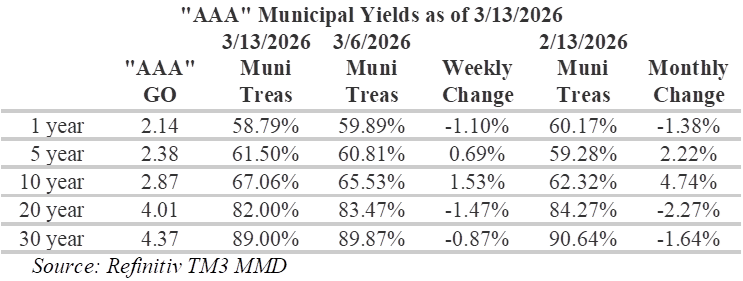
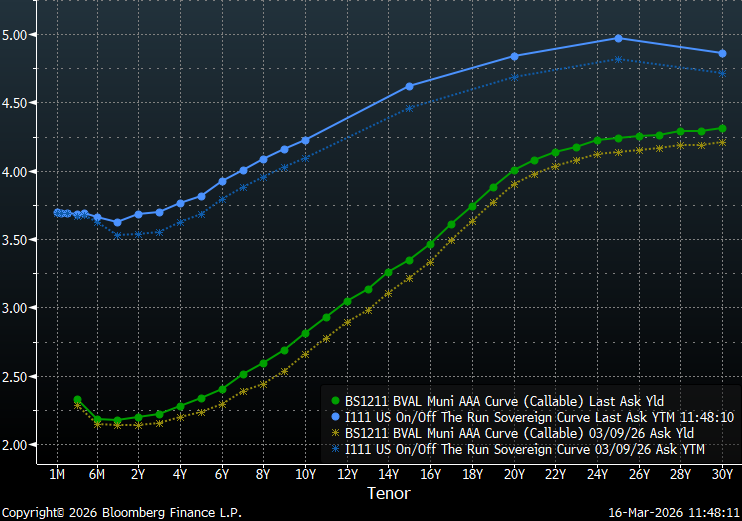
Bond investors are currently asking for more compensation for the risk of holding long-dated Treasuries.  Over the past week, Treasury yields have increased by approximately 16 bps for the 30-year maturity while the extreme short-end, around 1-month, remains virtually unchanged.  Munis have responded similarly, although to a lesser degree, with rates roughly 9 bps higher on the long-end.  However, the largest moves in the municipal scale were in the intermediate maturities from 8 to 12-years.  As a result, municipal/Treasury ratios have become more appealing in the in the 5 and 10-year tenors with ratios on the long-end and short-end becoming more rich, characterized by lower relative yields.  Currently, ratios for maturities shorter than 1-year are back in the 50’s while 30-year munis are now yielding less than 90% of equivalent Treasuries.


Insights and Strategy

Despite shifting muni/Treasury ratios, slopes along the municipal yield curve continue to reward extending duration.  Investors are currently incentivized to move out the yield curve with appealingly steep yields in the 10-20 year range, with a slope of 102 bps, versus only 74 bps from 1-10 years.  Currently, the steepest slopes on the municipal curve are available from 16 to 20-years where investors can pick-up approximately 51 bps.  However, caution is advised for tenors past 20-years, where there is only 25 bps to be gained by extending out to 30-years.  It is also notable that although municipal curve slopes remain appealingly steep, they have moderated in certain portions of the curve over the past week.

Although ratios have compressed on the long-end, due to the flat tail, municipal bond investors can currently buy maturities under 20-years that yield almost 90% of the 30-year curve.  With muni/Treasury ratios for 10-year maturities, although improved, still quite rich at around 65%.  While the yield curve remains very flat over these longer tenors, ratios past 20-years remain attractive relative to Treasuries.  For investors seeking to maximize curve positioning with relative value, the 17 to 20-year part of the municipal yield curve has become very tempting with slopes of 12 to 14-bps per year.

The new issue municipal calendar is a bit lighter this week and is expected to bring $8.27 billion of new issues.  Notable deals include: Black Belt Energy Gas District, which plans to sell $1.23 billion; New York City Water & Sewer System is scheduled to sell $983.1 million, and Cleveland Clinic Health System Obligated Group is expected to sell $530.8 million.  According to LSEG Lipper Global Fund Flows, investors added roughly $216 million to long-term municipal bond funds and $280 million to intermediate maturity funds.  Considering current muni/Treasury ratios, it is not surprising that the majority of inflows are going to intermediate and long-term muni funds.

Herbert J. Sims & Co. Inc. is a SEC registered broker-dealer, a member of FINRA, SIPC. The information contained herein has been prepared based upon publicly available sources believed to be reliable; however, HJ Sims does not warrant its completeness or accuracy and no independent verification has been made as to its accuracy or completeness. The information contained has been prepared and is distributed solely for informational purposes and is not a solicitation or an offer to buy or sell any security or instrument or to participate in any trading or investment strategy, and is subject to change without notice. All investments include risks. Nothing in this message or report constitutes or should be construed to be accounting, tax, investment or legal advice.

Curve Commentary: March 9, 2026

Overview

The war in the Middle East continues to draw the markets focus as bond traders attempt to manage inventory exposure with oil prices now through $100 per barrel.  Last week’s softening labor market data from the Bureau of Labor Statistics and skyrocketing oil prices have fixed income markets nervous that energy costs could trigger a surge in inflation while constricting economic growth.  Not surprisingly, Fed Funds Futures are now implying only one rate cut over the next 12-months and another cut 12-months later. 


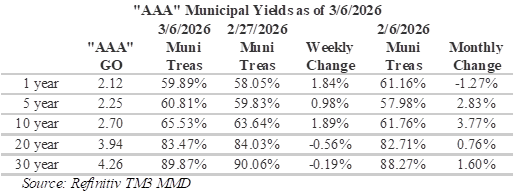
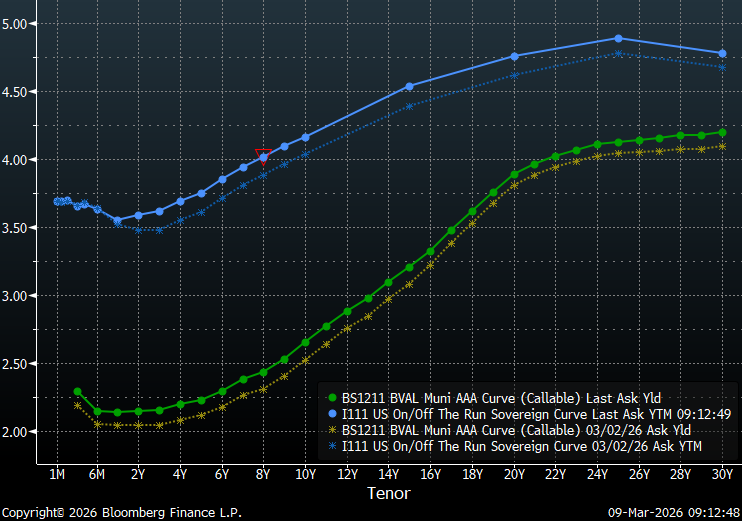
Although the long-end of both the municipal and Treasury yield curves has experienced increases of similar magnitude over the past week, tenors less than 1-year have performed remarkably different.  While six-month Treasury yields are virtually unchanged from last week, munis in this range increased by 10bps.  The impact of this difference is a treasury curve that is steepening and a muni curve that is shifting upward in a more parallel fashion.  The result contradicts recent trends, with muni/Treasury ratios for periods 10-years and less have becoming more attractive over the past week while longer tenors become slightly less favorable.  Currently, ratios for maturities shorter than 1-year are yielding almost 60% of their Treasury equivalents while 30-year munis are yielding just under 90% of equivalent Treasuries.

Insights and Strategy

Despite shifting muni/Treasury ratios, slopes along the municipal yield curve continue to reward extending duration.  Investors are currently incented to move out the yield curve with appealingly steep yields in the 10-20 year range, with a slope of 124 bps, versus only 58 bps from 1-10 years.  Currently, the steepest slopes on the municipal curve are available from 15 to 20-years where investors can pick-up approximately 69 bps.  However, caution is advised for tenors past 20-years, where there is only 32 bps to be gained by extending all the way out to 30-years.  It is also notable that although municipal curve slopes remain appealingly steep, they have also moderated in certain portions of the curve over the past week.

Nevertheless, by positioning in the longer intermediate portion of the curve, investors benefit from a steep roll-down over time.  Furthermore, due to flat long-term rates, municipal bond investors can currently buy maturities under 20-years that yield almost 90% of the 30-year curve.  With muni/Treasury ratios for 10-year and shorter maturities, although improved, still quite rich at under 60%.  extending maturities further out the curve have the added benefit of more appealing relative yields.  Ratios in 20-year and longer maturities remain attractive, relative to Treasuries, due to seasonal activity and wider spreads.  However, the yield curve remains very flat over these longer tenors.  For investors seeking to maximize curve positioning with relative value, the 17 to 20-year part of the municipal yield curve has become very tempting with slopes of 15 to 16-bps per year.

This week’s deal municipal bond deal calendar anticipates another week of strong issuance with an estimated $13.5 billion of new issues.  Notable issues include: the Dormitory Authority of the State of New York, which plans to sell $2.575 billion; the State of California is scheduled to sell $2.387 billion in general obligation bonds, and California Community Choice is expected to sell $904.945 million in clean energy project revenue bonds.  Due to current events, it is possible the status of current deals may change as conditions evolve.  Despite 15 consecutive weeks of inflows and approximately $1.4 billion being added to municipal bond funds last week, according to LSEG Lipper Global Fund Flows, investors may be reluctant to commit capital due to international events.  Considering current muni/Treasury ratios, it is not surprising that the majority of inflows are going to intermediate and long-term muni funds.

Herbert J. Sims & Co. Inc. is a SEC registered broker-dealer, a member of FINRA, SIPC. The information contained herein has been prepared based upon publicly available sources believed to be reliable; however, HJ Sims does not warrant its completeness or accuracy and no independent verification has been made as to its accuracy or completeness. The information contained has been prepared and is distributed solely for informational purposes and is not a solicitation or an offer to buy or sell any security or instrument or to participate in any trading or investment strategy, and is subject to change without notice. All investments include risks. Nothing in this message or report constitutes or should be construed to be accounting, tax, investment or legal advice.

The 23rd Annual HJ Sims Late Winter Conference

The 23rd Annual HJ Sims Late Winter Conference brought together leaders from the senior living and charter school sectors for a dynamic and forward-focused program. The agenda explored key trends, financing strategies, and operational solutions designed to address current challenges and support long-term growth across both non-profit and proprietary organizations.

Attendees experienced engaging keynote presentations, panel discussions, and dual education tracks tailored to each sector, along with joint sessions that encouraged shared learning and collaboration. Meaningful networking opportunities throughout the conference fostered valuable connections and thoughtful dialogue among industry peers from across the country.

Help us make the next Late Winter Conference even more successful by completing our feedback survey. We very much appreciate your input.

Please note that you must complete the survey to receive your educational credits certificate. If you did not receive our survey, please contact Catherine Vancho at [email protected]

Save the Date

HJ Sims Completes $632,925,000 Financing for New York City’s First Life Plan Community

Fairfield, CT, March 4, 2026 – HJ Sims is pleased to announce the successful completion of a $632.9 million tax-exempt bond financing for RiverSpring Health Living, Inc. Proceeds of the issue will be used to develop River’s Edge, a new life plan community with approximately 260 independent living apartments located on RiverSpring Living’s 32-acre campus in the Riverdale section of the Bronx, New York with dramatic views overlooking the Hudson River, New Jersey’s Palisades and the Manhattan skyline.

The one- and two-bedroom apartments will range in size from approximately 750 to 1,400 square feet in an 11-story, 441,000 square foot building. Common spaces will include a variety of dining options, theater, library, beauty salon and day spa. A wellness center and health spa will contain an indoor pool, fitness center and locker rooms. The campus has room for a possible future second apartment building as well.

The bonds, issued by BuildNYC Resource Corporation, represent the largest tax-exempt financing for a new life plan community and the first such community to be developed in New York City. HJ Sims was the co-manager along with Ziegler.

The highly experienced development team for River’s Edge includes Integrated Development II, the architects Perkins Eastman and Consigli Construction.

HJ Sims has been privileged to work with RiverSpring Living for over 10-years on this and other financings. “Sims delivered outstanding results on the River’s Edge bond sale,” said David V. Pomeranz, President & CEO of RiverSpring Living. “Their deep understanding of the market, thoughtful structuring, and strategic insights ensured a smooth transaction and strong investor response.”

About HJ Sims

Founded in 1935, HJ Sims is a privately held investment bank and wealth management firm focused on delivering a broad spectrum of financial services to its clients. Sims is one of the nation’s oldest and most respected underwriters of tax-exempt bonds, with specific expertise in the senior living and education sectors. Since underwriting the first senior living tax-exempt bond in 1965, Sims has provided over $35 billion in financing for senior living providers nationwide. For more information, please visit: hjsims.com.

About RiverSpring Living

RiverSpring Living has been dedicated to serving seniors for over 100 years, providing nursing care, rehabilitation, memory care, assisted and independent living on its Riverdale campus and beyond. For more information on RiverSpring Living, please visit riverspringliving.org. To learn more about River’s Edge, please visit riversedge.org.


Curve Commentary: March 2, 2026

Overview

This morning, Treasury bonds sold-off amid surging oil prices as inflation fears drove yields higher.  As conflict in the Middle East escalates, disruption in tanker activity and supply concerns will remain in-focus.  Typically global conflict will place downward pressure on rates as investors seek safety; however, in a market already sensitive to inflation and the potential for further rate cuts oil driven inflation concerns have unsettled investors.  

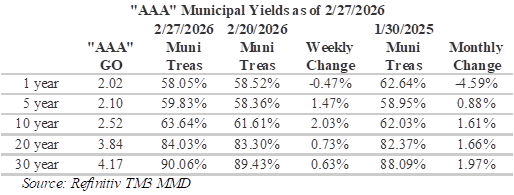
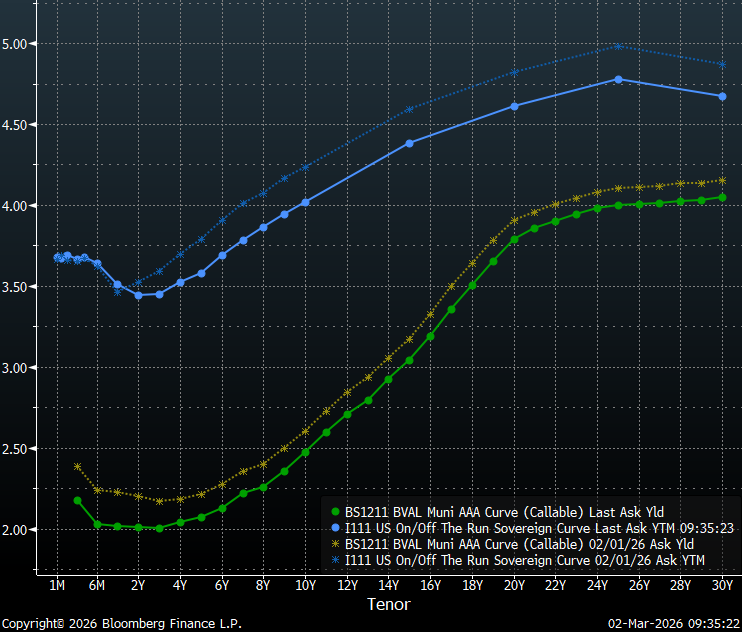
Trading in munis has been muted today, with investors cautiously waiting for additional information.  Over the past month munis have generally lagged the rally in Treasuries, particularly for tenors past 2-years.  The result has been a Treasury curve that has flattened about 18 bps while the muni curve steepened by about 6 bps.  Recent activity is the continuation of a long-term trend in muni/Treasury ratios with ratios at the extreme short-end becoming more rich (less appealing) and ratios on the long-end becoming cheaper (more appealing).  Currently, ratios for maturities shorter than 1-year are yielding 58.5% of their Treasury equivalents while 30-year munis are yielding over 90% of equivalent Treasuries.  

Slopes along the municipal yield curve continue to reward extending duration.  Investors are incented to move longer out the yield curve by appealingly steep yields in the 10-20 year range, with a slope of 132 bps, versus only 50 bps from 1-10 years.  Currently, the steepest slopes on the municipal curve are available from 15 to 20-years, where investors can pick-up approximately 74 bps.  However, caution is advised for tenors past 20-years, where there is only 33 bps to be gained by extending out the remaining 10-years. 

Insights and Strategy

Investors positioning in the longer intermediate portion of the curve benefit from a steep roll-down over time.  In addition, due to flat long-term rates, municipal bond investors can currently buy maturities under 20-years that yield almost 90% of the 30-year curve.  With muni/Treasury ratios for 10-year and shorter maturities quite rich at under 60%, extending maturities further out the curve have the added benefit of more appealing relative yields.  Ratios in 20-year and longer maturities remain attractive, relative to Treasuries, due to seasonal activity and wider spreads.  However, the yield curve remains very flat over these longer tenors.  For investors seeking to maximize curve positioning with relative value, the 17 to 20-year part of the municipal yield curve has become very tempting with slopes of 15 to 16-bps per year.

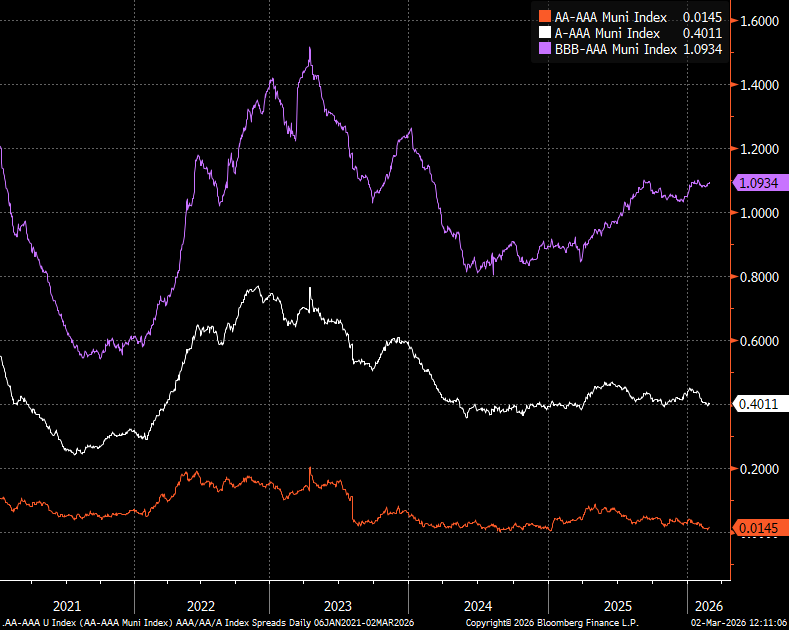
Credit risk continues to be rewarded, with ‘BBB’ credit spreads generally widening in 2026.  However, ‘A’ and ‘AA’ credit spreads have been tightening due to reduced risk appetite as investors move into higher rated sectors and credits amid global and economic uncertainty.  While selective assumption of risk continues to be rewarded for lower investment grade and high-yield credits, investors considering assuming credit risk should be cautious due to the potential for credit spread widening.  

The municipal new issue calendar expands this week to $11.8 billion of new issues.  Notable issues include: the City of Houston, TX, which plans to sell $1.43 billion in hotel occupancy tax & special revenue bonds, Arizona Transportation Board is scheduled to sell $786.3 million, and Lamar Consolidated Independent School Board is expected to sell a $545 million issue.  This week’s deals should see a strong reception following 14 consecutive weeks of inflows, with approximately $1 billion being added to municipal bond funds last week, according to LSEG Lipper Global Fund Flows.  Considering current muni/Treasury ratios, it is not surprising that the majority of inflows are going to intermediate and long-term muni funds.


Herbert J. Sims & Co. Inc. is a SEC registered broker-dealer, a member of FINRA, SIPC. The information contained herein has been prepared based upon publicly available sources believed to be reliable; however, HJ Sims does not warrant its completeness or accuracy and no independent verification has been made as to its accuracy or completeness. The information contained has been prepared and is distributed solely for informational purposes and is not a solicitation or an offer to buy or sell any security or instrument or to participate in any trading or investment strategy, and is subject to change without notice. All investments include risks. Nothing in this message or report constitutes or should be construed to be accounting, tax, investment or legal advice.